2026 Tesla Model Y Dual Motor Review: FSD Tackles Daily Commutes, But Constant Supervision Keeps Drivers on Edge
The Tesla Model Y is no longer just defending its territory; it is fighting to maintain its status as the world’s default electric vehicle. In 2026, l...
Editorial Team
World Of EV
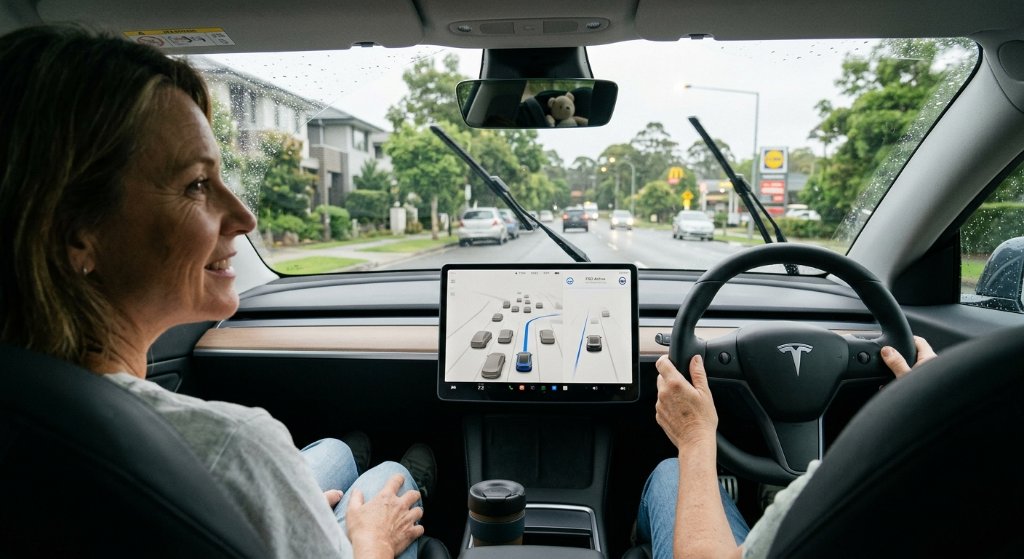
The Tesla Model Y is no longer just defending its territory; it is fighting to maintain its status as the world’s default electric vehicle. In 2026, legacy competitors and agile startups have finally closed the hardware gap, offering compelling styling and rapid charging speeds. Yet, a fresh, real-world owner-focused evaluation of the 2026 Tesla Model Y Dual Motor proves that Tesla’s vertical integration and software dominance still dictate the rules of the EV game.
At the center of this real-world test is Tesla's highly debated Full Self-Driving (FSD) system. While Tesla continues to promise a driverless future, the reality on the ground highlights both the massive strides the company has made and the psychological hurdles that still remain for everyday owners.
FSD in the Real World: Highly Capable, with a Catch
For the average driver, handing over steering and braking controls to an AI brain triggers an immediate psychological barrier. The reviewer noted that engaging FSD for the first time routinely causes driver hesitation and demands a high level of trust. Because the system requires consistent, active supervision, drivers cannot simply sit back and relax. Instead, they must remain hyper-vigilant, ready to take over at a fraction of a second's notice.
However, once you move past the initial anxiety, the technology exhibits remarkable competency:
- Routine Commuting Mastery: FSD easily manages standard daily commutes, negotiating lane changes, highway exits, and suburban streets with fluid, human-like decision-making.
- Reduced Driving Fatigue: On predictable routes, the system significantly lowers the cognitive load of driving, proving that Tesla's vision-only approach can handle the vast majority of everyday driving scenarios.
- Continuous Optimization: Frequent over-the-air updates ensure the system reacts more predictably with each iteration, gradually smoothing out jerky behaviors that plagued earlier builds.
The Undisputed Benchmarks: Software and Space
While autonomous tech commands the headlines, the Model Y’s daily usability relies heavily on its core design. Competitors like the Hyundai Ioniq 5 and Ford Mustang Mach-E might offer eye-catching designs, but the Model Y Dual Motor maintains its lead in pure efficiency and utility.
The software-centric interface remains the industry gold standard. Rather than cluttering the cabin with redundant physical switchgear, Tesla’s single-screen setup provides ultra-responsive controls, intuitive navigation, and flawless phone-as-a-key integration. Furthermore, the Model Y’s extensive cargo capacity remains unmatched in its class. Thanks to deep sub-trunk compartments and a front trunk (frunk), the crossover easily out-packs rivals that still rely on modified internal combustion platforms.
Why This Matters:
The real-world performance of the 2026 Model Y highlights a critical inflection point for the entire automotive industry.
- The Bull Case: For Tesla, proving that FSD can reliably manage routine drives—even under supervision—solidifies its position as the undisputed leader in software-defined vehicles. While traditional OEMs struggle with buggy software and fragmented digital architectures, Tesla is successfully training millions of drivers to accept autonomous intervention.
- The Bear Case: The persistent need for "consistent supervision" reveals the limits of the current hardware suite. If owners still feel hesitation and stress while monitoring FSD, Tesla’s near-term dream of a fully driverless, steering-wheel-free Robotaxi fleet remains a distant horizon.
- The Market Reality: For buyers, the Model Y remains the most frictionless EV to own. It wins not because it has the plushest ride or the fastest charging curve, but because its software, cargo utility, and charging network form an unbeatable, unified ecosystem.
Ultimately, the 2026 Tesla Model Y Dual Motor demonstrates that automakers no longer win the battle for EV supremacy on battery size or horsepower alone, but in the digital realm. While competitors chip away at Tesla's physical dominance, the Model Y's seamless software integration and highly capable (if still imperfect) FSD system keep it leagues ahead of the pack. As Tesla refines its autonomous algorithms, the Model Y will likely remain the benchmark that legacy automakers must chase—even as they realize that catching up to Tesla requires writing better code, not just building better cars.