265 Miles for $2.16: How One Tesla Model 3 Owner Just Rewrote the Road Trip Playbook
The prevailing narrative from electric vehicle skeptics has long been that road trips are a logistical nightmare, plagued by range anxiety and extorti...
Editorial Team
World Of EV
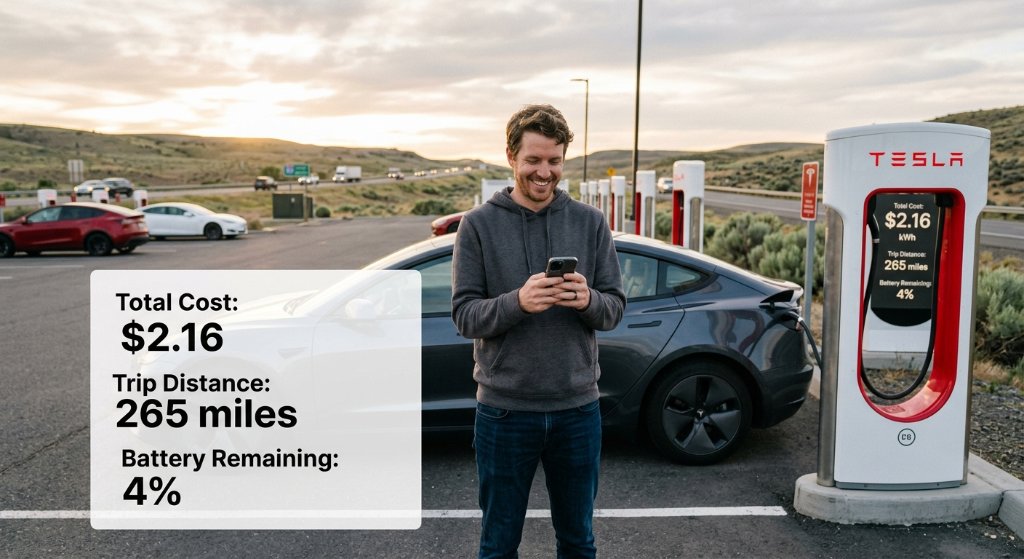
The prevailing narrative from electric vehicle skeptics has long been that road trips are a logistical nightmare, plagued by range anxiety and extortionate public charging fees. But a recent real-world test by Canadian Tesla enthusiast Devin Olsen has completely shattered that assumption. Olsen completed a 265.4-mile journey in his Tesla Model 3 RWD on a single charge, arriving with 4% battery remaining and spending a grand total of just $2.16 on electricity.
This remarkable achievement highlights the often-overlooked financial superpower of EVs: the home-charging arbitrage. While legacy automakers scramble to build massive, heavy battery packs to cure range anxiety, Tesla is proving that real-world efficiency, optimized aerodynamics, and low-cost residential power are the true keys to revolutionizing long-distance travel.
Anatomy of a Sub-Cent-Per-Mile Road Trip
Olsen's journey wasn't a carefully staged hypermiling experiment on a closed track; it was a practical, real-world drive that included a four-day parking stint midway through the trip. Yet, the efficiency metrics recorded by his updated Model 3 RWD were nothing short of extraordinary, averaging an incredibly low 168.7 Wh per mile across the entire 265.4-mile run.
By bypassing public DC fast chargers and relying entirely on his home-charging setup before departing, Olsen unlocked a tier of travel economics that internal combustion engine (ICE) vehicles simply cannot touch.
The key metrics from Olsen's historic run include:
- Distance Covered: 265.4 miles (427.2 km) on a single charge.
- Energy Consumption: An average of 168.7 Wh/mile.
- Total Electricity Cost: $2.16 USD, utilizing a low-tier residential rate of $0.06 per kWh.
- Direct Savings: Approximately $55 USD saved on fuel compared to an equivalent gasoline-powered sedan.
- State of Charge: Started at 100%, parked for four days mid-trip, and arrived home with a 4% safety buffer—completely eliminating the need for a mid-route Supercharger stop.
The Silent Weapon: 99.9% Autonomous Cruising
The ultra-low energy bill is only half the story. Olsen also revealed that Tesla's Full Self-Driving (FSD) system handled roughly 99.9% of the highway driving. The only manual takeovers required during the entire 265-mile journey were during complex maneuvers at ferry terminals.
This level of performance highlights how far Tesla’s machine-learning-based "end-to-end" neural network architecture has come. By shifting the bulk of highway navigation, speed adjustments, and lane changes to the vehicle's AI, FSD fundamentally changes the road trip experience from exhausting manual labor to relaxed executive supervision. When paired with the whisper-quiet cabin and refined aerodynamics of the refreshed Model 3, long-distance driving shifts from a chore to a passive, stress-free commute.
Why This Matters:
Tesla's $2 road trip is a masterclass in why vertical integration and obsessive efficiency engineering win the EV race.
First, it highlights the stark "Charging Divide." If Olsen had relied on commercial DC fast chargers, his trip would have cost roughly $15 to $20—still cheaper than gasoline, but far from the headline-grabbing $2.16. The real winners in the EV transition are suburban homeowners who can charge overnight on cheap utility rates. For this demographic, the financial case for an EV is a slam dunk, while apartment dwellers and road-trippers relying solely on public infrastructure face a much slower return on investment.
Second, it exposes the structural inefficiency of Tesla’s competitors. Legacy OEMs like General Motors and Ford are packing massive 100+ kWh batteries into heavy SUVs to achieve 300 miles of range. In contrast, Tesla achieves similar real-world range out of a much smaller, lighter, and cheaper Lithium Iron Phosphate (LFP) battery in the Model 3 RWD. By optimizing aerodynamics (the Model 3 boasts a slippery 0.219 Cd) and powertrain efficiency, Tesla can build highly capable, affordable EVs that use less raw materials and cost virtually nothing to run.
Finally, the success of FSD on this trip signals a massive shift in consumer expectations. Drivers are realizing that road-trip fatigue isn't just about the physical miles; it's about the cognitive load of driving. As autonomous software approaches near-perfect highway reliability, legacy vehicles lacking robust hands-free systems will increasingly feel like relics of a bygone era.
The Road Ahead
While Olsen's $2.16 road trip relies on the ideal scenario of cheap electricity and a highly aerodynamic sedan, it serves as a powerful proof of concept. It demonstrates that the theoretical peak of EV ownership is already here. As charging infrastructure expands and efficiency remains the focal point of engineering, the narrative of the "stressful, expensive EV road trip" is rapidly heading for the rearview mirror.