AAA Study: Extreme Temperatures Slash EV Range and Spike Costs, Demanding Smarter Driving and Tech
A groundbreaking new study by AAA, released today, delivers a potent dose of reality for electric vehicle owners and prospective buyers: extreme tempe...
Editorial Team
World Of EV
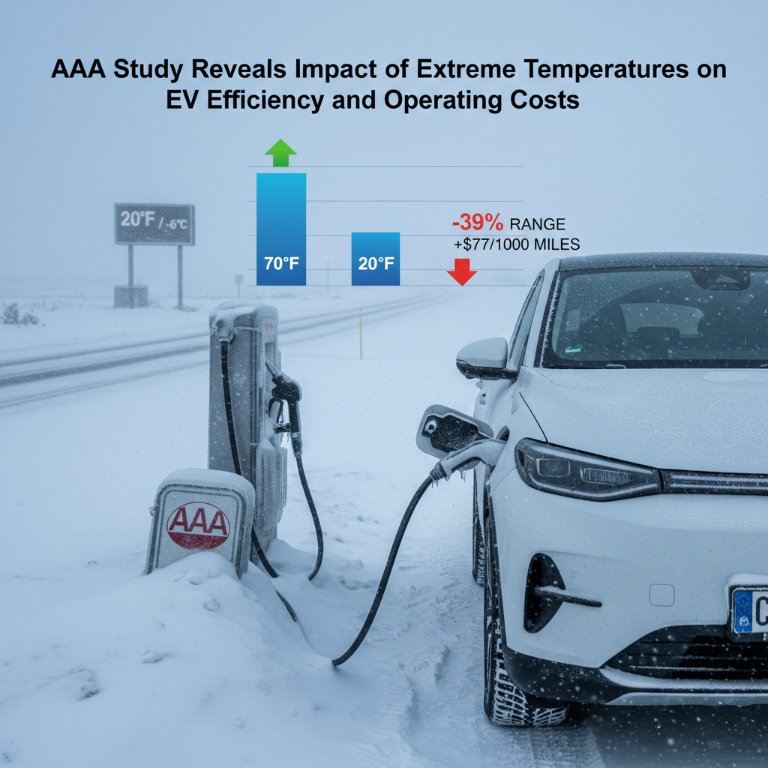
A groundbreaking new study by AAA, released today, delivers a potent dose of reality for electric vehicle owners and prospective buyers: extreme temperatures significantly degrade EV efficiency, drastically cut driving range, and substantially inflate operating costs. This isn't just an anecdotal observation; AAA's rigorous testing provides hard data that validates many drivers' real-world experiences, underscoring the critical need for both advanced thermal management solutions in EVs and more informed consumer behavior.
For years, the promise of electric mobility has centered on lower running costs and environmental benefits. While these largely hold true in moderate climates, the new findings reveal a complex picture, particularly for those in regions experiencing harsh winters or scorching summers. The study examined three electric vehicles and three hybrids, testing them at 20°F, 75°F (moderate), and 95°F.
The Chilling Truth: Cold Weather's Crippling Impact
The most dramatic effects materialized in cold conditions. At a chilly 20°F, EVs suffered a staggering 35.6% drop in MPGe (Miles Per Gallon equivalent) and a corresponding 39.0% decrease in calculated driving range compared to moderate temperatures. This isn't merely an inconvenience; it translates directly into a significant financial hit for drivers reliant on public charging. Operating costs surged by up to $76.93 per 1,000 miles when utilizing public chargers in cold weather.
This severe decline stems from several factors. Lithium-ion batteries, the workhorse of modern EVs, operate optimally within a specific temperature range, typically between 60-95°F (15-35°C). When temperatures plummet, the electrochemical reactions within the battery slow down, increasing internal resistance and reducing the battery's ability to deliver and accept power efficiently. Moreover, warming the cabin and the battery itself consumes a substantial amount of energy, drawing directly from the limited range.
Heating Up: The Impact of Extreme Summer Conditions
While less severe than cold, hot temperatures also take their toll. At 95°F, EVs experienced a 10.4% reduction in efficiency and an 8.5% loss of driving range. This efficiency dip is primarily due to the increased energy demand from the vehicle's air conditioning system, which works harder to cool the cabin and often the battery pack to maintain optimal operating temperatures. Sustained high temperatures can also strain battery systems, potentially increasing internal resistance over time.
Why This Matters:
This AAA study is a crucial wake-up call for the entire EV ecosystem, from manufacturers to consumers. It moves beyond theoretical discussions to provide concrete, actionable data that impacts real-world EV ownership.
- For Prospective Buyers: This data highlights the importance of considering your local climate when evaluating an EV purchase. While overall operating costs remain lower than gasoline vehicles in many scenarios, potential buyers in extreme climates must factor in reduced range and higher charging costs, especially if relying on public fast chargers. This may sway some towards hybrids, which the study also examined, showing a 22.8% decline in fuel economy in cold conditions but generally smaller penalties than EVs.
- For Current EV Owners: Understanding these limitations empowers owners to adapt their driving and charging habits. Features like battery preconditioning become indispensable. Preconditioning, which warms or cools the battery to its optimal temperature while plugged in, can significantly mitigate range loss and enable faster charging in cold weather by drawing power from the grid rather than the battery itself. Utilizing heated seats and steering wheels instead of cranking up the cabin heater can also conserve energy.
- For Manufacturers and Technologists: This study underscores the ongoing imperative for advancements in battery thermal management systems (BTMS). Companies like Tesla, which have invested heavily in sophisticated liquid-cooling BTMS, aim to maintain battery performance across varied conditions. The industry must continue developing more energy-efficient heating and cooling solutions for cabins and batteries, alongside solid-state battery technologies that promise greater thermal stability. Improved thermal management not only enhances range and efficiency but also prolongs battery lifespan and ensures safety.
- Market Signals: The findings could fuel continued interest in hybrid vehicles, as AAA's survey noted 35% of U.S. adults are likely to purchase a hybrid due to fewer concerns about range and charging access. This suggests the EV transition isn't a straight line and that market segments will continue to diversify based on regional needs and technological advancements.
Ultimately, the AAA study provides valuable real-world insights, shifting the narrative from aspirational range figures to practical, climate-dependent performance. It reinforces that while EVs offer compelling advantages, understanding and managing their thermal characteristics is paramount for a truly seamless electric future.
Conclusion
The AAA's latest research unequivocally demonstrates that extreme temperatures are a tangible factor in EV performance and cost, particularly in cold climates. While the industry progresses with more advanced thermal management and battery preconditioning systems, EV owners must embrace smarter driving and charging strategies. As the EV market matures, realistic expectations and continuous technological innovation will be key to maximizing the electric vehicle experience for all drivers.