America's Size Obsession: A Major Roadblock on the EV Highway
Despite an increasing array of compelling electric vehicles hitting the market and significant efforts to entice buyers with discounts, a fundamental ...
Editorial Team
World Of EV
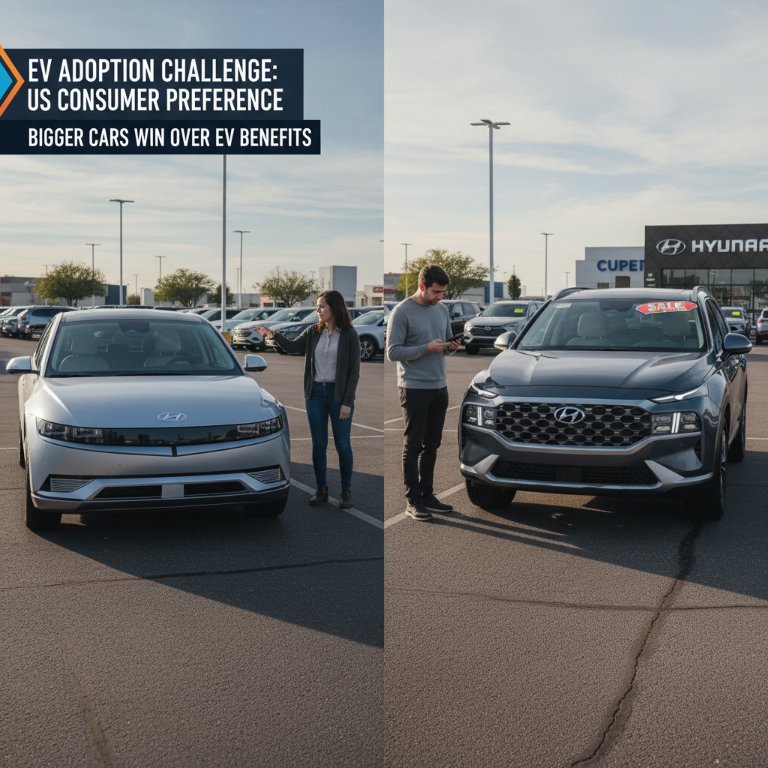
Despite an increasing array of compelling electric vehicles hitting the market and significant efforts to entice buyers with discounts, a fundamental preference among American consumers for larger vehicles remains a formidable hurdle to widespread EV adoption. Recent 'real world' observations underscore this challenge, revealing that even attractive incentives for EVs like the Hyundai IONIQ 5 often fail to outweigh the perceived benefits of a larger internal combustion engine (ICE) SUV, such as the Hyundai Santa Fe.
This isn't merely a niche observation; it's a stark reminder that while EV proponents rightly champion the engaging driving experience, long-term financial savings, and crucial environmental benefits, these factors frequently take a back seat to the demand for larger vehicle footprints in the United States. This deeply entrenched consumer behavior, evident even as battery costs continue their downward trend, forces a critical re-evaluation of current EV market strategies.
The Enduring Appeal of Size
The American automotive landscape has long been defined by a penchant for spaciousness and utility. From full-size sedans of yesteryear to today's ubiquitous SUVs and pickup trucks, a larger vehicle often equates to capability, safety, and family readiness in the consumer's mind. For many non-EV drivers, the practical considerations of hauling cargo, accommodating multiple passengers, or simply feeling secure on the road with a commanding view outweigh the innovative allure of electric propulsion. Our friend’s decision to opt for a Santa Fe, despite a generous discount on an IONIQ 5, perfectly illustrates this psychological barrier.
- Perceived Utility: Larger vehicles offer greater cargo capacity and passenger room, a non-negotiable for many American families.
- Commanding Presence: The higher driving position and larger physical footprint of SUVs and trucks contribute to a feeling of safety and control.
- Familiarity and Convenience: The existing ICE infrastructure and established norms around larger vehicles reduce perceived friction for potential buyers, especially when compared to the ongoing evolution of EV charging.
The Mismatch of Supply and Demand
While the global EV market has seen a proliferation of compact to mid-size crossovers and sedans, the truly large, family-friendly, and work-capable electric SUVs and trucks are still relatively scarce or command premium prices. Mazda's early struggles with the MX-30, a charming but range-limited compact EV, serve as a potent historical example of misjudging market appetite, particularly in a segment where range and size are paramount. Similarly, many current EV offerings, while technically impressive, don't directly compete with the full-size SUVs and pickup trucks that dominate American sales charts.
Why This Matters:
This consumer preference for larger vehicles is not a minor footnote; it is a fundamental challenge that strikes at the heart of mass EV adoption in the United States. It dictates who wins, who loses, and what signals the market is sending to manufacturers.
- Who Wins: In the immediate term, established manufacturers of large ICE SUVs and trucks will continue to capture a significant portion of the market, as evidenced by the Santa Fe's continued appeal. Among EV players, companies like Rivian, Ford (with the F-150 Lightning), and General Motors (with upcoming Silverado EV and Hummer EV) are strategically positioned by offering compelling, large-format electric alternatives. Their success indicates a clear demand for 'right-sized' EVs that meet traditional American preferences.
- Who Loses: EV manufacturers primarily focused on smaller or mid-sized crossover platforms for the US market, such as Hyundai (IONIQ 5/6) and Kia (EV6), face an uphill battle to convert a significant portion of the mainstream market. While these vehicles are excellent in their own right, they often don't directly address the core 'size' requirement of many American buyers, thus limiting their addressable market. Ultimately, the environment also loses as the transition away from fossil fuels slows.
- Market Signal: This trend is a clear and unambiguous signal to every automotive OEM: a robust US EV strategy absolutely must include compelling, competitively priced, large-format electric SUVs and trucks. Relying solely on the inherent benefits of EVs or generous discounts for smaller models will not be sufficient to accelerate adoption to desired levels.
- Do-or-Die Moment: For many legacy automakers, successfully launching competitive large EVs is a do-or-die moment. Failing to capture this critical segment means ceding crucial market share and potentially missing the opportunity to lead the next generation of automotive sales in one of the world's most profitable markets.
The path to widespread EV adoption in the U.S. will not be paved solely with efficiency or environmental virtue. Instead, it must also accommodate the deeply ingrained American desire for larger vehicles. Manufacturers who understand and adapt to this fundamental preference, bringing truly competitive and 'right-sized' electric SUVs and trucks to market, will ultimately lead the charge into an electrified future.