Austin's Nights Now Tesla Robotaxi Territory: Unsupervised Expansion Levels Up Autonomous Ambitions
Tesla's Robotaxi program has achieved a critical operational milestone in Austin, Texas, removing the previous shackles of daylight-only service. For ...
Editorial Team
World Of EV
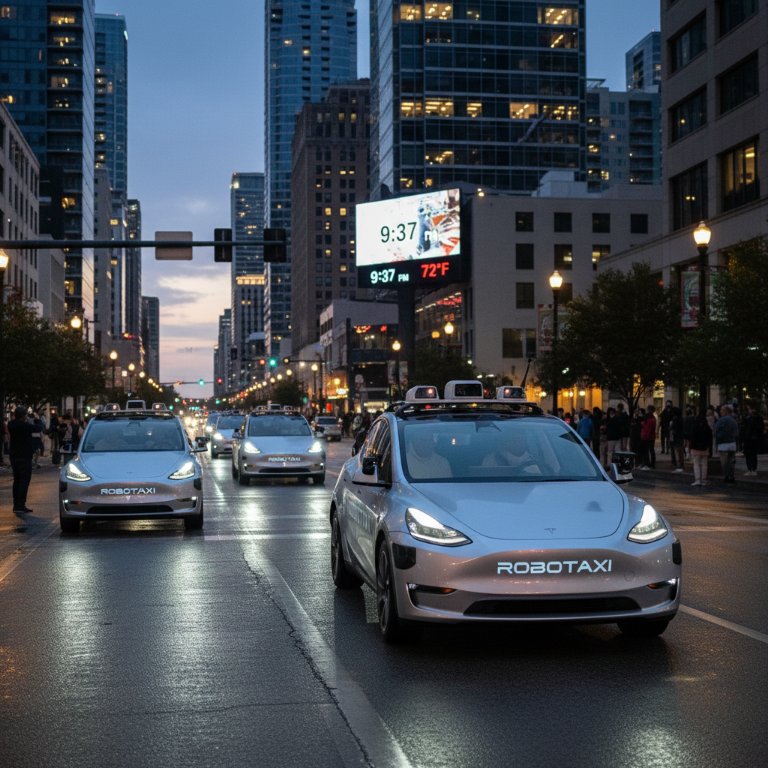
Tesla's Robotaxi program has achieved a critical operational milestone in Austin, Texas, removing the previous shackles of daylight-only service. For the first time, Austin's fleet will navigate the city's streets unsupervised during evening hours, a significant expansion that aligns it with the already established nighttime operations in Dallas and Houston since April. This move isn't merely an extended shift; it fundamentally broadens the Robotaxi's operational design domain (ODD) to robustly encompass challenging low-light conditions, signaling a deeper confidence in Tesla's Full Self-Driving (FSD) technology.
Expanding the Operational Envelope
Until now, Tesla's unsupervised Robotaxi service in Austin was confined to daylight hours, limiting its utility and the depth of real-world data collection. The new allowance for evening operations represents a substantial leap, as it requires the FSD system to flawlessly process visual data in varying light levels, contend with headlamp glare, identify subtle environmental cues, and navigate potentially more complex nighttime scenarios such as reduced visibility for pedestrians and cyclists. This expansion to low-light conditions isn't just about longer service hours; it's a testament to the maturation of Tesla's AI and sensor suite in handling a far more intricate driving environment.
The Importance of Night Operations
- Sensor Performance: Lidar and radar systems excel in darkness, but camera-based vision systems, like Tesla's primary approach, face heightened demands. The system must accurately perceive lane lines, traffic signals, road signs, and other vehicles with diminished light.
- Object Detection and Classification: Distinguishing between diverse objects – a parked car, a pedestrian in dark clothing, or an animal – becomes significantly harder for an AI in low light compared to broad daylight.
- Dynamic Lighting: Navigating through areas with inconsistent lighting, such as passing under streetlights, through shadows, or encountering oncoming headlights, requires sophisticated processing to maintain situational awareness.
- Human Factor: Nighttime driving often involves different human behaviors, including potentially more impaired drivers or pedestrians, adding layers of unpredictability that the FSD system must anticipate and react to.
Why This Matters:
- Accelerated Data Collection and FSD Refinement: Operating in low-light conditions provides an invaluable stream of diverse data, allowing Tesla's FSD system to learn and improve at an accelerated pace. This real-world experience is critical for refining the AI's perception, prediction, and planning capabilities under challenging circumstances.
- Revenue Potential and Scalability: Unsupervised 24/7 (or near 24/7) operation is a non-negotiable requirement for a viable Robotaxi service. By expanding into evenings, Tesla significantly increases the potential utilization and revenue generation capacity of its fleet, moving closer to a truly scalable business model. This directly impacts Tesla's long-term financial projections and investor confidence in its autonomous vision.
- Competitive Pressure: This move intensifies pressure on competitors in the autonomous driving space. While companies like Waymo and Cruise have long operated in specific cities with extensive mapping, Tesla's approach, leveraging its existing vehicle fleet and FSD software, demonstrates a different, potentially faster path to widespread deployment. This signals that Tesla is closing the gap on operational complexity and environmental conditions.
- Consumer Confidence: As the public witnesses Robotaxis operating safely and effectively in more challenging scenarios, confidence in autonomous technology will grow. This is vital for widespread adoption, as public acceptance is a key hurdle for the industry. For prospective EV buyers, this ongoing progress strengthens the value proposition of Tesla vehicles equipped with FSD capability.
This extension to evening operations in Austin marks a vital stride in Tesla's relentless pursuit of widespread autonomous mobility. It underscores the company's growing confidence in its FSD suite and serves as a significant indicator of the imminent future where Tesla's Robotaxis could become a ubiquitous, 24/7 fixture in urban landscapes, redefining personal and shared transportation.