Beat the Heat: Why Hyundai’s E-GMP Platform is the Ultimate Summer Heatwave Hack
Summer heatwaves are notorious for killing EV range and stressing thermal management systems. Yet, Hyundai Motor UK is reframing this seasonal dread w...
Editorial Team
World Of EV
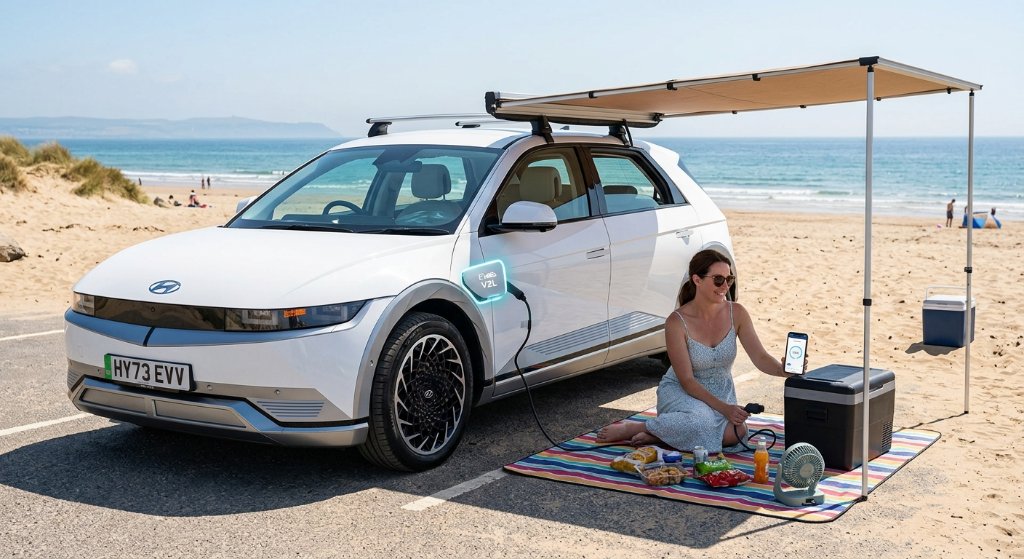
Summer heatwaves are notorious for killing EV range and stressing thermal management systems. Yet, Hyundai Motor UK is reframing this seasonal dread with a clever new guide of "life hacks" designed to turn their electric vehicles into the ultimate hot-weather sanctuaries.
While early EVs struggled with thermal management and lacked the utility to do much more than drive, Hyundai's dedicated E-GMP (Electric-Global Modular Platform)—which underpins the award-winning Ioniq 5 and Ioniq 6—has quietly set the benchmark for high-voltage efficiency and bidirectional charging. What seemed like niche tech specs at launch are now proving to be indispensable summer survival tools, showcasing a level of versatility that traditional internal combustion engine (ICE) vehicles simply cannot match.
Smart Pre-Cooling: Saving Range Before You Roll
One of the most significant drains on an EV’s battery during the summer is the initial blast of air conditioning needed to cool a cabin that has been baking in the sun. Hyundai's integration of smart connectivity solves this thermodynamic challenge before the driver even steps inside.
- Grid-Powered Comfort: By using the Bluelink smartphone app, owners can remotely trigger the climate control system while the vehicle is still plugged into a charger. This draws power directly from the grid rather than depleting the onboard battery.
- Range Preservation: Starting a journey with an already-cooled cabin means the vehicle only needs minimal energy to maintain the temperature, preserving precious highway range.
- Thermal Preconditioning: The system doesn't just cool the cabin; it helps manage the battery pack's thermal state, ensuring the vehicle can accept high-power DC fast charging without throttling speeds due to extreme ambient heat.
The Silent Oasis: Zero-Emission Stationary Climate Control
Traditional ICE vehicles face a dilemma in extreme heat: run a loud, polluting, and inefficient engine at idle to keep the air conditioning going, or suffer in the heat. Hyundai’s EV architecture offers an elegant detour.
- Whisper-Quiet Idling: Because an EV’s climate control system runs off the high-voltage battery via an electric compressor, it operates in near-silence without tailpipe emissions.
- Utility Mode Activation: Hyundai’s dedicated "Utility Mode" allows occupants to use the car's air conditioning, infotainment, and lighting for hours—or even days—without draining the auxiliary 12V battery, converting the cabin into a mobile, air-conditioned office or rest area.
V2L: Unlocking the Ultimate Off-Grid Power Station
Perhaps the most significant differentiator for Hyundai's modern EV lineup is Vehicle-to-Load (V2L) technology. This system essentially turns the car into a giant, rolling power bank.
- Bidirectional Power Delivery: Hyundai's E-GMP platform delivers up to 3.6kW of AC power through an adapter on the external charging port or a standard three-pin socket under the rear seats.
- Beach and Camp Utility: During summer excursions, V2L can seamlessly power high-draw outdoor appliances, including portable mini-fridges, electric grills, cooling fans, and even e-bike chargers, completely eliminating the need for noisy petrol generators.
Why This Matters:
This isn't just a list of neat summer tips; it is a masterclass in how EV manufacturers can reframe the conversation around electric vehicle utility.
By highlighting features like V2L and remote pre-conditioning, Hyundai is demonstrating tangible lifestyle advantages that legacy ICE vehicles and even many rival EVs cannot match. For instance, while Tesla's volume sellers (the Model 3 and Model Y) offer "Camp Mode," they still lack a dedicated, easily accessible, high-output V2L plug for external appliances. Hyundai, along with sister brand Kia, has effectively weaponized its 800-volt E-GMP architecture to deliver a superior lifestyle ecosystem.
Furthermore, this highlights a broader shift in consumer expectations. An EV is no longer just a tool to get from Point A to Point B; it is a decentralized energy node. In an era of escalating global temperatures and increasingly frequent grid strains, the ability to leverage a vehicle's massive battery for localized cooling, auxiliary power, and thermodynamic efficiency is becoming a major selling point. Hyundai’s proactive messaging signals to the market that they aren't just selling cars—they are selling energy resilience.