Beyond Range: Volvo Unpacks 'Hot Dog Anxiety,' The Silent Threat to EV Charging Confidence
While 'range anxiety' has long been the familiar specter haunting prospective electric vehicle owners, a new, equally critical concern is now taking c...
Editorial Team
World Of EV
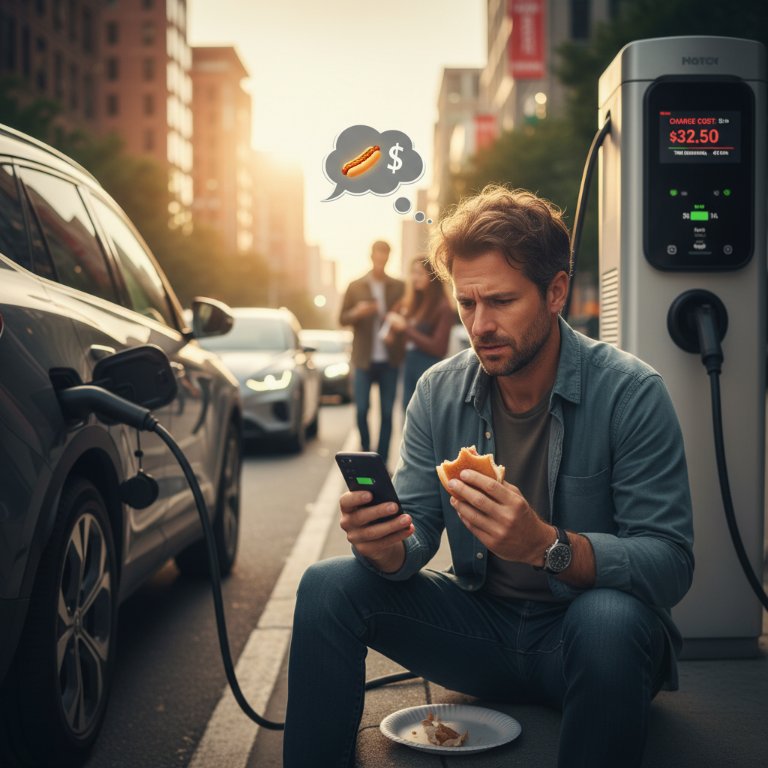
While 'range anxiety' has long been the familiar specter haunting prospective electric vehicle owners, a new, equally critical concern is now taking center stage: 'Hot Dog Anxiety.' Anders Bell, Volvo's astute Head of Engineering and Technology, has coined this evocative term to highlight the often-overlooked financial and temporal burdens associated with public fast charging. This isn't merely about locating a charger; it's about the real-world cost and time commitment that can turn a quick stop into an unexpectedly expensive and prolonged ordeal, especially for those without consistent home or workplace charging access. This phenomenon strikes directly at the heart of EV accessibility and mainstream adoption.
Defining the Public Charging Predicament
'Hot Dog Anxiety' encapsulates the frustration of EV owners who, after a public fast-charging session, find that the combined cost and time spent make their 'hot dog' (or any other minor purchase during the charge) surprisingly expensive. Bell vividly describes it as: "You go in and buy your hot dog, and you've just been charged $25 [for fast charging] and it's become an expensive hot dog." This sentiment underscores a critical distinction from traditional range anxiety, which primarily focuses on the fear of not finding a charger. Instead, 'Hot Dog Anxiety' zeroes in on the quality of the experience once a charger is found – specifically, the opaque and often high costs, coupled with the time expenditure, that deviate significantly from the quick, predictable fill-up of a gasoline vehicle. For instance, home charging averages around $0.18/kWh, whereas public DC fast charging can soar to $0.45 to $0.65 per kWh, making it more than triple residential rates in some cases.
This issue disproportionately affects renters, apartment dwellers, and urban residents who lack dedicated home charging infrastructure. For them, public charging isn't a convenience; it's a necessity. Data shows that relying exclusively on public DC fast charging could cost an EV driver approximately $2,144 annually for 13,489 miles driven, significantly higher than the roughly $693 for home charging. Furthermore, while fast chargers are becoming more prevalent, with a significant increase in deployment across the globe, the cost of electricity itself has also risen, contributing to this anxiety.
Volvo's Insight and the Industry's Blind Spot
Volvo's open acknowledgment of 'Hot Dog Anxiety' through Anders Bell (who previously worked at Tesla) is highly significant. It signals a mature understanding of the holistic EV ownership experience from a major OEM. Many automakers have historically focused on range and charging speed, often overlooking the practical economic and time implications of public charging networks. This focus on the consumer's post-purchase reality demonstrates a critical evolution in thinking within the automotive industry. Bell, as Volvo's Chief Engineering & Technology Officer, is at the forefront of this shift, emphasizing a need for vertical integration in battery manufacturing and an 'omnivore' approach to cell sourcing, suggesting a proactive stance on optimizing the entire EV value chain, not just the vehicle itself.
Why This Matters:
This emerging 'Hot Dog Anxiety' is more than just a catchy phrase; it's a crucial market signal that could dictate the pace of mainstream EV adoption. Here's why:
- Impact on Mass Adoption: For EVs to truly move beyond early adopters and reach a broader consumer base, the charging experience must be as convenient and cost-effective as — or superior to — fueling a gasoline car. Currently, the unpredictable costs and time associated with public fast charging present a significant barrier, especially for the 30% of EV shoppers who cite lack of charging infrastructure as a top concern, or the 70% of EV owners who do most of their charging at home. Those without home charging options are effectively penalized, slowing the transition for a large segment of the population.
- Who Wins and Who Loses:
- Losers: Current public charging networks that maintain opaque, variable, and high-cost pricing models risk alienating customers and impeding growth. Also losing are EV buyers in urban areas or multi-unit dwellings who cannot charge at home, as they bear the brunt of these costs.
- Winners: OEMs like Volvo, and charging network operators who proactively address this anxiety by offering transparent, competitive pricing, subscription models, or integrated charging solutions will gain a significant competitive advantage. Innovations like BYD's Super-e platform, aiming for ultra-fast charging across mainstream models, or future inductive charging solutions, will alleviate both time and cost concerns.
- Market Signal and Industry Response: This phenomenon signals a maturing EV market where initial 'range anxiety' concerns are giving way to practical 'charging anxiety' issues. The industry must now shift focus from merely deploying chargers to optimizing the entire charging ecosystem for user experience. This includes faster charging technologies, clearer pricing structures, and potentially, greater integration between vehicle manufacturers and charging providers to offer seamless, predictable, and affordable charging. Some states are even implementing EV charging taxes, which further exacerbate the cost issue for public chargers.
- A Do-or-Die Moment: For the EV transition to maintain its momentum, overcoming 'Hot Dog Anxiety' is paramount. If public charging remains a source of financial stress and time inefficiency, it risks confining EV ownership to a privileged few with home charging access, thereby undermining broader environmental and policy goals. Addressing this head-on is crucial for democratizing EV ownership and ensuring long-term market vitality.
Volvo's candid identification of 'Hot Dog Anxiety' underscores the evolving challenges in the EV landscape. As the industry moves forward, collaborative efforts focusing on transparent pricing, improved charging infrastructure efficiency, and innovative business models will be vital to ensure that the electric revolution is accessible, affordable, and stress-free for all. The future of EV adoption hinges not just on technological advancements, but on overcoming these very human anxieties that impact the daily lives of drivers.