Beyond the Assembly Line: Why the Survival of the EV Revolution Now Depends on Mature Repair Infrastructure
For the last decade, the electric vehicle narrative has been obsessed with production milestones, gigafactory capacities, and delivery charts. From Te...
Editorial Team
World Of EV
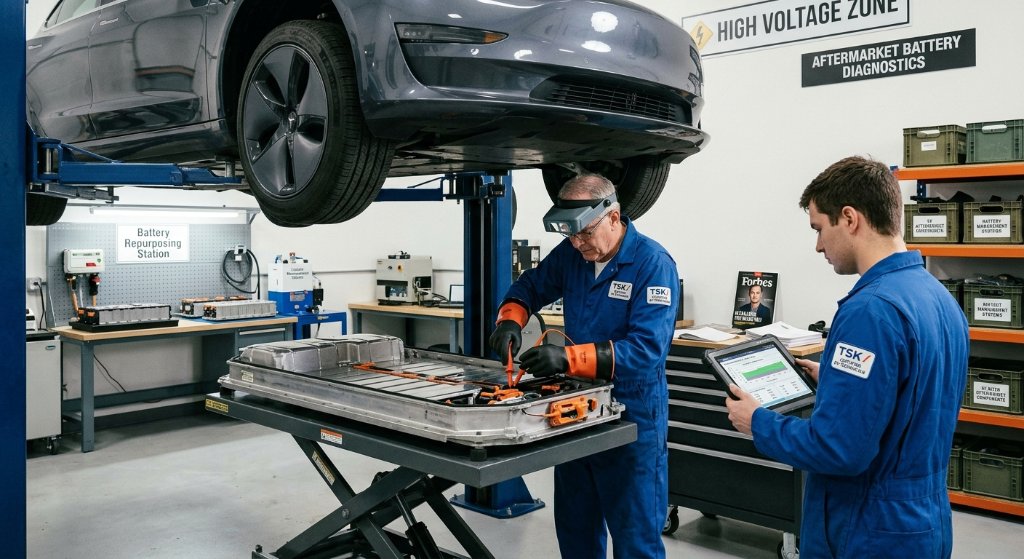
For the last decade, the electric vehicle narrative has been obsessed with production milestones, gigafactory capacities, and delivery charts. From Tesla scaling its mass-market models to legacy automakers scrambling to launch their first-gen dedicated platforms, the focus was entirely on getting cars onto the road. But as those early-generation EVs begin to age out of their factory warranties, the industry is facing a quiet but critical reckoning: we know how to build EVs, but we still don't know how to efficiently fix them.
Oleksandr Chumachenko, CEO of TSK and Forbes Business Council member, recently highlighted this transition, noting that the EV market is entering a crucial phase focused on vehicle longevity rather than just production. As first-generation models reach the end of their lifecycles, maintaining a positive consumer experience relies heavily on building a mature, independent repair infrastructure. Without it, the entire economic foundation of the EV transition could crumble.
The High-Voltage Technician Deficit
Currently, the automotive repair ecosystem is vastly unprepared for a world dominated by high-voltage battery packs. Traditional independent mechanics—who form the backbone of affordable car maintenance—are largely locked out of EV servicing due to a lack of specialized training and access to OEM diagnostic tools.
- Lack of Certification Standards: Currently, there is no universal, globally recognized standard for independent high-voltage EV repair technicians, leading to safety and quality inconsistencies.
- Safety and Tooling Barriers: Working with 400V and 800V architectures requires intense training and specialized protective equipment, creating a high barrier to entry for local shops.
- OEM Monopolies: Automakers tightly guard their diagnostic software and replacement parts, forcing out-of-warranty buyers back to expensive, slow dealership service centers.
Demystifying Battery-Health Diagnostics
A major hurdle in the used EV market is the absolute lack of standardized battery diagnostics. Unlike used combustion vehicles, where a mechanic can easily assess engine health, a used EV battery remains a "black box" to average buyers and insurers.
- Standardized State of Health (SoH): There is an urgent need for independent, unalterable battery-health documentation to determine a vehicle's true residual value and prevent buyers from purchasing degraded packs.
- Pack-Specific Repair Knowledge: Instead of discarding an entire $15,000 battery pack due to a single bad module or sensor, technicians must be trained to perform surgical, module-level repairs.
- Insurer Hesitation: Insurance companies are currently writing off relatively new EVs after minor accidents simply because they cannot verify if the battery pack has sustained internal damage, driving up insurance premiums for everyone.
Why This Matters:
This is a make-or-break moment for the EV transition. If the industry fails to establish a robust secondary repair market, the total cost of ownership (TCO) for EVs will skyrocket, driven by astronomical insurance premiums and plummeting resale values.
- Who Wins: Independent repair disruptors (like TSK and other specialized EV shops) who are pioneering module-level repairs, alongside insurance companies that adopt advanced battery-telematics data to avoid unnecessary write-offs.
- Who Loses: Legacy OEMs who rely on "replace-only" service models, and early adopters who will see their vehicles' residual values crater if third-party repair remains non-existent.
- The Market Signal: The era of treating EVs like disposable consumer electronics is officially over. To win over the mass market, EVs must become as repairable, long-lasting, and transparent as the combustion vehicles they are trying to replace.
Looking Ahead
The EV transition is moving from its infancy to its adolescence, and the growing pains are real. While scaling manufacturing was the challenge of the 2010s, building a trustworthy, decentralized repair ecosystem is the defining challenge of this decade. Automakers, independent shops, and regulators must work together to democratize battery data and technician training, or risk watching the used EV market—and consumer trust—stagnate.