Beyond the Hardware: How Rivian’s Software Licensing Play Is Quietly Positioning It for a Multi-Billion Dollar Windfall
When Rivian first burst onto the scene with its rugged R1T and R1S, it was widely viewed as a premium electric vehicle hardware manufacturer. Yet, ben...
Editorial Team
World Of EV
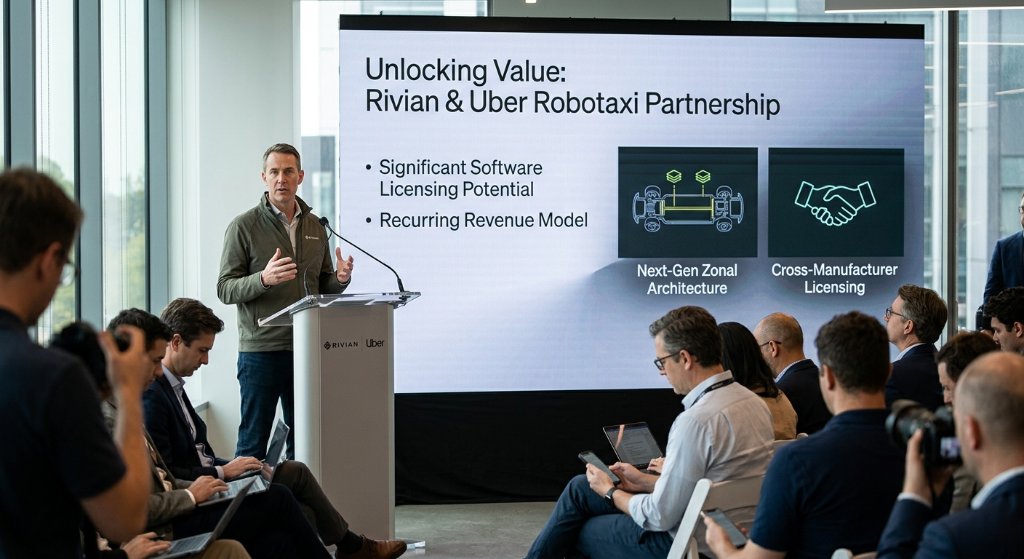
When Rivian first burst onto the scene with its rugged R1T and R1S, it was widely viewed as a premium electric vehicle hardware manufacturer. Yet, beneath the clean lines of its adventure-ready SUVs lies a sophisticated software ecosystem that is rapidly becoming the company's true secret weapon. In a recent defense of the company’s long-term autonomous and zonal architecture roadmap, CEO RJ Scaringe and other top executives made it clear that Wall Street is severely underestimating the financial powerhouse brewing within Rivian’s software division—particularly through its game-changing robotaxi deal with Uber and its multi-billion-dollar joint venture with Volkswagen.
For years, critics have questioned Rivian's capital-intensive path to profitability, pointing to the immense costs of scaling automotive production. However, by transitioning its proprietary software-defined vehicle (SDV) platform and autonomous vehicle (AV) stack into high-margin licensing streams, Rivian is doing what many legacy automakers have failed to achieve: evolving from a pure-play EV builder into an indispensable technology supplier for the entire transport industry.
Unlocking the Undervalued Power of the Uber Partnership
The centerpiece of Rivian’s autonomous strategy is its blockbuster deal with Uber, which promises to deploy up to 50,000 fully autonomous R2-based robotaxis onto Uber's ride-hailing network by the end of the decade. While investors focused heavily on the headline figure of up to $1.25 billion in total investment from Uber, Scaringe and his leadership team highlighted that the market is overlooking the most profitable element of this agreement: recurring software licensing fees.
Key pillars of the Uber and Rivian autonomous network include:
- The Robotaxi Pipeline: A firm commitment for 10,000 autonomous R2 SUVs, with options to scale to an additional 40,000 vehicles starting in 2030.
- Passive Revenue Streams: Every mile these autonomous R2s operate on Uber’s platform will yield high-margin, recurring software licensing fees directly to Rivian.
- Gen 3 Autonomous Hardware: The deployment leverages Rivian’s massive leap forward in processing, featuring its in-house Gen 3 Autonomous Platform utilizing robust LiDAR and AI-prediction capabilities rather than a pure camera-vision approach.
The Volkswagen Zonal Blueprint: Moving Fast on Milestones
While the Uber deal secures Rivian’s future in autonomous mobility, its landmark joint venture with Volkswagen Group—worth up to $5.8 billion—is actively proving the viability of its hardware-software architecture. Volkswagen, which has famously struggled to establish a cohesive in-house software unit through its troubled Cariad division, is essentially paying Rivian to bypass years of messy developmental bottlenecks.
At the heart of this partnership is Rivian’s industry-leading zonal architecture. Rather than using dozens of separate, complex electronic control units (ECUs) scattered throughout a car, zonal architecture consolidates vehicle operations into a few highly powerful central computers.
The status of this partnership shows remarkable momentum:
- Another $1 Billion Unlocked: Following rigorous winter testing of prototypes in extreme environments like Sweden, VW officially triggered its latest $1 billion investment tranche.
- Cross-Brand Compatibility: The Rivian-built software-defined vehicle (SDV) platform has already been successfully integrated into prototypes across multiple VW Group brands, including Audi, Scout Motors, and the ID.EVERY1 concept.
- Further Licensing Talks: Rivian confirmed it is actively in discussions with other global automotive manufacturers to license its zonal architecture, potentially establishing its tech as the industry-standard "Android" of the EV world.
Why This Matters:
This is a critical turning point for Rivian, shifting the narrative from whether the company can survive the "EV valley of death" to how quickly it can scale its software margins.
- Who Wins? Rivian is the ultimate winner here. In the capital-heavy automotive industry, hardware margins are notoriously thin. By layering software-as-a-service (SaaS) and platform licensing on top of vehicle sales, Rivian is paving a clear path to high-margin profitability. Volkswagen also wins by quickly fixing its massive software deficit, safeguarding its future EV lineup.
- Who Loses? Legacy manufacturers who refuse to adopt third-party software architectures. Automakers insisting on building their own software stacks from scratch risk falling years behind, burning billions in capital on clunky, uncompetitive systems.
- The Market Signal: This represents a "do-or-die" vindication of Rivian's vertically integrated approach. While competitors like Tesla have heavily promoted their vision-only FSD, Rivian’s strategy of building an open-loop zonal architecture ripe for commercial licensing to the likes of VW and Uber represents a highly practical, multi-pronged revenue model. If Scaringe can secure even one more major legacy OEM licensee, Rivian’s financial stability will be virtually guaranteed, cementing its place as a cornerstone of the automotive future.
Conclusion
By aggressively leveraging its software expertise, Rivian is redefining what it means to be an EV startup. No longer constrained solely by the physical limits of factory output, the California-based automaker is successfully positioning itself as the foundational software architect of the modern transport sector. As the R2 platform nears production and licensing revenues begin to hit the balance sheet, the market will likely have to re-evaluate Rivian—not just as an electric truck builder, but as a high-value automotive tech juggernaut.