Beyond the Impact: Tesla Vision's Predictive Airbags Redefine Automotive Safety
Tesla, a company that has never shied away from disrupting established automotive norms, has once again unveiled a significant technological leap, thi...
Editorial Team
World Of EV
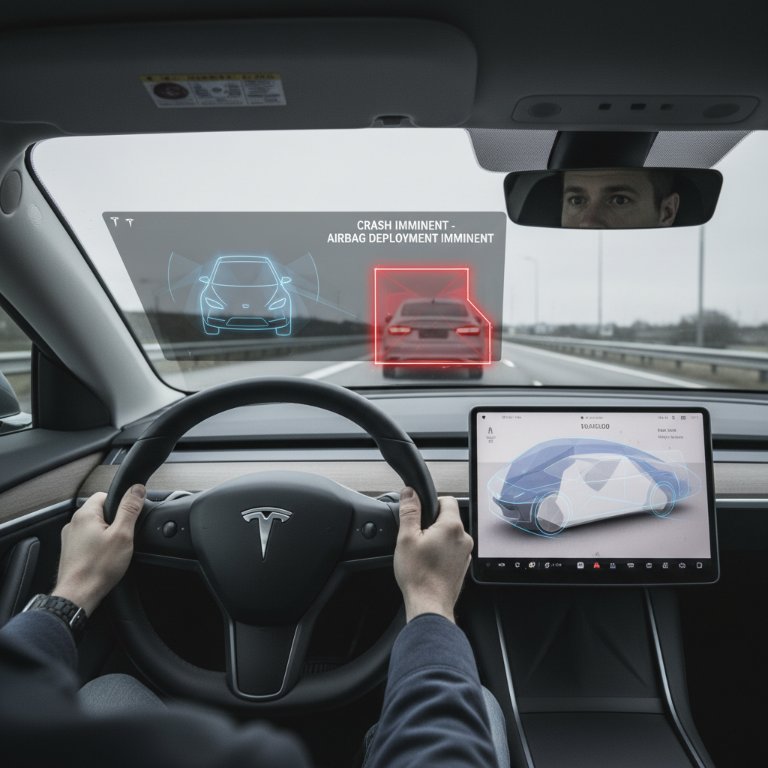
Tesla, a company that has never shied away from disrupting established automotive norms, has once again unveiled a significant technological leap, this time focusing squarely on occupant protection. Autoblog reports a groundbreaking enhancement to Tesla Vision, the company's camera-centric advanced driver-assistance system, enabling it to prepare airbags for deployment even *before* a physical crash occurs. This isn't merely an incremental update; it marks a pivotal moment in the evolution of automotive safety, shifting from reactive to genuinely proactive protection.
For years, Tesla has been a polarizing force, particularly with its controversial pivot to a camera-only 'Tesla Vision' system, deprecating radar in favor of a purely optical approach for its Autopilot and Full Self-Driving (FSD) capabilities. Critics questioned the robustness of a system relying solely on cameras, especially in adverse weather conditions. However, this latest development in predictive airbag deployment demonstrates Tesla's unwavering commitment to its vision-first strategy, now extending its AI's perceptual prowess into the realm of crash safety.
The Predictive Leap in Occupant Protection
At its core, this advancement leverages the sophisticated neural networks and extensive real-world data underpinning Tesla Vision. Unlike conventional airbag systems that trigger *after* impact — often milliseconds too late to fully mitigate certain injuries — Tesla's updated system uses its array of external cameras to:
- Anticipate Collision Dynamics: The system analyzes potential collision vectors, speeds, and forces in real-time, predicting an imminent crash scenario.
- Pre-Arm Safety Systems: Crucially, it initiates preparations for occupant protection *prior* to the physical collision. This includes:
- Pre-tensioning seatbelts to secure occupants firmly.
- Optimizing seating positions for better crash absorption.
- *Pre-filling* airbags. By inflating airbags a fraction of a second before impact, the system aims to provide a softer, more controlled deceleration for occupants, potentially significantly reducing the severity of injuries.
This foresight capability is a paradigm shift, moving beyond mere impact mitigation to active, pre-emptive occupant protection. It underscores the immense potential of AI and vision-based systems when backed by vast datasets and continuous learning.
Vision's Evolving Role in Tesla's Safety Philosophy
This development further solidifies Tesla's commitment to its vision-first philosophy. While the initial transition away from radar for FSD drew scrutiny, this new safety feature illustrates how Tesla is leveraging its unique, large-scale camera data collection and processing capabilities across *all* aspects of vehicle functionality. It’s a testament to the belief that a sufficiently advanced vision system, complemented by powerful AI, can outperform traditional sensor suites by providing a richer, more contextual understanding of the vehicle's surroundings and impending threats.
Why This Matters:
- For Tesla Owners: This directly translates to enhanced safety and a potentially reduced risk of severe injury in a collision. In the long run, such advancements could influence insurance premiums, making Tesla vehicles more attractive.
- For Tesla (the Company): This innovation further cements Tesla’s reputation as a technology leader, especially in AI-driven solutions. It provides a powerful counter-narrative to past criticisms regarding its vision-only approach, demonstrating tangible safety benefits. It also creates a significant competitive differentiator in a crowded EV market where safety is a paramount concern for buyers.
- For the Automotive Industry: This development is a wake-up call for traditional OEMs. While many have advanced pre-collision systems, the concept of *pre-emptive* airbag deployment based purely on vision and AI sets a new benchmark. It will undoubtedly accelerate research and development into similar predictive safety technologies across the board, pushing competitors to invest more heavily in AI, vision processing, and sensor fusion that can achieve similar levels of predictive capability. Companies that fail to adapt to this AI-driven safety paradigm risk falling behind.
Conclusion
Tesla Vision's ability to prepare airbags before an actual crash is more than just a new feature; it's a glimpse into the future of automotive safety. It highlights how artificial intelligence, when integrated deeply into vehicle systems, can transform occupant protection from a reactive measure into a proactive shield. As Tesla continues to refine its AI and accumulate more real-world driving data, we can expect even more sophisticated safety innovations that will continue to push the boundaries of what's possible, ushering in an era where vehicles not only aim to prevent accidents but also to minimize their impact with unprecedented precision.