Beyond the Stalk: Tesla's 2026 Cockpit Overhaul Splits EV Veterans as 'MadMax' Thumbwheel Steals the Show
The transition to a software-defined vehicle is rarely smooth, even for the most seasoned EV veterans. This reality was laid bare recently when long-t...
Editorial Team
World Of EV
The transition to a software-defined vehicle is rarely smooth, even for the most seasoned EV veterans. This reality was laid bare recently when long-term Tesla owner Arthur Frederick "Fritz" Hasler published a detailed experiential review on CleanTechnica chronicling his transition from a 2019 Model 3 to a brand-new 2026 Model Y. Hasler's experience highlights a widening chasm in the EV space: the line between forward-thinking minimalism and user-unfriendly over-engineering.
For years, Tesla has been methodically stripping physical controls from its cabins—a polarizing strategy that began with the refreshed Model S and X in 2021 and solidified with the "Highland" Model 3 and "Juniper" Model Y updates. While Tesla champions this as the ultimate expression of clean design and manufacturing efficiency, early adopters are finding themselves back at square one, relearning basic driving tasks they’ve done for decades.
The Friction of the "Stalkless" Reality
The most glaring pain point for Hasler was the complete omission of physical gear stalks. In all 2026 Tesla models, the right-side control stalk is gone, replaced entirely by on-screen controls and automated systems.
- The Screen-Swipe Shifter: Drivers must now slide an on-screen vehicle avatar up or down to engage Drive or Reverse.
- Failed Automation: Tesla's "Auto Shift out of Park" feature, designed to automatically determine the correct gear using cabin cameras, remains inconsistent. Hasler noted that after two months of ownership, the automatic shifting only worked occasionally.
- Tactile Deficit: This design forces drivers to take their eyes off the road and reach for the center touchscreen just to execute basic maneuvers, like backing out of a tight parking space or performing a three-point turn.
From Math to Mood: The Righthand Thumbwheel Hack
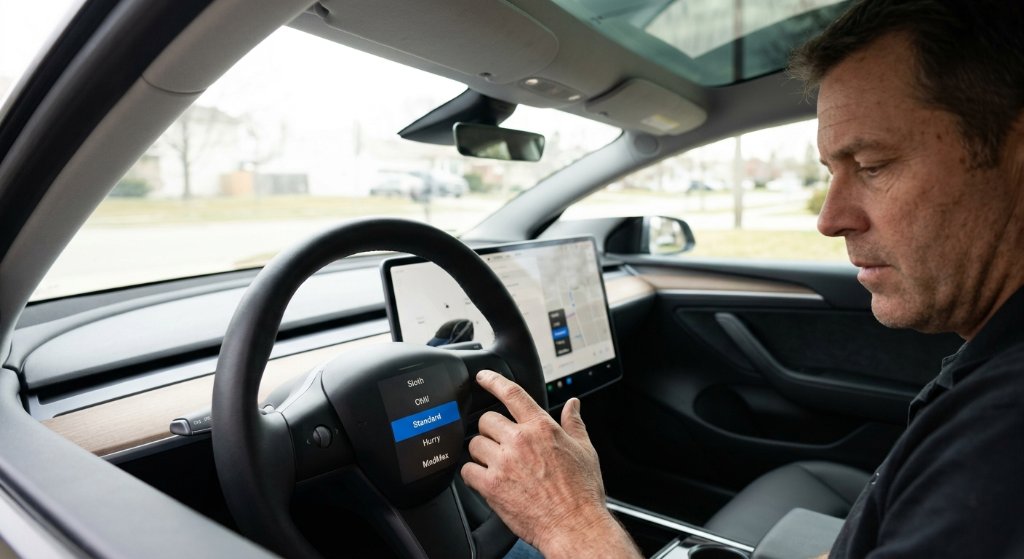
It wasn't all criticism, however. Hasler highlighted a major breakthrough in how Tesla handles driver-assist speed controls on the steering wheel. Instead of forcing drivers to constantly click or scroll the right-hand thumbwheel to adjust precise mph increments, the 2026 models leverage a qualitative "vibe-based" system for its Full Self-Driving (FSD) and cruise settings.
Using the updated steering wheel scrolling mechanism, drivers can quickly toggle through five distinct behavior profiles:
- Sloth: Ultra-conservative, slow-paced driving.
- Chill: Smooth, energy-efficient acceleration and pacing.
- Standard: Balanced daily driving.
- Hurry: Assertive lane changes and faster pacing.
- MadMax: Maximum assertiveness, keeping up with aggressive highway traffic.
This allows the car to dynamically negotiate its own speed based on the selected "vibe," sparing the driver from constantly twiddling with the scroll wheel to match the ebb and flow of traffic.
Base vs. Premium: The 2026 Dilemma
Hasler also detailed the distinct differences between the base RWD Model Y (which starts at $39,990) and the Premium trims. For prospective buyers, the choice is no longer just cosmetic:
- Battery and Range: The base model features a 60 kWh pack (321 miles EPA), whereas the Premium trim boasts a 75 kWh battery raising range to 357 miles and unlocking faster charging curves.
- The "Autopilot Blackmail": Strikingly, 2026 Tesla models without FSD do not include standard steering assist (Autosteer). Without the $99/month FSD subscription, drivers are left with basic speed cruise control—a feature that is standard on virtually every modern EV, from Hyundai's Ioniq 5 to cheaper Chinese imports.
Why This Matters:
This is a pivotal moment for Tesla's product philosophy. By removing physical gear selectors and locking basic driver assistance features like Autosteer behind a FSD subscription paywall, Tesla is taking a massive gamble on brand loyalty.
Who wins? Tesla's bottom line. Stripping stalks and physical switches reduces manufacturing complexity and slashes production costs, helping Tesla maintain its industry-leading profit margins. Furthermore, pushing users toward a $99/month subscription for basic lane-centering builds highly lucrative recurring software revenue.
Who loses? The consumer—particularly those transitioning from traditional internal combustion engine (ICE) vehicles or older EVs. By making basic operations like shifting into reverse a multi-step digital interaction, Tesla introduces unnecessary friction and potential safety hazards. Competitors like Rivian, Hyundai, and Kia are already capitalizing on this backlash by keeping tactile physical buttons for critical controls, positioning themselves as the "driver-first" alternative.
Conclusion
Tesla's 2026 lineup proves that the company is fully committed to a future where the car does all the thinking—whether the driver likes it or not. While "vibe-based" speed toggles like the "MadMax" thumbwheel hack represent brilliant, software-driven UX design, the forced reliance on screen-only shifting and subscription-locked safety features could alienate mainstream buyers. If Tesla continues to strip away tactile utility in the name of minimalism, they may find that the next generation of EV buyers will willingly slide into the driver's seat of a competitor who still values the simple click of a physical switch.