Blink Charging Overhauls Global Operations to Cure EV Charger Anxiety—But Is It Too Late?
Blink Charging is staging a massive, top-down intervention to save its brand reputation. Under the leadership of newly appointed Vice President of Glo...
Editorial Team
World Of EV
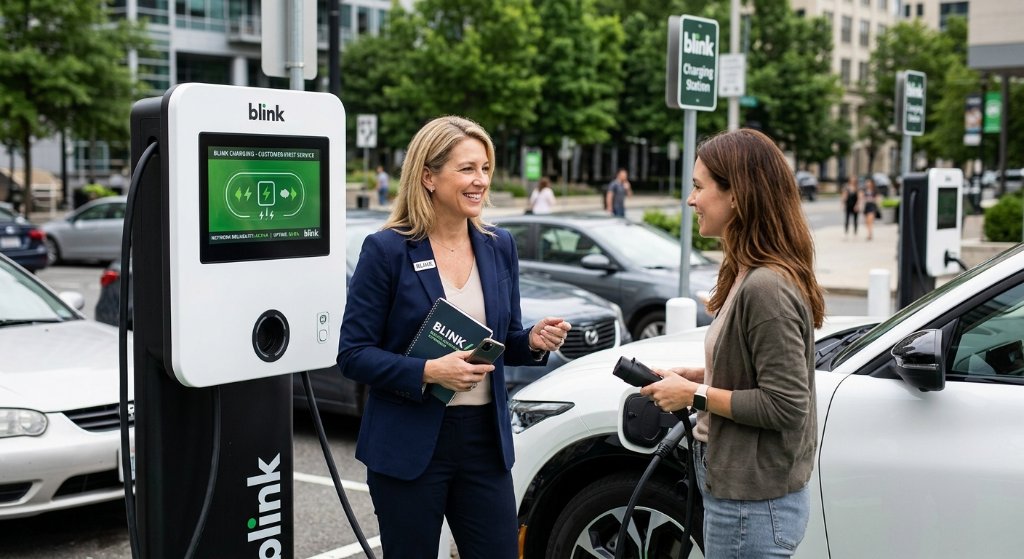
Blink Charging is staging a massive, top-down intervention to save its brand reputation. Under the leadership of newly appointed Vice President of Global Customer Experience, Elizabeth Castelluccio, the public charging giant has announced a sweeping "customer-first" global service transformation. The overhaul represents a direct, aggressive pivot away from the fragmented operational models of the past and toward a cohesive, real-time response network designed to tackle the EV industry’s most critical vulnerability: charger anxiety.
The timing of this pivot could not be more critical. Blink's stock has taken a severe beating, plummeting more than 40% over the last six months to trade under the dollar mark, resulting in a market capitalization of roughly $113 million. Simultaneously, the broader non-Tesla EV charging industry is facing a full-blown existential crisis. For years, drivers using third-party networks have battled a frustrating lottery of broken card readers, frozen screens, and offline hardware—prompting massive dissatisfaction in major consumer studies. With virtually every global automaker now adopting Tesla's North American Charging Standard (NACS) and unlocking the highly reliable Supercharger network, non-Tesla networks like Blink are fighting for their very survival.
Dismantling Silos: What's New in Blink’s Restructuring
Under Castelluccio's command, Blink is stripping down its traditional corporate structure and completely rebuilding how it handles customer support and physical maintenance. Instead of treating customer service as a reactive cost center, the company is elevating customer experience to a core driver of operational growth and network trust.
Key pillars of this global restructuring include:
- Unified Support & Operations: Consolidating customer support, customer success, onboarding, and field operations under a single umbrella. This eliminates the classic industry "finger-pointing" loop where software teams blame physical site hosts for broken hardware, and vice-versa.
- Real-Time Operational Monitoring: Transitioning to a proactive, real-time uptime management model. Rather than waiting for a stranded driver to call in a broken plug, Blink’s network operations will monitor and triage failures instantly.
- Voice of the Customer (VoC) Integration: Constructing a system to feed real-time driver and host feedback directly back into product design and corporate decision-making.
- Enterprise Account Recovery: Creating a high-priority, cross-functional channel to quickly resolve issues and preserve relationships with commercial site hosts—the businesses that actually install Blink chargers on their properties.
- Global Performance Metrics: Developing a unified KPI framework to track overall station health, driver risk factors, and exact uptime figures globally.
The High Stakes of the Host-Driver Disconnect
To lay the groundwork for this transformation, Blink conducted a survey of more than 400 EV charging host sites and everyday drivers. The data echoed what EV drivers have known for years: while there is universal agreement that infrastructure must scale rapidly to match the convenience of legacy gas stations, the current level of reliability across the public charging landscape remains deeply inconsistent.
"Customer experience in EV charging is inconsistent across the industry, and that has to change," admitted Mike Battaglia, President and CEO of Blink Charging. Historically, independent networks relied on a hands-off ownership model, where local property owners (hosts) bought the hardware and were largely left responsible for its maintenance. When a charger broke, it could sit idle for weeks. By integrating its onboarding, field services, and support teams, Blink is attempting to force unified accountability onto a notoriously fragmented ecosystem.
Why This Matters:
This is a textbook "do-or-die" moment for Blink Charging. For years, independent charging networks operated in a consequence-free environment where EV drivers had no choice but to put up with abysmal reliability. That era is officially over. Now that major automakers—from Ford and GM to Hyundai and Rivian—are transitioning to Tesla's NACS inlet, EV drivers have a highly reliable alternative in the Supercharger network. If Blink cannot guarantee near-perfect uptime and seamless plug-and-charge capabilities, they will be entirely sidelined.
The true winners of this operational shift are the site hosts and the EV drivers, who are finally getting the corporate leverage they deserve. If Castelluccio's team succeeds in implementing real-time monitoring and eliminating maintenance delays, Blink can salvage its brand value and prove to investors that its network is a viable, profitable alternative to Tesla's dominant footprint. However, if this restructure turns out to be nothing more than corporate restructuring and shifting titles, expect Blink to face severe consolidation pressures or be swallowed up by larger energy conglomerates.
Conclusion
Blink Charging's global transformation under Elizabeth Castelluccio is a much-needed acknowledgment of the industry's primary bottleneck: public trust. By shifting from a reactive support model to proactive, real-time uptime management, the company is finally addressing the baseline expectations of the modern EV driver. The blueprint is solid, but in an industry where reliability is the ultimate currency, execution will determine whether Blink charges ahead or runs completely out of juice.