Brute Force Wins: A 9,000-Mile Towing Test Proves GM Was Right About Massive EV Batteries
When General Motors first unveiled its Ultium-based behemoths, like the GMC Hummer EV and the Chevrolet Silverado EV, the EV purist community collecti...
Editorial Team
World Of EV
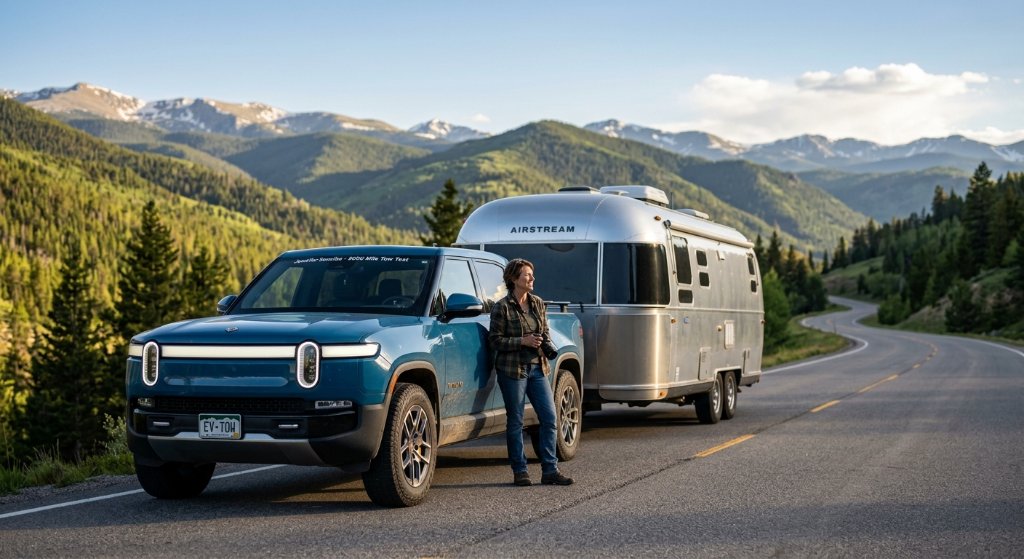
When General Motors first unveiled its Ultium-based behemoths, like the GMC Hummer EV and the Chevrolet Silverado EV, the EV purist community collectively scoffed. Armed with calculators, critics pointed to the massive, multi-thousand-pound 200+ kWh battery packs as symbols of bloated inefficiency—parading them as 'dead weight' built to satisfy American excess. However, those critics forgot a fundamental law of nature: physics always wins.
In a groundbreaking, 9,000-mile real-world towing trial, automotive journalist Jennifer Sensiba has vindicated GM's big-battery strategy. Dragging a 7,000-pound travel trailer across the United States—from New Mexico to California, along Route 66 to Chicago, out to the Outer Banks of North Carolina, and back—Sensiba’s journey has shattered the myth that electric trucks can't tow long distances. More importantly, it has proven that massive battery capacities are not a design flaw; they are a thermodynamic necessity.
The 9,000-Mile Crucible: Redefining Electric Road-Tripping
Rather than opting for short, manicured test runs on highly optimized charging corridors, Sensiba subjected her 2025 Chevrolet Silverado EV LT Extended Range to a grueling, cross-country gauntlet. Her setup included:
- The Tow Vehicle: A 2025 Chevrolet Silverado EV LT featuring a ~170 kWh battery pack (offering up to 10.2 kW of PowerBase offboard power).
- The Load: A 7,000-pound (loaded) inTech OVR Navigate travel trailer.
- The Route: Over 9,000 miles spanning New Mexico, California, the Arizona mountains, Illinois, North Carolina's Outer Banks, and back.
The mechanical reality of electric towing was an absolute revelation. Free from the gear-hunting, screaming RPMs, and sluggishness of traditional gas or diesel engines, the electric truck handled the weight effortlessly. Instant torque made merging onto high-speed highways stress-free, while heavy regenerative braking on steep mountain descents provided total, secure speed control.
Why Brute-Force Batteries Are a Thermodynamic Necessity
The critical takeaway of the 9,000-mile journey lies in the inescapable mathematics of aerodynamics. When pulling an RV, you aren't just fighting weight; you are fighting a massive aerodynamic brick.
- The Aerodynamic Penalty: Towing a standard travel trailer typically cuts any EV's range by half or more.
- The Math of Towing: Behind the Silverado EV LT, the trailer pulled efficiency down to roughly 0.9 miles per kWh.
- Why Small Batteries Fail: In a typical light-duty EV with a 100 kWh battery, a 0.9 mi/kWh efficiency translates to a useless 90-mile maximum range.
- Raw Capacity is King: By packing 170 kWh (or up to 205 kWh in GM's max-range trims), the Silverado EV ensured a reliable, practical towing range of 150 to 180+ miles between fast-charging stops.
This is where the physics of brute force triumphs over hyper-efficiency. You cannot engineer your way out of air resistance with smarter motor software or aerodynamic mirrors. The only way to span the vast gaps between chargers while dragging an RV is to carry more fuel—and in an EV, that means more battery.
The Ultimate Off-Grid Mobile Power Station
Crucially, Sensiba discovered that carrying a massive 170 kWh battery directly in front of the trailer hitch unlocks massive lifestyle advantages. Thanks to GM's PowerBase system, the Silverado EV essentially serves as a massive, silent microgrid.
- Boondocking Without Anxiety: The truck can export up to 10.2 kW of power.
- Zero Noise, Zero Fumes: By plugging the RV directly into the truck’s 120V/240V outlets, Sensiba powered the trailer's air conditioning, microwave, and lights at rest stops, truck parks, and remote sites without relying on a loud, polluting gas generator.
Why This Matters:
This 9,000-mile trial is a major inflection point for the electric truck segment, signaling who will dominate the next decade of utility-focused electrification.
- GM Vindicated: General Motors emerges as the clear winner here. Their much-criticized Ultium platform—which uses a double-stacked battery pack architecture—was built for heavy-duty work. While others tried to make sleek, light-weight pickups, GM accepted the weight penalty to give truck buyers what they actually need: real utility.
- The Losers (Sleeker, Small-Battery Rivals): Trucks like the Rivian R1T (with its max 141 kWh pack) or the Ford F-150 Lightning (with its 131 kWh extended-range pack) are fantastic daily drivers, but their physical battery limitations make them far less practical for heavy, cross-country RV towing. Meanwhile, the Tesla Cybertruck’s structural 123 kWh battery pack requires a costly, bed-blocking "range extender" battery just to compete in this arena.
- A Signal to the Market: If the EV transition is to win over mainstream, rural, and recreational buyers, the industry must stop treating high-capacity batteries as an environmental sin. Massive batteries are the prerequisite for heavy-duty work. Moving forward, expect to see trailer manufacturers designing "EV-friendly" RVs with integrated secondary battery packs that can feed back into the tow vehicle, creating a tandem energy ecosystem.
Conclusion
For years, the EV industry has searched for a magic bullet to solve the towing puzzle, but the answer has been staring us in the face: raw, unadulterated battery capacity. Jennifer Sensiba's 9,000-mile epic didn't just prove that electric road-tripping with an RV is viable; it proved it is physically superior to internal combustion in almost every metric. The era of mocking heavy EV battery packs is officially over. If you want to do real-world truck work in an electric future, size is everything.