BYD Reclaims Global EV Crown as Tesla Braces for Q2 Delivery Shockwave
The global electric vehicle race has a clear, undisputed frontrunner once again, and it does not reside in Austin, Texas. Chinese automotive giant BYD...
Editorial Team
World Of EV
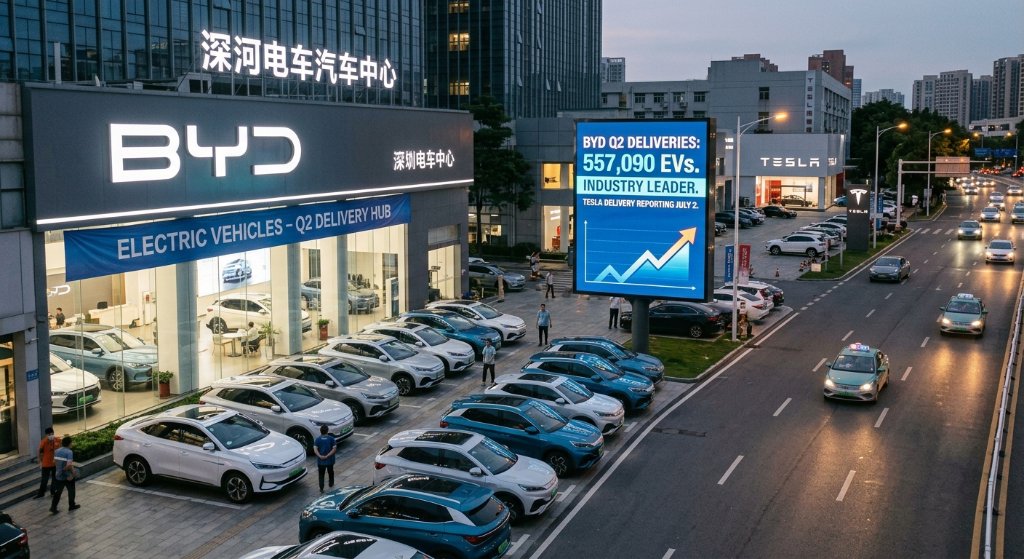
The global electric vehicle race has a clear, undisputed frontrunner once again, and it does not reside in Austin, Texas. Chinese automotive giant BYD has officially reported delivering a staggering 557,090 fully electric vehicles (BEVs) for the second quarter of 2026. This blockbuster performance places massive, undeniable pressure on Tesla ahead of its scheduled Q2 delivery release on July 2, signaling a permanent shift in the global automotive landscape.
This is not a sudden flash in the pan. BYD and Tesla have been trading the global BEV crown like heavyweight prizefighters since late 2024, when BYD first knocked Tesla off its perch. While Tesla managed a narrow, fleeting recapture of the top spot in Q1 2026—mainly due to a temporary domestic slowdown in China following the end of certain purchase-tax exemptions—this new Q2 data proves that BYD’s momentum is relentless. Tesla’s momentary Q1 reprieve was an anomaly, and the gap between the two giants is now widening into a chasm.
BYD's Record Q2 Versus Tesla's Estimated Slowdown
Wall Street and Bloomberg consensus estimates peg Tesla's projected Q2 deliveries between 396,500 and 406,024 units. If these projections hold, Tesla faces a staggering deficit of over 150,000 vehicles against its primary global rival.
Key takeaways from this quarter's landscape include:
- The 150,000-Unit Chasm: This expected gap highlights a fundamental divergence in trajectory. While BYD is scaling rapidly, Tesla’s volume is flatlining.
- A Pure EV Comparison: The 557,090 figure represents BYD’s pure battery-electric vehicles (BEVs) only. If plug-in hybrids (PHEVs) are factored in, BYD's total volume is more than double Tesla's.
- Tesla’s Leftover Inventory: In Q1 2026, Tesla built over 50,000 more cars than it delivered, creating an inventory pileup that has forced the company to offer aggressive discounting and low-interest financing throughout Q2 to clear lots.
The Export Engine and Tech Dominance Fueling BYD
Why is BYD accelerating while Tesla stalls? The answer lies in rapid internationalization and relentless technological iteration. BYD is no longer just a Chinese domestic champion; it has successfully transitioned into a global powerhouse.
- The Global Export Push: BYD has aggressively scaled its footprint across Europe, Southeast Asia, and Latin America. The automaker expects overseas sales to hit 1.5 million units in 2026, eclipsing its original target of 1.3 million.
- Vertical Integration Advantages: BYD’s in-house manufacturing of critical components, particularly its highly regarded Blade battery, allows it to maintain razor-thin pricing margins. Tesla, heavily reliant on external battery suppliers and its slow-to-ramp 4680 cells, simply cannot match this cost structure.
- Rapid Model Cadence: Unlike Tesla’s notoriously slow product cycles, BYD continuously refreshes its lineup and is aggressively investing in next-generation autonomous driving tech to close the software gap with its American rival.
Tesla’s Fatigue: Aging Platforms and Brand Distractions
Tesla’s slowing growth is a self-inflicted wound. The pioneer of the modern EV is suffering from product stagnation. The Model 3 and Model Y, which still account for the vast majority of Tesla's volume, are facing severe market fatigue.
Without a truly cheap, mass-market next-generation platform (the long-promised $25,000 vehicle) in active high-volume production, Tesla has had to rely on price cuts that erode profit margins. Compounding this is the slow leak of brand damage in Europe and North America, partially driven by Elon Musk's polarizing political activities and distractions with non-automotive ventures like robotics and AI.
Why This Matters:
This is a watershed moment that signals a permanent shifting of the guard in the automotive industry.
- Who Wins: BYD and the Chinese EV ecosystem. BYD’s ability to scale BEVs globally while maintaining a robust portfolio of plug-in hybrids makes them highly resilient to localized market fluctuations. They are proving that high-quality, vertically integrated EVs can be built affordably and shipped worldwide.
- Who Loses: Tesla and legacy Western automakers. Tesla loses its long-held identity as the undisputed king of electric mobility, a title that justified its gargantuan tech-like stock valuation. Meanwhile, legacy automakers who dragged their feet on transition plans are now caught in the crossfire between a stagnating Tesla and an unstoppable BYD.
- The Market Signal: This is a "do-or-die" moment for Tesla’s product strategy. It can no longer rely on the Model 3 and Y to carry the company. If Tesla does not fast-track a high-volume, low-cost platform and resolve its leadership distractions, it risks being permanently relegated to a niche player in a market it once pioneered.
Conclusion
As we await Tesla’s official figures on July 2, the writing on the wall is clear: the EV crown has returned to Shenzhen. Tesla must decide whether it is a mass-market car manufacturer capable of competing on volume and price, or an AI and robotics company that happens to sell cars. BYD has made its choice, and the results speak for themselves.