Canadian EV Market Ignites: Renewed Consumer Interest Signals a Crucial Turning Point
After a challenging period marked by stagnant growth, Canada's electric vehicle market is showing signs of a robust resurgence. The latest J.D. Power ...
Editorial Team
World Of EV
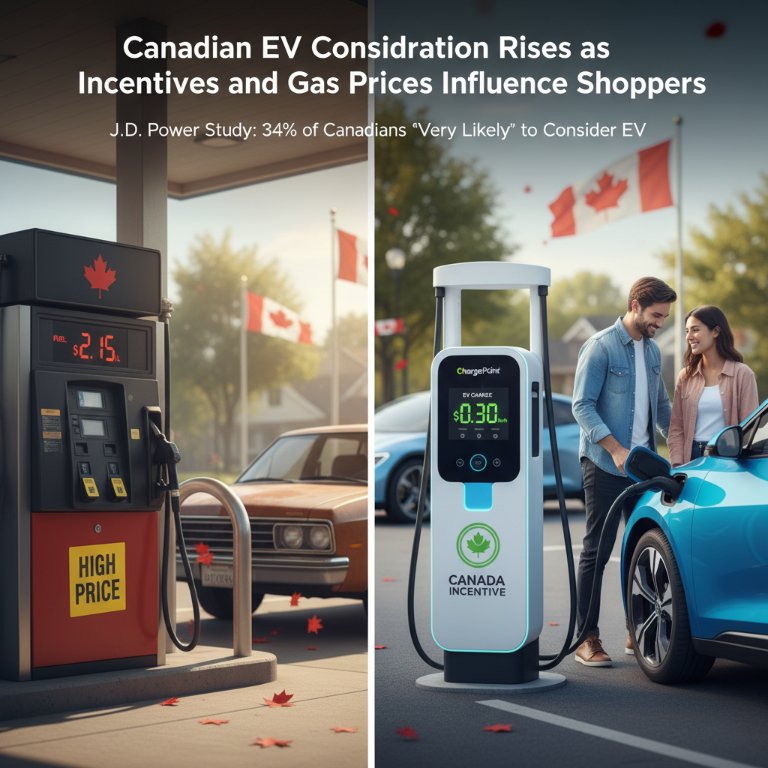
After a challenging period marked by stagnant growth, Canada's electric vehicle market is showing signs of a robust resurgence. The latest J.D. Power 2026 Canada Electric Vehicle Consideration (EVC) Study reveals a significant uptick in consumer interest, with 34% of Canadian new-vehicle shoppers now 'very likely' or 'somewhat likely' to consider an EV for their next purchase. This marks a notable six percentage point increase from 2025 and, crucially, represents the first rise in EV consideration in four years.
This renewed enthusiasm is a welcome development for an industry that has faced headwinds, particularly after the federal iZEV incentive program was paused in early 2025 due to exhausted funding, leading to a temporary slump in EV sales. The current study indicates that higher fuel costs and the reintroduction of federal incentives are the primary drivers behind this positive shift.
Catalysts for Renewed Enthusiasm
The J.D. Power study, which surveyed 4,938 Canadian new-vehicle shoppers between March and April 2026, provides compelling insights into the forces at play.
- Soaring Fuel Costs: Consistently high gasoline prices across Canada are pushing more consumers to seek out alternatives. While recent weeks have seen some regional fluctuations, the overall trend of elevated pump prices, particularly in provinces like British Columbia, highlights the financial appeal of EVs. Drivers are increasingly sensitive to the economic burden of internal combustion engine (ICE) vehicles.
- Return of Federal Incentives: The reintroduction of a new federal rebate program, the Electric Vehicle Affordability Program (EVAP), has played a pivotal role. Launched in February 2026, EVAP offers up to $5,000 for battery-electric and fuel cell electric vehicles and up to $2,500 for plug-in hybrid vehicles. This program replaced the iZEV program, which concluded in March 2025. A quarter of shoppers surveyed indicated that EVAP positively influenced their consideration.
Despite the positive momentum, key barriers persist, with limited driving range (65%), lack of charging station availability (56%), and inadequate performance in extreme temperatures (54%) remaining top concerns for those unlikely to consider an EV.
Why This Matters:
This surge in Canadian EV consideration signals a critical turning point for the market. After years where consumer interest either flatlined or even declined, the 2026 J.D. Power study offers a definitive validation that the underlying desire for electrification is strong when supported by favorable economic conditions and policy.
- For Automakers: This is a clear signal to accelerate EV offerings and bolster charging infrastructure investments in Canada. Manufacturers that can deliver compelling, affordable, and winter-capable EVs will be the big winners. The study also noted a growing openness among Canadian consumers (56%) to consider Chinese EV brands, primarily due to lower pricing and advanced technology, though concerns about quality and reliability remain. This opens the door for new competition and further diversification of the market.
- For Consumers: The renewed interest, driven by economic pressures and incentives, indicates a market moving towards greater affordability and choice. As demand rises, and with federal programs targeting more accessible models, we can anticipate more competitive pricing and a wider array of options tailored to Canadian conditions, including better cold-weather performance. The existing federal EVAP program specifically targets affordable EV models.
- For Policy Makers: The study underscores the direct impact of sustained incentive programs and the urgency of addressing charging infrastructure gaps and cold-weather performance concerns. While incentives have proven effective, overcoming practical barriers will be crucial for long-term, sustainable growth. The federal government's recent commitment to building 84,500 chargers by the end of the decade is a positive step.
- Market Maturity: The Canadian EV market appears to be transitioning from a purely policy-driven growth model, as seen with the iZEV program, to one where economic realities and improved product offerings are playing an increasingly dominant role. This signifies a maturation, albeit one still requiring strategic support to overcome persistent practical hurdles.
The increase in EV consideration, particularly with the return of robust federal incentives and the persistent pressure of high fuel prices, paints an optimistic picture for Canada's electric future. While practical challenges like range anxiety and cold-weather performance still need comprehensive solutions, this study confirms a growing readiness among Canadian consumers to embrace electric mobility. The industry must now capitalize on this momentum with innovative vehicles and a robust, reliable charging ecosystem to solidify this positive trend for the long term.