Car Features That Matter in 2026, by Crash and Claim Data
Most "best car tech" lists rank features by how they feel in a 20-minute test drive: the biggest screen, the cleverest party trick, the highest chargi...
World Of EV Editorial
World Of EV
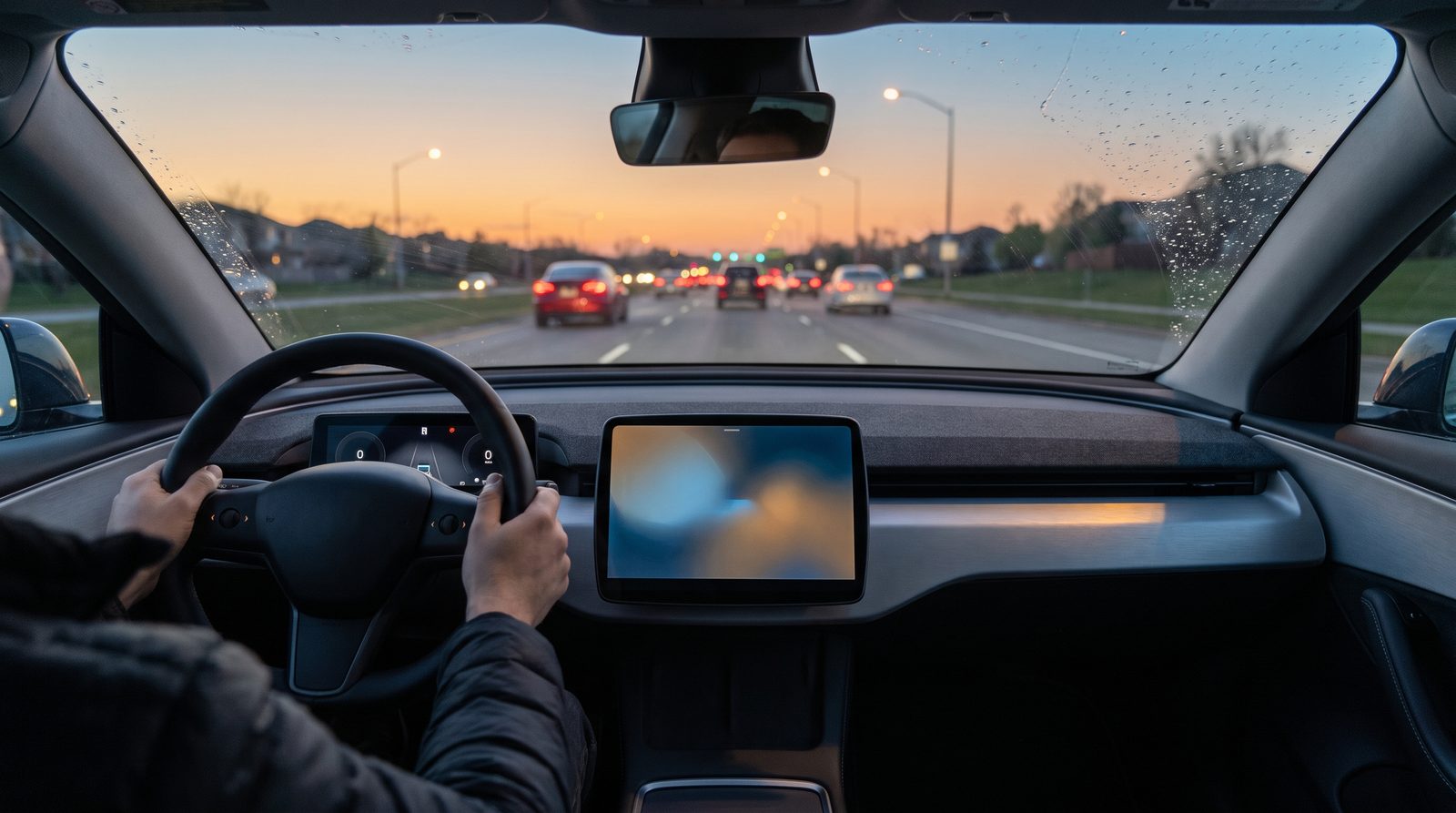
Most "best car tech" lists rank features by how they feel in a 20-minute test drive: the biggest screen, the cleverest party trick, the highest charging number. That's the wrong test. The right one is simpler: does this feature reduce crashes, injuries or insurance claims, or does it save real money or time? Insurers, regulators and owner surveys have measured a lot of this, and the data doesn't line up with the marketing.
So we sorted 15 features for gas, hybrid and electric buyers by what the data shows. The unglamorous ones (rear automatic braking, good headlights) come out on top. Hands-free driving, gesture control and touchscreen-only controls don't.
All 15 car features rated at a glance
| Feature | Verdict | Why, in one line |
|---|---|---|
| Forward AEB incl. pedestrian detection | MATTERS | Halves front-to-rear crashes in IIHS data; weak at night |
| Rear automatic braking | MATTERS | 78% fewer backing crashes with camera and sensors |
| Blind-spot warning | MATTERS (modest) | 14% fewer lane-change crashes |
| Good-rated headlights / adaptive driving beam | MATTERS | 19% fewer nighttime single-vehicle crashes vs poor-rated |
| Full hybrid powertrain | MATTERS | $600–$750 a year less fuel in EPA estimates |
| OTA updates that can fix recalls | MATTERS | Safety recalls fixed without a dealer visit |
| Plug-in hybrid | SITUATIONAL | EU fleet data: real-world CO2 averaged 3.5x the lab figure (2021 registrations) |
| Auto start-stop | SITUATIONAL | Small city gain, zero on the EPA highway number |
| Hands-free Level 2 (Super Cruise, BlueCruise, FSD) | SITUATIONAL | Convenience; IIHS finds little evidence of a crash benefit |
| Lane departure warning / lane keeping | SITUATIONAL | 11% fewer target crashes, but warning-only didn't cut claims |
| Heat pump (EV) | SITUATIONAL | Matters where winters are cold; savings unquantified |
| Native NACS port / Plug & Charge (EV) | SITUATIONAL | Big for road-trippers, minor for home chargers |
| Gesture control | GIMMICK | 43.4 problems per 100 vehicles (2024) |
| Paid subscriptions for hardware you own | GIMMICK | BMW tried it with heated seats and backed down |
| Touchscreen-only core controls | GIMMICK (makes the car worse) | Euro NCAP's 2026 protocol docks points for it; no crash study yet |
How we judged them
Three tiers, no exceptions:
- MATTERS: measured evidence of fewer crashes, injuries or insurance claims (IIHS, HLDI, NHTSA), or a large, repeatable real-world saving in money or time (EPA, DOE).
- SITUATIONAL: a real benefit only for some buyers, climates or habits. Anything sold as safety whose evidence only supports convenience also lands here.
- GIMMICK: no measured benefit plus high owner-complaint rates, or a feature that makes the car worse (more distraction, a paywall).
A feature with no data can't earn MATTERS. Where the evidence is thin, we say so. Most of the crash figures below come from the IIHS-HLDI "Real-world benefits" summary (July 2025), which compares police-reported crash and insurance-claim rates for vehicles with and without each feature. Several of the underlying studies cover older-generation systems, and we note the study years where they matter.
MATTERS: the features with evidence behind them
Forward automatic emergency braking, including pedestrian detection
This is the strongest result in the dataset. Per the IIHS-HLDI summary, AEB cuts front-to-rear crashes by 50% and front-to-rear crashes with injuries by 56%. It also lowers claim rates for damage to other vehicles by 14% and for injuries to people in other vehicles by 24%. Note the age of that evidence: the headline 50% figure comes from a 2017 IIHS study of police-reported crashes in 22 states from 2010 to 2014. Those were first-generation systems.
Pedestrian AEB is real but has a blind spot, literally. IIHS found pedestrian-detecting AEB cut pedestrian crashes by 27% and pedestrian injury crashes by 30%, but on unlit roads at night it made no difference, and IIHS notes that's when three-quarters of fatal pedestrian crashes happen. When IIHS added a nighttime test in 2022, only 4 of the first 23 vehicles earned its top "superior" rating and 12 earned "basic" or no credit, even though 19 of the 23 had rated superior or advanced in daylight. One EV was among the four superior: the Ford Mustang Mach-E.
Where the mandate stands (checked November 26, 2026): NHTSA's FMVSS No. 127, finalized in May 2024, requires AEB and pedestrian AEB on new light vehicles manufactured on or after September 1, 2029. The standard requires AEB to work at speeds up to 90.1 mph and pedestrian AEB up to 45.3 mph. Automakers sued in January 2025; their trade group had earlier told Congress the rule was "practically impossible with available technology." The D.C. Circuit case has been on hold since February 2025, and in a March 2026 status report DOT said it was preparing a proposal that would "amend certain aspects of the rule." According to a law-firm summary of the filing, that includes two more years of lead time for automakers. On November 25, 2026, NHTSA filed that proposal (Federal Register Doc. 2026-24140): it would push compliance to vehicles manufactured on or after September 1, 2031 (2032 for small-volume makers). It is only a proposal, open for 60 days of public comment, so until a final rule is issued the September 2029 date still stands. Either way, don't wait for the mandate: buy it now.
Rear automatic braking
The most underrated feature on the list. The IIHS-HLDI summary shows rear automatic braking cutting backing crashes by 78% when it's combined with a rearview camera and parking sensors. It also cut claims for damage to other vehicles by 29% and to the insured vehicle by 9%. A camera alone manages 17% and rear cross-traffic alert 22%. NHTSA has proposed adding rear automatic braking with pedestrian avoidance to the technologies its NCAP program recommends (May 2026).
It's still often a trim-level feature. On the 2027 Hyundai Ioniq 5, Hyundai's own spec page lists Parking Collision-Avoidance Assist–Reverse as standard only on the XRT and Limited trims. Rear cross-traffic collision avoidance is standard on all of them. If a dealer says "it brakes in reverse," check which system they mean.
Blind-spot warning (modest)
The benefit is real but much smaller than AEB's: IIHS-HLDI found 14% fewer lane-change crashes, 23% fewer lane-change crashes with injuries, and 7–8% lower claim rates for damage and injuries to other vehicles. Worth having, but it shouldn't decide which car you buy.
Good headlights and adaptive driving beam
Headlights are the feature buyers check least and trims vary most. An IIHS study found vehicles with good-rated headlights had 19% fewer nighttime single-vehicle crashes than those with poor-rated ones, plus 29% fewer such crashes with driver injuries and about a quarter fewer pedestrian crashes. The study covered roughly 44,000 nighttime crashes. When it came out in October 2021, IIHS noted that many automakers had started fitting a single good-rated system as standard instead of selling the better lights as an expensive add-on. Look up the exact trim you're buying on iihs.org.
Adaptive driving beam (ADB) is a high beam that shades oncoming cars so you can leave it on. It became legal in the US only with NHTSA's February 2022 final rule amending FMVSS 108. In IIHS testing, a vehicle with ADB produced significantly less glare than an SUV with HID low beams and a sedan with curve-adaptive HID low beams, but IIHS also says the US rule "is likely to limit their effectiveness" and that only a few manufacturers offer ADB here. If your car has it, use it. If it doesn't, a good-rated low and high beam matters more.
Full hybrid powertrain (gas buyers)
For gas buyers, this is the biggest money-saver on the list, and it needs no change in habits. EPA figures on fueleconomy.gov (15,000 miles a year, 55% city driving):
| Model | Gas: combined MPG / annual fuel | Hybrid: combined MPG / annual fuel | Yearly saving |
|---|---|---|---|
| 2025 Toyota RAV4 AWD | 29 / $2,300 | 39 / $1,700 | $600 |
| 2026 Honda Accord | 32 / $2,100 | 48 / $1,400 | $700 |
| 2026 Hyundai Tucson AWD | 26 / $2,600 | 36 / $1,850 | $750 |
The hybrid's edge is largest in the city. The Accord Hybrid is rated 51 mpg city against the gas car's 29. Toyota has already made the call for RAV4 buyers: fueleconomy.gov lists only hybrid powertrains for the 2026 RAV4. And the saving repeats every year you own the car.
Over-the-air updates that can fix recalls
The benefit isn't app stores or games; it's a safety recall fixed overnight in your driveway. NHTSA's record for Tesla recall 23V-838 (December 2023) covered 2,031,220 vehicles, including the Model Y, and lists the remedy as a free over-the-air software update. Ford's recall 22V-333 for a powertrain software fault on 2021 Mach-Es could be fixed either by a dealer or over the air.
The catch: the same channel can ship flawed fixes. NHTSA opened a recall query in April 2024 into whether 23V-838's remedy was adequate. It cited 20 post-remedy crashes and noted that part of the remedy required owners to opt in and could be readily reversed. OTA delivers fixes well. It doesn't guarantee they work.
SITUATIONAL: real benefits, for some buyers
Plug-in hybrids
A PHEV is a great car if you plug it in every day. If you don't, it's a heavier, pricier hybrid. The EPA rates the 2025 RAV4 plug-in (formerly RAV4 Prime) at 42 miles of electric range, but at 38 mpg once the battery is empty. That's slightly worse than the regular RAV4 Hybrid's 39. Europe has measured the real-world result. The European Commission's analysis of on-board fuel-consumption data from about 320,000 PHEVs registered in 2021 found real-world CO2 averaged 3.5 times the type-approval figure across the fleet, not just among owners who never plug in. For 2022 registrations the gap held steady in absolute terms (99 to 102 g/km) but grew in relative terms, from 249% to 314% above the lab figure. The Commission's explanation is that owners aren't charging and driving on electricity as often as the official figures assume. Buy one only if you'll plug in.
Auto start-stop (gas and hybrid)
Real but small, and only in traffic. EPA lists two otherwise-matching 2025 RAV4 AWD configurations: with stop-start, 27 mpg city; without it, 25. Both are rated 33 mpg on the highway. The difference is about $100 a year. Oak Ridge National Laboratory testing (2023) found stop-start improved fuel economy by up to 7.27% on the EPA city cycle and 26.4% on the stop-and-go New York City cycle. If you sit in traffic every day, leave it on. On the highway it does nothing.
Hands-free Level 2: Super Cruise, BlueCruise, Tesla FSD (Supervised)
These are convenience systems, not safety features, and IIHS says so directly. A July 2024 IIHS-HLDI study found no clear evidence that partial automation prevents crashes beyond what AEB already does. IIHS's president called it "a convenience feature like power windows or heated seats rather than a safety technology."
The safeguards are weak too. IIHS's first partial-automation safeguard ratings (March 2024) rated 14 systems: 1 acceptable, 2 marginal, 11 poor. GM's Super Cruise rated marginal. Ford's BlueCruise, Tesla Autopilot and Tesla's then-FSD Beta all rated poor. As of today, the IIHS ratings page lists no systems rated since that round, so there are no newer scores to check.
Regulators are watching. NHTSA upgraded its BlueCruise probe to an engineering analysis in January 2025 covering about 129,000 2021–2024 Mach-Es. NHTSA found that Ford's adaptive cruise ignores reported stationary objects at approach speeds of 62 mph and up. In two fatal crashes, Mach-Es going over 70 mph at night with BlueCruise engaged hit stationary vehicles without braking. Cadillac now lists Super Cruise as standard on the 2027 Lyriq "with 3-year OnStar One plan" (see our Cadillac Lyriq page), so check what it costs after that. Enjoy it on a long highway drive, but don't pay extra for it thinking it makes you safer.
Lane departure warning and lane keeping
Real but modest. Per IIHS-HLDI, lane departure warning cuts single-vehicle, sideswipe and head-on crashes by 11% and injury crashes of those types by 21%. But IIHS also reports that warning-only systems did not reduce insurance claim rates in HLDI's analysis. And it only helps if it's switched on. When IIHS checked about 2,400 cars at dealerships in 2024, 87% had a lane system active, up from 51% eight years earlier. IIHS attributes the gain partly to two design changes: systems switched on and off through a settings menu rather than a button were more likely to be left on, and vibration alerts, which drivers find less annoying than beeps, could account for some of it. Choose a car whose system vibrates the wheel or seat instead of chiming. Lane centering belongs in the Level 2 section above.
Heat pump (EVs)
This depends on your winters. fueleconomy.gov, citing a 2019 AAA test, says EV range can drop 41% at 20°F, with about two-thirds of the extra energy going to heating the cabin. Without the heater, range is only about 12% lower. A heat pump goes after that cabin-heating share. We found no Tier 1 figure for how much a heat pump actually recovers, so we won't invent one. In Minnesota it's worth seeking out. In San Diego it barely matters. Fitment varies by model and trim, so check the spec sheet for the exact car you're buying.
Native NACS port and Plug & Charge (EVs)
These matter for road-trippers, much less for home chargers. The AFDC station count lists about 81,200 public DC fast-charging ports in the US as of late November 2026. A native NACS port means you plug into Tesla Superchargers without an adapter. The 2027 Ioniq 5 ships with one plus a CCS adapter, and the 2027 Lyriq lists an onboard NACS port. Plug & Charge, where the charger bills you automatically when you plug in, removes app friction on the networks that support it. Vehicle-to-load and vehicle-to-home are useful in outages, but few owners need them.
GIMMICKS: car features to skip or not pay for
Gesture control
J.D. Power's 2024 Tech Experience Index, as reported by DC Velocity, found interior gesture controls logged 43.4 problems per 100 vehicles, and 21% of owners said the feature lacks functionality. Waving at the dashboard to change the volume does the job of a knob, and owners say it does it badly.
Subscriptions for hardware you already own
In 2023 BMW stopped selling monthly subscriptions to heated seats that were already installed in the car. Its sales chief Pieter Nota told Autocar, as The Drive reported, that BMW doesn't offer seat heating by monthly subscription any more. Paying monthly to turn on parts you already bought makes the car worse. If a feature's hardware is in the car, the price should be on the window sticker.
Touchscreen-only core controls
This verdict rests on Euro NCAP's scoring, not a crash-rate study. Euro NCAP's 2026 protocols, in force since January, score cars higher for "physical buttons for commonly used functions." The driver-engagement protocol requires "direct physical input" for the turn signals, hazard lights, horn, eCall/SOS, gear selector, front wipers and full beam. A car that puts those on a touchscreen loses points in the Safe Driving stage. That's why we call touchscreen-only controls a gimmick that makes the car worse: they cost safety-rating points and make you look away from the road for things you need instantly.
Tesla has already partly backed down. Its refreshed Model 3 moved turn signals to steering-wheel buttons in 2023, and in August 2025 Carscoops reported that Tesla had put the stalk back as standard in China. Screens themselves are a separate question. The Volvo EX30 has no display behind the wheel: Volvo puts speed, charge level, navigation and media on a single 12.3-inch center screen. Where the information sits isn't what Euro NCAP scores; whether the signals, hazards and wipers have physical controls is. Volkswagen went the other way on buttons: its ID. Polo cockpit (January 2026) brings back a strip of physical climate and hazard buttons, which VW says was "systematically optimised based on customer feedback."
In fairness: car tech that works
This isn't an anti-tech list. J.D. Power's 2026 Tech Experience Index, as reported by Auto Remarketing, found smart ignition had the highest satisfaction and among the fewest problems. Smart climate control also scored high with low problem counts. The features owners like are the ones they barely notice. As for the AI chatbot assistants now arriving in dashboards: there's no data on them yet, so we rate them unproven.
EV charging: ask for the 10–80% time, not peak kW
We left peak charging power out of the ratings because it's a spec, not a feature. Hyundai markets the Ioniq 5 with an "ultra-fast charging system up to 800V/350 kW," and Hyundai's own figures show the same car takes 20 to 81 minutes from 10–80% depending on the charger, so a peak kW number without the charger and the minutes tells you little. Ask for both.
The bottom line
If you're picking a trim, put the money into rear automatic braking, the best-rated headlights IIHS lists for that model, and a car with real buttons for signals, hazards and wipers. Buying gas? Get the hybrid. Skip gesture control, don't pay for hands-free driving as a safety feature, and when a salesperson quotes peak kW, ask for the 10–80% time.
Sources
- IIHS-HLDI, Crash avoidance technologies: Real-world benefits, July 2025.
- IIHS, Advanced driver assistance topic page (LDW claims finding, research summaries).
- IIHS, Cicchino 2017, FCW and AEB effectiveness (2010–2014 data, 22 states).
- IIHS, Pedestrian crash avoidance systems cut crashes — but not in the dark, Feb. 3, 2022.
- IIHS, Few vehicles excel in new nighttime test of pedestrian autobrake, Aug. 30, 2022.
- Federal Register, FMVSS No. 127 final rule, May 9, 2024; NPRM proposing to delay compliance to Sept. 1, 2031 (Doc. 2026-24140, docket NHTSA-2026-2476), filed Nov. 25, 2026.
- eCFR, 49 CFR 571.127 (compliance date, speed ranges).
- Alliance for Automotive Innovation, Automakers seek repeal of AEB rule, Jan. 2025.
- National Law Review (Tier 2; Nelson Mullins law-firm summary), The Road Ahead for FMVSS 127, Apr. 22, 2026: abeyance, March 23, 2026 DOT status report language, and the two-year lead-time detail.
- Federal Register, NCAP notice proposing rear automatic braking with pedestrian avoidance, May 28, 2026.
- Hyundai Motor America, 2027 IONIQ 5 page (PCA-R trims, NACS port, 10–80% times by charger).
- IIHS, Good IIHS headlight ratings linked to lower crash rates, Oct. 14, 2021; Headlights topic page.
- NHTSA via govinfo.gov, Adaptive driving beam final rule, Feb. 22, 2022.
- Euro NCAP, 2026 protocol changes announcement, Nov. 26, 2025; Safe Driving – Driver Engagement Protocol v1.1, Oct. 2025.
- Carscoops (Tier 2), Tesla brings back Model 3 turn-signal stalk in China, Aug. 19, 2025.
- Volvo Cars, The Volvo EX30 design (blocks automated access; text verified against the matching Volvo Car Canada release rehosted on Cision, May 31, 2023).
- Volkswagen Newsroom, New cockpit generation debuting with the ID. Polo, Jan. 3, 2026.
- fueleconomy.gov, side-by-side comparisons: RAV4 gas/hybrid/PHEV; Accord gas/hybrid; Tucson gas/hybrid; 2026 RAV4 model list, checked Oct. 5, 2026; RAV4 with vs without stop-start.
- fueleconomy.gov, Fuel economy in cold weather.
- Oak Ridge National Laboratory, Auto stop-start fuel consumption benefits, 2023.
- NHTSA recall records: 23V-838; 22V-333.
- NHTSA ODI, RQ24-009 opening resume, Apr. 25, 2024; EA25-001 opening resume, Jan. 17, 2025.
- European Commission, Real-world CO2 emissions and fuel consumption of cars and vans collected in 2022, July 26, 2024.
- IIHS, Little evidence that partial automation prevents crashes, July 11, 2024.
- IIHS, First partial driving automation safeguard ratings, March 2024; ratings page, checked Nov. 26, 2026.
- Cadillac, 2027 LYRIQ page (Super Cruise standard with 3-year OnStar One plan; NACS port).
- IIHS, Fewer drivers are opting out of lane departure prevention, Oct. 1, 2024.
- U.S. DOE AFDC, Station counts by state, accessed Nov. 26, 2026.
- DC Velocity (Tier 2, relaying J.D. Power 2024 TXI), J.D. Power survey: automakers pack too much tech into vehicles, Aug. 26, 2024.
- The Drive (Tier 2, relaying Autocar), BMW is giving up on heated seat subscriptions, Sept. 7, 2023. Autocar original: BMW will not charge extra to activate existing functions in cars (returns HTTP 402 to automated fetch).
- Auto Remarketing (Tier 2, relaying J.D. Power 2026 TXI), J.D. Power 2026 U.S. Tech Experience Index, Aug. 21, 2026.