CATL’s Massive New Oslo Hub Rewrites the Rules of EV Battery Repair in Europe
CATL, the world’s undisputed EV battery king, has officially planted a massive flag in Europe. By opening its largest NING SERVICE experience center o...
Editorial Team
World Of EV
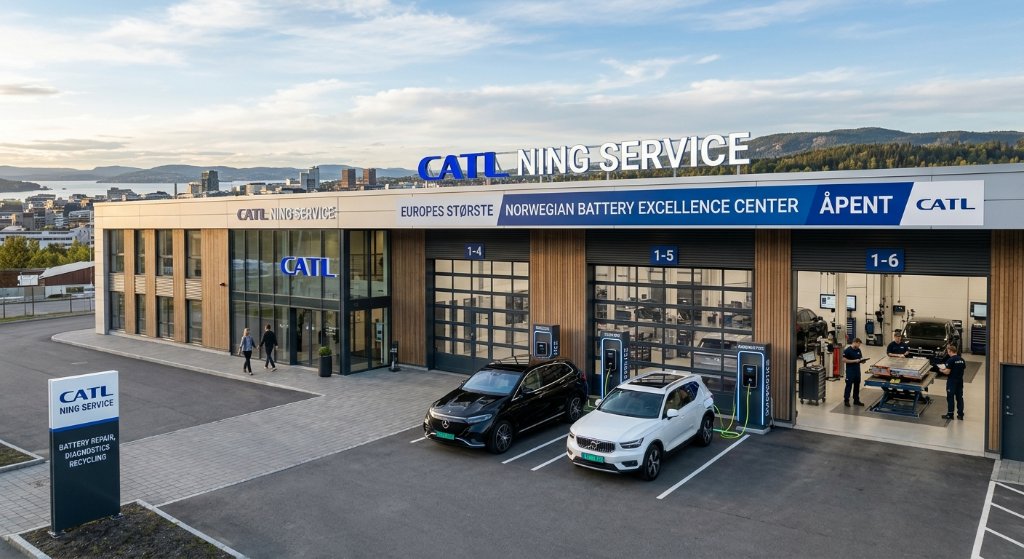
CATL, the world’s undisputed EV battery king, has officially planted a massive flag in Europe. By opening its largest NING SERVICE experience center outside Asia in Oslo, Norway, the Chinese battery giant isn't just expanding its footprint—it is fundamentally rewriting the economics of owning and repairing an electric vehicle.
For years, the EV industry has faced a quiet, terrifying crisis: the "replacement-only" model of battery servicing. A minor scrape to an underbody pack or a single faulty module has routinely resulted in insurance companies writing off otherwise perfectly good vehicles, driving premiums through the roof. With Norway serving as the ultimate real-world testbed—where battery-electric vehicles (BEVs) captured an astonishing 98.7% of new car sales in August 2026—CATL’s new 8,000-square-meter facility aims to prove that battery repairability, rather than outright replacement, is the sustainable future of the automotive aftermarket.
Shifting From Replacement to Precision Repairs
CATL’s NING SERVICE, launched in 2024 to tackle battery degradation and lifecycle costs, is executing a massive paradigm shift. Instead of treating battery packs as sealed, throwaway black boxes, the Oslo center focuses on "targeted precision repairs." This includes component-level intervention—even down to cell-to-pack (CTP) levels—which allows technicians to replace damaged or degraded cells instead of the entire, highly expensive battery pack.
- Massive Turnaround Reduction: The facility cuts turnaround times for complex battery repairs from 72 hours down to just 48 hours, vastly reducing vehicle downtime for owners.
- Broad Compatibility: The center has the capability to service and repair battery packs for 76.8% of EV models currently on European roads, regardless of whether they initially shipped with CATL batteries.
- Cutting-Edge Diagnostics: The workshop utilizes CATL's proprietary "Intelligent Eagle Eye System" to oversee diagnostics and quality control, ensuring repairs meet factory-grade safety standards.
A Training Ground and Circular Economy Hub
Beyond functioning as a workshop, the 8,000-square-meter facility serves as a vital training academy and regional logistics powerhouse. As EV adoption rapidly outpaces the supply of qualified mechanics, CATL is using this hub to train European technicians in high-voltage safety and specialized battery diagnostics. Furthermore, through its Global Energy Circularity Commitment (GECC) partnership with the Ellen MacArthur Foundation, the center ensures that batteries reaching the absolute end of their lifecycle are funneled into second-life storage systems or circular recycling pipelines, recovering precious materials like lithium, nickel, and cobalt.
An Experience Space for the Next Era of Mobility
Remarkably, CATL is looking far beyond passenger cars. The Oslo center doubles as an interactive brand experience space and sales agency for the next generation of electrified transit.
- Electric Marine Vessels: Tailored battery and propulsion solutions for Scandinavia's vital shipping and ferry routes.
- eVTOL Aircraft: Serving as a commercial sales and support hub for advanced electric vertical takeoff and landing aircraft (partnering with ecosystem leaders like AutoFlight).
- Advanced Robotics: Supporting industrial automation and robotics (such as Galbot) to expand CATL’s footprint beyond terrestrial vehicles.
Why This Matters:
The opening of this flagship center in Oslo is a masterclass in vertical integration and a direct challenge to traditional legacy automakers.
First, the consumer and the insurance industry win big. By reducing repair times by 33% and shifting the repair standard from full battery pack replacement to cell-level maintenance, CATL is directly tackling EV insurance anxiety. If other markets adopt this standard, it could drastically lower insurance premiums, which have ballooned due to minor underbody impacts totaling out EVs.
Second, this is a strategic chess move against European OEMs. While European legacy automakers struggle to build their own regional battery supply chains, CATL is cementing itself not just as a supplier, but as the indispensable backbone of the continent's aftermarket infrastructure. By establishing training hubs and servicing 76.8% of all EV models—even non-CATL ones—CATL is making it almost impossible for European car brands to bypass them. It signals a "do-or-die" moment for European automakers to either partner with CATL's aftermarket ecosystem or invest billions to build competing, high-cost service networks of their own.
Finally, it sets the stage for a global rollout. Oslo is merely the launchpad. With further NING SERVICE centers planned for Turkey, the UK, France, Spain, and South Africa, CATL is building an unbeatable aftermarket moat. They aren't just selling batteries anymore; they are owning the entire lifecycle, ensuring that as global fleets age, every road leads back to CATL.
Conclusion
CATL's bold move in Oslo proves that the EV transition has entered its mature phase. We are no longer just asking how far an EV can drive on a single charge; we are asking how long that battery can be kept in the loop efficiently and affordably. By bringing cell-level repair, training, and circular recycling under one roof, CATL has established a benchmark that the rest of the automotive industry must now hustle to match.