Chore-Day Champions, Road-Trip Challengers: Why the 2026 Tesla Model Y and Hyundai Ioniq 9 Prove the 'EV Divide' is Real
### The Suburban Dream Meets the Interstate Reality If you want to understand where the electric vehicle transition stands in 2026, look no further t...
Editorial Team
World Of EV
The Suburban Dream Meets the Interstate Reality
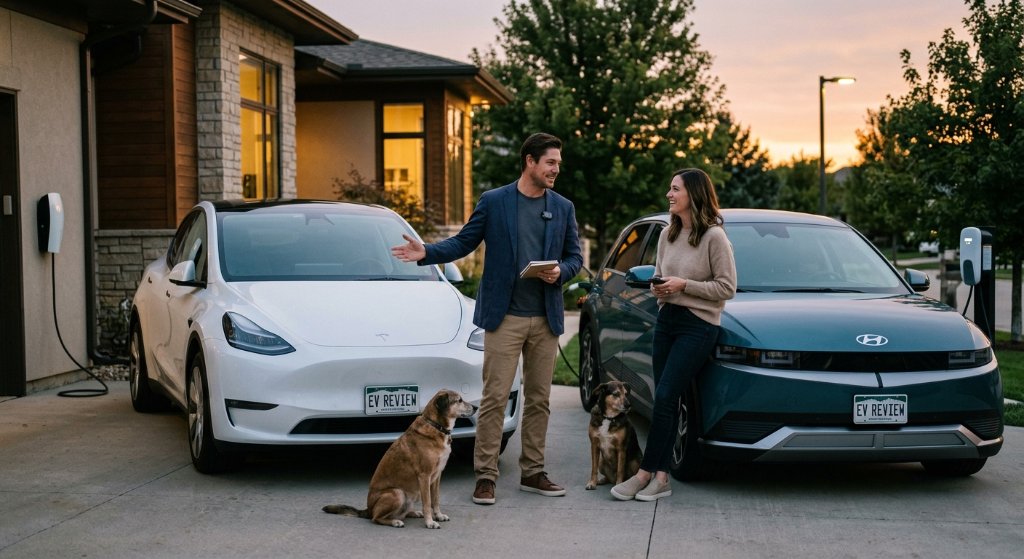
If you want to understand where the electric vehicle transition stands in 2026, look no further than the driveways of real-world adopters. A comprehensive long-term evaluation from EV owners Craig and Deanne Conover, who lived with two of the year’s most significant electric family haulers—the freshly redesigned 2026 Tesla Model Y 'Juniper' and Hyundai's massive new flagship, the 2026 Ioniq 9—reveals a stark, fascinating dichotomy.
While both vehicles offer an unmatched masterclass in local daily commuting, they also highlight a persistent truth: the American highway system still demands a meticulous planning tax on EV road-trippers. This isn't a failure of vehicle engineering—both the Model Y and the Ioniq 9 represent the pinnacle of current EV technology—but rather a reflection of an infrastructure transition that is still very much a work in progress.
Local Mastery: Silent Speed and the Overnight Charge
For daily driving and running local chores, the Conovers' findings confirm that going back to an internal combustion engine (ICE) vehicle feels like stepping back into the Stone Age. When confined to regional driving, both the Model Y and the Ioniq 9 excel in ways gas-powered rivals simply cannot match.
Key daily driving strengths highlighted by the real-world test include:
- Whisper-Quiet Serenity: The 2026 Model Y 'Juniper' refresh finally addresses Tesla's historically buzzy cabin with upgraded acoustic glass and enhanced sound dampening. Meanwhile, the Ioniq 9 leverages its massive E-GMP platform and active road noise control to deliver a vault-like, ultra-premium cabin experience.
- Instantaneous Torque: Navigating stop-and-go traffic and squeezing into tight merges is effortless. The immediate throttle response of both SUVs turns stressful city driving into a serene, low-effort endeavor.
- The Convenience of the 'Wake-Up' Charge: By plugging into a Level 2 charger at home overnight, the daily concept of 'refueling' is completely eliminated. Drivers start every morning with a full 'tank,' avoiding dirty gas stations and volatile fuel prices.
The Highway Reality Check: Why Planning Still Reigns Supreme
However, the honeymoon period shifts gears once these SUVs cross county lines. Despite the Model Y’s highly praised efficiency and the Ioniq 9’s massive 110.3-kWh battery pack (boasting up to an EPA-estimated 335 miles of range), long-distance highway travel still introduces friction.
The Conovers noted that road trips in either vehicle still require drivers to budget additional travel time and plan their routes with meticulous precision. The pain points of long-haul EV travel remain highly visible:
- The 'Time Tax' of Fast Charging: Even with Hyundai's ultra-fast 800-volt architecture—capable of charging the Ioniq 9's massive pack at lightning speeds under ideal conditions—charging stops still take significantly longer than a traditional five-minute gasoline splash-and-go.
- The High-Speed Efficiency Penalty: Pushing a large SUV at 70+ mph on the interstate creates aerodynamic drag that rapidly eats into real-world range, often forcing stops earlier than dashboard estimators suggest.
- The Planning Mental Load: Unlike gas stations, which sit on almost every highway exit, DC fast-charging stations must still be intentionally mapped. Drivers must actively monitor charger speeds, network reliability, and potential queues.
Why This Matters:
The Conovers' real-world experience highlights a critical inflection point for the EV market. The modern electric vehicle has officially won the battle of the daily commute. For the 80% of driving that happens within 40 miles of home, a 2026 EV is objectively superior to any gas-powered equivalent.
However, the 'road trip hurdle' remains the last major psychological and logistical barrier to mainstream EV adoption.
- The Winners: Tesla still holds a structural advantage here. Even as other manufacturers gain access to the Supercharger network, Tesla's seamless, plug-and-charge software integration relieves much of the planning anxiety that plagues non-Tesla drivers. Hyundai also wins on pure engineering; the Ioniq 9's lightning-fast 800V charging capabilities prove that the brand is ready for the future, even if America's highway charging network is still catching up.
- The Losers: The 'one-car household' dream for buyers who frequently travel long distances. Until high-speed DC chargers are as ubiquitous, fast, and reliable as gas pumps, many multi-car families will continue to relegate their EVs to local duty and keep a gas or hybrid vehicle in the garage for interstate journeys.
- The Market Signal: Automakers can no longer rely solely on increasing battery size to win over skeptical buyers. A bigger battery, like the Ioniq 9's massive pack, adds weight and cost without fully solving the highway time penalty. The battleground has officially shifted from vehicle range to infrastructure reliability and charging speed.
Conclusion
Ultimately, living with the 2026 Tesla Model Y and the Hyundai Ioniq 9 proves that EV engineering has largely delivered on its promises. As daily drivers, they are unparalleled in their comfort, performance, and operating economics. But until public high-speed charging becomes completely frictionless, the highway road trip will remain a conscious, planned-out adventure rather than a spontaneous drive.