Closing the Chasm: New Research Reveals EV Ownership Far Exceeds Fuel Drivers' Expectations
A groundbreaking study by Octopus Electroverse and Autotrader has unearthed a substantial disparity between the public's perception of electric vehicl...
Editorial Team
World Of EV
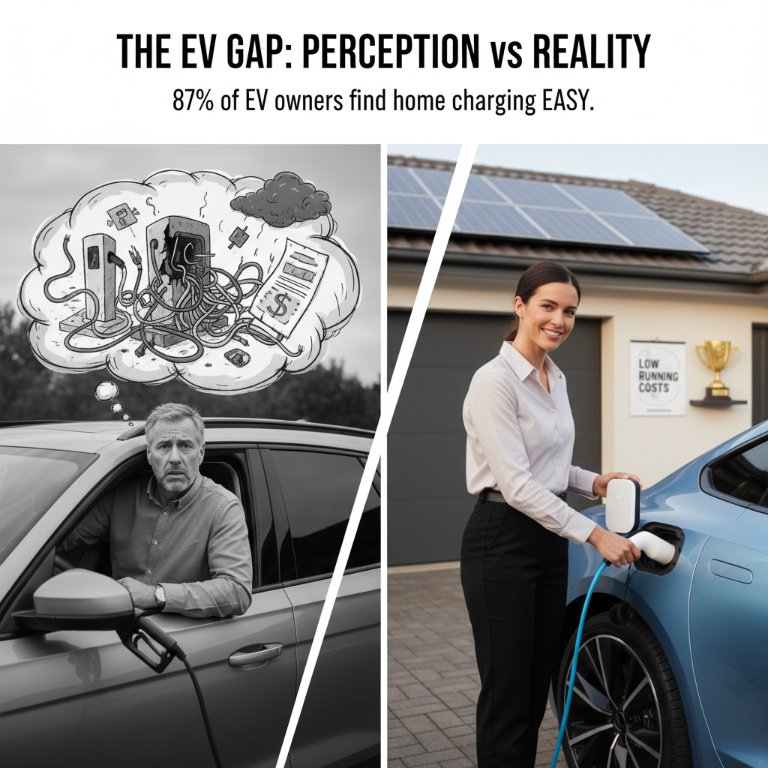
A groundbreaking study by Octopus Electroverse and Autotrader has unearthed a substantial disparity between the public's perception of electric vehicle (EV) ownership and the lived reality of EV drivers. This extensive research highlights that across critical aspects such as charging convenience, vehicle reliability, daily running costs, and overall performance, EV owners consistently report significantly higher satisfaction levels than petrol and diesel drivers anticipate. This 'massive gap in expectation versus experience' is not merely an interesting observation; it stands as a a formidable barrier hindering broader EV adoption.
For years, the EV transition has been characterized by enthusiastic early adopters and a hesitant mainstream. While innovative manufacturers like Tesla have pushed the envelope with advanced battery technology (such as their 4680 cells) and rapid charging networks, and established players like BYD have demonstrated the reliability of blade batteries, a consistent underlying challenge has been overcoming widespread public skepticism. This new data confirms that much of this skepticism is rooted in a fundamental misunderstanding of the modern EV ownership experience.
The Charging Convenience Myth Debunked
One of the most persistent anxieties for prospective EV buyers revolves around charging. Fuel drivers often envision a cumbersome process, a stark contrast to the familiar five-minute fill-up at a petrol station. However, the study paints a dramatically different picture. A staggering 87% of EV owners who charge their vehicles at home describe the experience as both easy and convenient. This data decisively counters the 'range anxiety' narrative that has plagued EV discourse for years, demonstrating that for the vast majority, daily charging is a seamless, overnight affair that offers the luxury of waking up to a 'full tank' every morning. Furthermore, two-thirds of EV drivers report that public chargers are easy to find and quick to use, with the UK network now boasting over 111,000 charge points.
Unseen Benefits: Reliability and Running Costs Redefined
Beyond charging, the research reveals a significant disconnect regarding other ownership aspects. Petrol and diesel drivers are nearly nine times more likely to believe EVs incur higher maintenance costs and eight times more likely to assume greater day-to-day running costs. The reality, according to the study, is a pleasant surprise for EV owners. They save an average of £860 annually by utilizing specialized home charging tariffs. Moreover, Autotrader data indicates that, for the first time, new electric cars are now, on average, cheaper to purchase than petrol equivalents when factoring in discounts and government grants. In terms of reliability, EV owners are almost twice as likely to report their vehicles as more reliable than their petrol counterparts. Overall satisfaction among EV drivers stands at an impressive 85%, with nearly half (48%) describing themselves as 'extremely satisfied' – a figure significantly higher than the 31% of fuel drivers reporting the same level of satisfaction.
The Information Imperative: Empowering the Hesitant
The research underscores a critical need for education: 88% of current fuel drivers state they require more information before considering a switch to an EV. This highlights that the biggest barrier to widespread EV adoption isn't the technology itself, nor necessarily the infrastructure, but rather a profound lack of accurate, accessible information. Matt Davies, Director of Octopus Electroverse, aptly summarizes this, stating, "The biggest barrier to EV adoption today isn't infrastructure or performance, it's a lack of information."
Why This Matters:
This research isn't just another data point; it's a clarion call for the entire automotive industry and policymakers. The persistent perception gap signals that millions of drivers are missing out on a demonstrably superior ownership experience due to outdated fears and misinformation. For manufacturers, this means moving beyond simply producing compelling EVs and investing heavily in transparent, comprehensive consumer education campaigns that directly address these misconceptions. It's not enough to build a better mousetrap if the public still believes the old one is more reliable or affordable.
Who Wins?
- Current EV owners are clearly winning, enjoying lower running costs, higher reliability, and unparalleled convenience.
- The EV industry stands to win immensely if it can effectively bridge this information gap, unlocking a massive segment of hesitant buyers.
- Companies that proactively educate and demystify EV ownership will gain a significant competitive advantage.
Who Loses?
- Legacy automakers who fail to adapt their communication strategies risk being left behind as the market shifts.
- More importantly, fuel drivers who cling to outdated perceptions are losing out on significant financial savings and a more satisfying driving experience.
What This Signals:
- This study firmly indicates that the core technology and user experience of EVs are largely robust and satisfying.
- The challenge has shifted from innovation to communication.
- It's a signal that the market is ready for a surge in adoption, provided that accurate information can overcome entrenched biases. This is a "do-or-die" moment for achieving ambitious decarbonization targets; widespread EV adoption hinges not just on product availability, but on public understanding and confidence.
The findings from Octopus Electroverse and Autotrader illuminate a clear path forward: the future of EV adoption hinges on empowering petrol and diesel drivers with the truth about electric ownership. As the industry continues to innovate, the next frontier is not solely in battery chemistry or charging speeds, but in dismantling the psychological barriers that prevent a significant portion of the driving public from embracing a cleaner, more satisfying automotive future. The 'EV glow,' as Autotrader's Erin Baker puts it, is real – now it's time for everyone to see it.