Colorado Treats EV Charging Like Gasoline: New Weights and Measures Rules Mandate Strict Billing Accuracy
For decades, drivers of internal combustion engine (ICE) vehicles have taken one thing for granted: when the gas pump says you received 10.0 gallons o...
Editorial Team
World Of EV
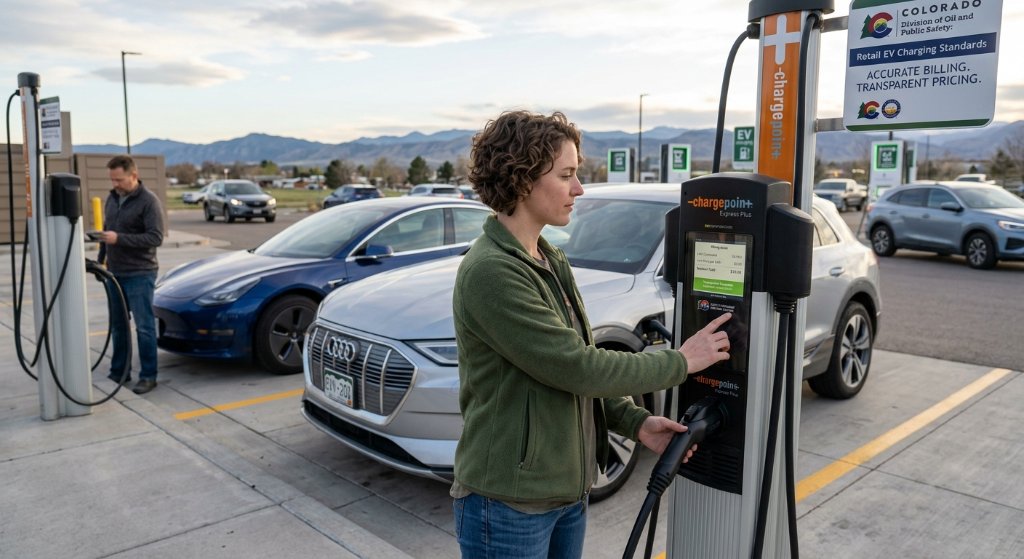
For decades, drivers of internal combustion engine (ICE) vehicles have taken one thing for granted: when the gas pump says you received 10.0 gallons of fuel, you actually received 10.0 gallons. That certainty is guaranteed by the physical "weights and measures" seals slapped onto every pump by state regulators. For electric vehicle drivers, however, the experience has more closely resembled a digital guessing game. Opaque billing screens, varying utility structures, and unverified software calculations have left EV owners wondering if they are truly getting every kilowatt-hour (kWh) they pay for.
That era of "black box" billing is officially coming to an end in Colorado. Effective July 1, 2026, the Colorado Division of Oil and Public Safety (OPS)—the very same body that regulates retail gasoline pumps—is implementing a sweeping set of new Retail Electric Vehicle Charging regulations. This watershed policy represents a major evolutionary leap for EV infrastructure, moving electricity out of the regulatory shadows and treating it as a standard, strictly monitored consumer fuel.
The New Rules: Translating "Gas Pump" Fairness to the Plug
Rather than allowing charge point operators (CPOs) to self-regulate, Colorado is stepping in to enforce strict metrological standards based on the National Institute of Standards and Technology (NIST) Handbook 44. Under the new framework, any commercial EV charging station that charges a fee for electricity must prove its accuracy.
The mandate introduces several key operational adjustments that operators must implement:
- Strict Registration Deadlines: Owners of existing retail EV chargers placed in service before July 1, 2026, must register their equipment with the OPS by January 1, 2027. New chargers installed after July 1 must be registered within 30 days of entering service.
- The NTEP Gold Standard: All new commercial chargers deployed after July 1, 2026, must carry an active National Type Evaluation Program (NTEP) Certificate of Conformance. Legacy equipment isn't entirely off the hook either; operators have until July 1, 2030, to secure NTEP or California Type Evaluation Program (CTEP) certification, or they must decommission the hardware.
- Certified Calibration: Chargers must be installed, tested, and regularly verified by a licensed Registered Service Agent (RSA). The metrological test results must be submitted directly to the state.
- A Year of Grace: While OPS inspectors will hit the pavement to inspect chargers later this year, the state is offering a transition window. Formal enforcement actions and fines will not begin until July 1, 2027.
Navigating the Bottlenecks: The Cart Before the Horse?
While the regulations are a massive win for consumer trust, they present immediate logistical headaches for the charging industry. The most glaring challenge is the talent bottleneck. Because these rules are entirely new, the pool of certified Registered Service Agents (RSAs) equipped to test and seal high-power DC fast chargers is incredibly small. Forcing operators to rely on a virtually nonexistent network of state-approved testers risks delaying the deployment of new charging stations.
Furthermore, the 2030 deadline for legacy equipment could quietly kill off older, slower charging sites. Retrofitting early-generation Level 2 or older 50 kW DC fast chargers with NTEP-compliant hardware is often financially unviable. Rather than upgrading this equipment, cash-strapped operators may simply pull the plug on older stations, leaving minor coverage gaps in rural or underserved areas of the state.
Why This Matters:
- The Big Winners: EV Drivers and Public Trust. By eliminating billing discrepancies, Colorado is removing yet another psychological barrier to EV adoption. Knowing that a state regulator has verified the accuracy of the dispenser brings "pump-side peace of mind" to the EV experience. It levels the playing field, making public charging as predictable and trustworthy as filling up a legacy gas tank.
- The Losers: Negligent Charge Point Operators (CPOs). CPOs can no longer hide behind poorly maintained hardware or buggy software. Underperforming networks that fail to maintain metrological tolerances will face state-enforced downtime and fines. This forces a much-needed "survival of the fittest" scenario among charging networks, weeding out players who refuse to invest in ongoing hardware maintenance.
- The Market Signal: The Professionalization of Electrons. This regulatory shift signals to the wider automotive and energy markets that EVs have officially transitioned from a niche hobby to a mainstream, state-regulated utility network. As other states inevitably follow Colorado’s lead, we will see a rapid standardization of EVSE (Electric Vehicle Supply Equipment) hardware across North America, driving manufacturers to build higher-quality, self-calibrating charging dispensers.
The Road Ahead
Colorado’s proactive approach to EV charging transparency is exactly what the industry needs to build long-term consumer confidence. While operators will undoubtedly face short-term regulatory friction and a scramble to find certified technicians, the long-term payoff is clear. Treating electricity with the same rigorous scrutiny as gasoline is the final step in normalizing the EV lifestyle. The "Wild West" era of EV charging is officially closing down, replaced by a mature, transparent, and verified fueling infrastructure.