Cracking the Battery Code: Why the '30-80%' Rule and Regenerative Braking Are Your EV's Best Friends
For decades, drivers have been conditioned by a simple internal combustion engine (ICE) reality: fill the tank to the brim, drive until it is empty, a...
Editorial Team
World Of EV
For decades, drivers have been conditioned by a simple internal combustion engine (ICE) reality: fill the tank to the brim, drive until it is empty, and expect the best fuel economy on the highway. But as the automotive landscape undergoes its most radical transformation in a century, first-time electric vehicle (EV) buyers are discovering that the old rules of thumb no longer apply. Transitioning to electric mobility requires a fundamental shift in how we think about energy management, a reality highlighted in a recent masterclass guide by journalist Royce Kurmelovs.
For early adopters who remember the rapid battery degradation of early air-cooled Nissan Leafs, understanding the science of battery preservation is the difference between a car that lasts a decade and one that requires a premature, five-figure battery replacement. To unlock the true potential of modern EV ownership, drivers must move past simple range anxiety and focus instead on battery health. By mastering the physics of lithium-ion cells and leveraging the unique mechanics of electric drivetrains, owners can significantly extend their vehicle's lifespan while maximizing daily efficiency.
The Golden Rule of State-of-Charge: The 30-80% Sweet Spot
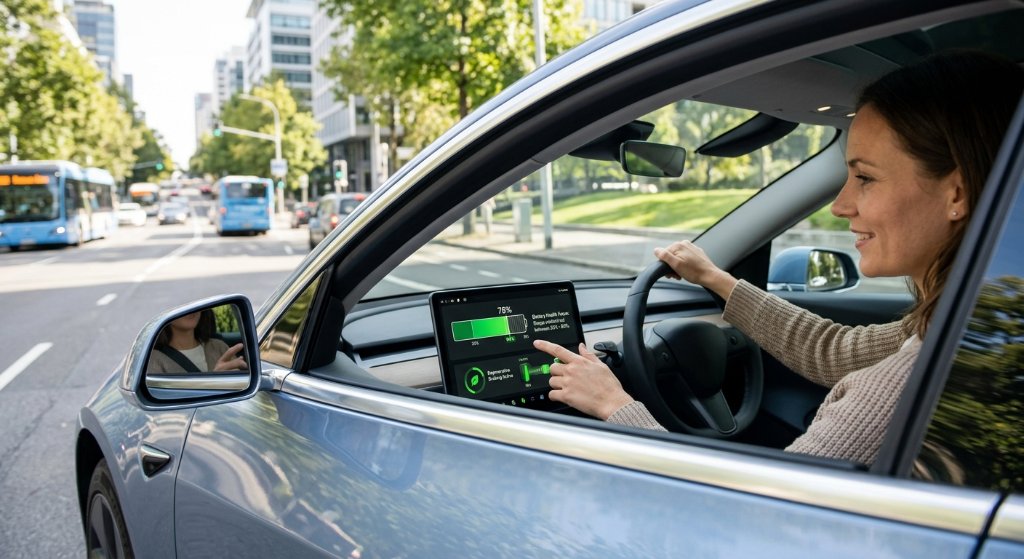
Lithium-ion batteries—the chemical engines powering everything from the Tesla Model Y to the Porsche Taycan—are at their happiest when they are relaxed. Charging a battery to 100% or draining it down to near-zero subjects the internal chemistry to extreme physical stress, accelerating the degradation of the cathode and anode. To protect long-term battery health, Kurmelovs highlights the "80% rule": keeping the battery's State-of-Charge (SOC) between 30% and 80% for daily driving.
- Minimize Chemical Degradation: Keeping the SOC in this sweet spot prevents high-voltage stress and dendrite formation, which can permanently reduce the battery's holding capacity.
- Optimize Charging Times: Charging speeds drop off a cliff after 80% as the vehicle's Battery Management System (BMS) slows down the flow of electricity to protect the cells. Stopping at 80% saves you precious time at fast chargers.
- Preserve Resale Value: A healthy battery pack is an EV's most valuable asset. Demonstrating disciplined charging habits will be a major selling point in the emerging used EV market.
Flipping the Efficiency Script: Why City Traffic Beats the Highway
One of the most jarring adjustments for new EV drivers is understanding where their vehicles are most efficient. In a gas car, highway cruising is king. In an EV, the opposite is true. High-speed highway driving forces the electric motor to work continuously against aerodynamic drag, with zero opportunities to recover energy. Conversely, slow city traffic—often the bane of ICE drivers—is where EVs truly shine, thanks to regenerative braking.
- How Regenerative Braking Works: When you lift your foot off the accelerator, the electric motor reverses direction, acting as a generator that slows the vehicle down while converting kinetic energy back into electricity to feed the battery.
- Embrace One-Pedal Driving: Activating maximum regenerative braking allows you to drive almost entirely without touching the brake pedal, turning stop-and-go gridlock into an opportunity to actively harvest free mileage.
- The Aerodynamic Penalty: Because aerodynamic drag increases exponentially with speed, driving at 75 mph consumes disproportionately more energy than driving at 60 mph, making highway driving the ultimate test of raw battery capacity.
Why This Matters:
This paradigm shift in driving and charging habits represents a critical turning point for the EV market. The "winners" of this transition will be educated consumers who treat their batteries as depreciating chemical assets to be actively managed, yielding lower total cost of ownership (TCO) and superior resale values. Conversely, the "losers" will be those who refuse to adapt, suffering from premature range loss and frustration at the charging plug.
For automakers, this shift signals a "do-or-die" mandate to improve software-driven Battery Management Systems and user interfaces. Manufacturers cannot rely on enthusiasts reading guides; they must build intuitive, automated guardrails—such as geofenced charging limits and smart thermal preconditioning—directly into the vehicle's OS to protect the battery from the driver's own bad habits. Ultimately, as battery health replaces mileage as the primary metric of used vehicle value, mastering these habits is no longer just for tech-savvy early adopters—it is the baseline for smart car ownership.
In conclusion, owning an EV is not simply about swapping gasoline for electrons; it is about embracing an entirely new relationship with your vehicle's powerplant. By committing to the 30-80% charging rule and mastering regenerative braking in urban environments, drivers can transition from passive operators to active energy managers, ensuring their electric vehicles remain efficient, reliable, and valuable for years to come.