Cybercab Rolls Off Line: Tesla's Driverless Future Just Got Real
Tesla has officially commenced production of its highly anticipated autonomous taxi vehicle, the Cybercab, marking a pivotal moment in the company's l...
Editorial Team
World Of EV
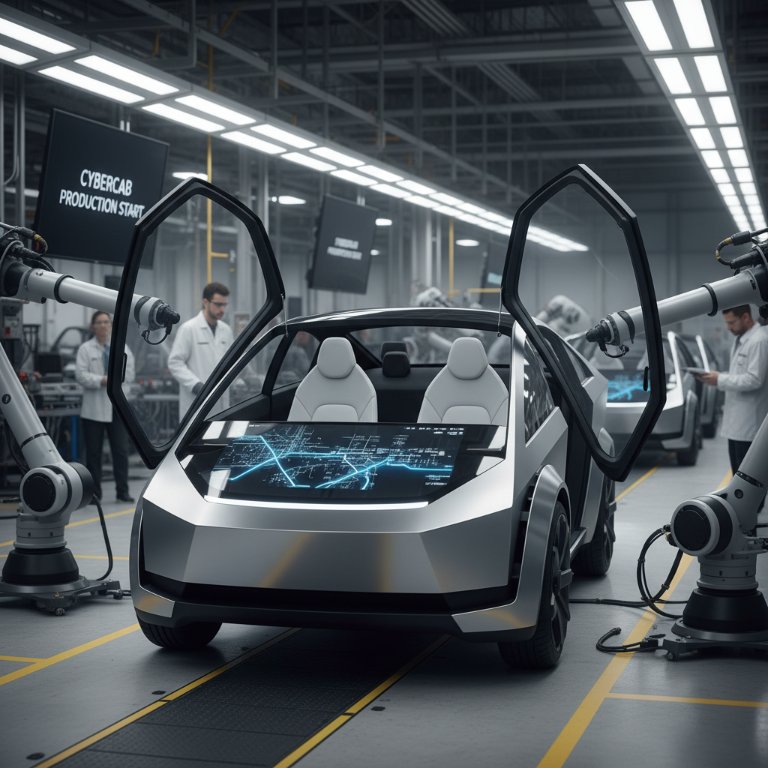
Tesla has officially commenced production of its highly anticipated autonomous taxi vehicle, the Cybercab, marking a pivotal moment in the company's long-standing ambition to revolutionize urban mobility. This two-seat, purpose-built vehicle, devoid of a steering wheel or pedals, is not merely a new model; it's a tangible declaration of Tesla's unwavering commitment to a fully autonomous future, moving beyond adaptable passenger cars into dedicated Robotaxi hardware.
For years, industry watchers and enthusiasts alike have tracked CEO Elon Musk's pronouncements regarding a Tesla-operated Robotaxi network, often viewing it as a distant promise. The Cybercab's physical manifestation now injects a critical dose of reality into that vision, even as significant revenue generation from these services remains targeted no earlier than 2027.
The Cybercab Arrives: A Radical Design
The Cybercab is a striking departure from conventional automotive design, underscoring its singular purpose: to operate as a fully autonomous vehicle within a smart taxi network. Its two-seat configuration speaks to the majority of ride-sharing trips involving a single passenger or a pair, optimizing space and energy efficiency. The most profound design choice, however, is the complete omission of manual driving controls.
- Two-Seat Configuration: Designed for optimal space and efficiency in urban ride-sharing scenarios, addressing the prevalence of single or dual passenger trips.
- No Steering Wheel or Pedals: This fundamental design choice eliminates any human intervention, serving as a powerful statement about the vehicle's intended L5 (full) autonomous operation.
- Purpose-Built Architecture: Unlike previous Tesla vehicles adapted for FSD, the Cybercab is engineered from the ground up specifically for autonomous service, suggesting optimized hardware and software integration for reliable, scalable robotaxi deployment.
This radical approach highlights Tesla's confidence in its Full Self-Driving (FSD) technology, pushing beyond the incremental updates and beta tests that have characterized its journey thus far. It signifies a hardware commitment that matches the software ambition, positioning the Cybercab as the ultimate expression of Tesla's autonomy strategy.
Tesla's journey to full autonomy has been well-documented, marked by both groundbreaking advancements and significant challenges. From early Autopilot features to the rollout of FSD Beta, the company has consistently pushed the boundaries of what's possible with camera-only vision systems. However, a dedicated Robotaxi has always been the ultimate prize, the grand vision articulated by Musk over a decade ago. While competitors like Waymo and Cruise have deployed limited driverless services in specific geo-fenced areas, often leveraging LIDAR and radar alongside cameras, Tesla has steadfastly pursued a vision-centric approach. The production of the Cybercab validates this long-term strategy, demonstrating that Tesla is not just developing software but building the bespoke vehicles required to deliver on its promise. This move could potentially leapfrog competitors who might be tied to retrofitting existing vehicle architectures, thereby accelerating Tesla's deployment capabilities once regulatory and technological hurdles are fully cleared.
Why This Matters:
The commencement of Cybercab production sends reverberations across the entire automotive and tech landscape, signaling a critical inflection point for Tesla and the broader autonomous vehicle industry.
- For Tesla, It's a 'Go For Broke' Moment: By committing to a purpose-built, control-free vehicle, Tesla is doubling down on its FSD technology and vision-only approach. This isn't just about iterating on existing models; it's a massive capital investment in a future where human drivers are obsolete. Success here would cement Tesla's position as a mobility disruptor; failure would be an incredibly costly setback.
- Industry Pressure Mounts: This move puts immense pressure on rivals developing autonomous driving systems. While many have focused on L2+ or L3 driver-assist systems, or geographically limited L4 services, Tesla is now manufacturing a vehicle designed solely for L5 autonomy. This could accelerate the race to full self-driving, forcing competitors to reassess their timelines and investment strategies.
- Disrupting Urban Mobility: If successful, the Cybercab network could fundamentally alter urban transportation. Imagine a future with significantly fewer privately owned vehicles, reduced traffic congestion, and accessible, on-demand, low-cost autonomous rides. This directly threatens traditional taxi services, ride-hailing giants like Uber and Lyft (unless they partner with Tesla or develop their own), and even public transit models.
- The '2027 Revenue' Reality Check: Tesla's own projection of significant revenue not anticipated before 2027 is crucial context. It underscores the immense regulatory, safety, and scaling challenges that still lie ahead. While the hardware is real, the road to widespread, profitable deployment remains long and complex, requiring robust validation and public acceptance. This timeline manages expectations, indicating that while production has started, the commercial rollout will be a marathon, not a sprint.
The Cybercab's production is more than just a new product launch; it's a bold strategic move that could redefine Tesla's future and accelerate the global transition to fully autonomous transportation. It's a tangible step towards fulfilling a long-held promise, with potentially enormous rewards for early movers and profound implications for everyone else.
With Cybercab production underway, Tesla is not merely building a car; it's laying the foundation for an entirely new paradigm of transportation. The journey to widespread Robotaxi deployment, with its inherent regulatory and technological hurdles, will undoubtedly be challenging. However, the physical arrival of the Cybercab signals that Tesla is now firmly committed to delivering on its audacious vision, pushing the industry closer than ever to a truly driverless future.