Data Explosion vs. Basic Real-World Traps: Can Tesla's 14-Billion Mile FSD Finally Overcome Its Pothole Blindspot?
Tesla’s Full Self-Driving (FSD) system has reached an astronomical milestone, officially crossing 14 billion cumulative miles on August 27, 2026. What...
Editorial Team
World Of EV
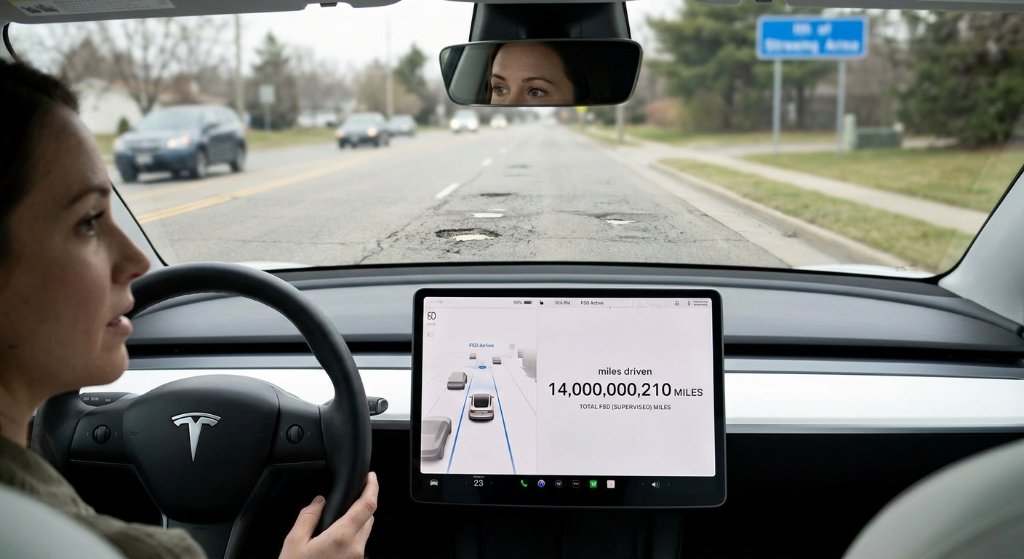
Tesla’s Full Self-Driving (FSD) system has reached an astronomical milestone, officially crossing 14 billion cumulative miles on August 27, 2026. What makes this feat truly jaw-dropping is the blistering velocity of its growth: the fleet racked up its most recent billion miles in a mere 24 days. It is a scaling achievement that no other automaker on Earth can match, driven by aggressive subscription pricing and a rapidly expanding global fleet.
Yet, beneath the triumph of big data, a glaring real-world vulnerability remains. Beta testers and owners continue to report that FSD is routinely foiled by basic road hazards like potholes and debris—flaws that undermine Tesla's quest for true, unsupervised autonomy. While Tesla’s neural networks are learning to navigate complex intersections, they are still struggling with the simple, physical realities of the asphalt below.
Blistering Velocity: The 14-Billion Mile Explosion
The speed of Tesla's data accumulation has compressed dramatically over the last year. What once took years to accumulate is now happening in a matter of weeks. This exponential rise is the direct result of Tesla’s strategic decision to transition to a $99/month FSD subscription model and push wide-scale free trials across North America.
To put the current 14-billion-mile milestone in perspective, consider the trajectory of FSD's cumulative mileage:
- 2021: 6 million miles
- 2024: 2.25 billion miles
- Early 2026: 8 billion miles
- May 2026: 10 billion miles (the milestone Elon Musk originally claimed would unlock "safe unsupervised" driving)
- August 2026: 14 billion miles (adding the last billion in just 24 days)
With a dataset roughly 40 times larger than its nearest rival, Alphabet’s Waymo, Tesla possesses an unrivaled machine-learning moat. But as FSD miles skyrocket, the software is hitting a wall with physical, micro-level navigation challenges.
The Unresolved Achilles' Heel: Potholes and Debris
While FSD v12 and v14 architectures have made massive strides in handling complex urban intersections and smooth highway lane merges, the system remains notoriously blind to road hazards. Teslas operating on FSD regularly fail to slow down or steer around deep potholes, manhole covers, and road debris, risking tire blowouts and suspension damage.
Over the weekend, CEO Elon Musk took to social media to declare that pothole avoidance is "coming soon". However, seasoned Tesla watchers greeted the announcement with skepticism, noting that Musk made that exact same promise back in 2019.
The struggle points to a fundamental technical challenge:
- The Vision-Only Limit: Tesla famously stripped its vehicles of radar and ultrasonic sensors, relying entirely on "Tesla Vision" cameras.
- The Depth Perception Puzzle: Without active depth-sensing hardware like LiDAR or radar, the system must reconstruct a 3D environment entirely from 2D camera feeds. Discerning a dark, flat patch of asphalt from a tire-destroying 3-inch-deep crater is an incredibly complex challenge for computer vision.
- The Cost of Failure: Swerving to avoid a pothole requires highly precise lateral maneuvers that must be balanced against adjacent lane traffic. Currently, FSD's default behavior is to plow straight through, leaving human drivers to aggressively disengage the system to protect their vehicles.
Why This Matters:
Tesla’s 14-billion-mile achievement represents a double-edged sword for the company and the broader EV industry.
- The Scaling Victory: Tesla has successfully built the ultimate data flywheel. By leveraging millions of customer cars as real-world testing probes, Tesla collects edge-case driving data at a scale that Waymo, Cruise, or Zoox can only dream of. From a software-training perspective, Tesla is winning.
- The Autonomous Roadblock: Despite matching and exceeding the "10 billion mile" threshold Musk previously set for unsupervised driving, FSD remains firmly in the "Supervised" category. A robotaxi cannot operate if a simple pothole can disable the vehicle, pop a tire, or damage a wheel. No fleet operator can absorb those operational costs.
- The Pure-Vision Gamble: This persistent issue signals that Tesla's vision-only approach may face a hard boundary. If neural networks cannot reliably identify and respond to micro-geometry on the road, Tesla may be forced to either execute a massive software breakthrough in depth-perception AI or rethink its hardware suite for future Robotaxis.
The Bottom Line
While Tesla's data flywheel is spinning faster than ever, the distance between "supervised" convenience and "unsupervised" reality is measured not in billions of miles, but in small, jagged holes in the pavement. Until Tesla’s physical AI can reliably avoid a simple crater, the FSD dream remains bound by the realities of the open road.