Data Proof: Home EV Charging Slashes Annual Costs by up to $2,000, Defying Depreciation Fears
The narrative surrounding electric vehicles has taken a beating lately. With headlines dominated by high interest rates, dealership inventory build-up...
Editorial Team
World Of EV
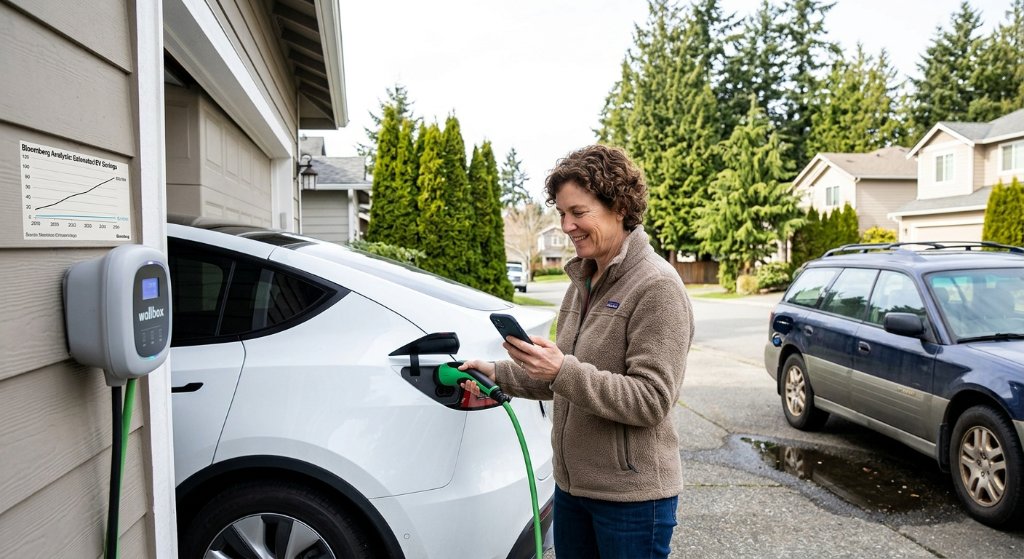
The narrative surrounding electric vehicles has taken a beating lately. With headlines dominated by high interest rates, dealership inventory build-ups, and the high-profile depreciation woes that led rental giants like Hertz to dump their EV fleets, skeptical consumers have increasingly retreated to the perceived safety of hybrids. Yet, focusing solely on the sticker price ignores the quiet financial revolution happening in residential garages across America.
A comprehensive new analysis by Bloomberg reveals a massive operational counterweight to these anxieties: EV owners who charge at home save an average of nearly $1,500 annually compared to those driving gas-powered cars. In states blessed with the right mix of high fuel costs and cheap grid power, those savings cross a threshold that makes the upfront premium of an EV look like a minor speed bump.
The Geography of Savings: Where EVs Win Big
While the national average savings are impressive, the financial argument for going electric becomes undeniable when broken down by region. The Pacific Northwest, in particular, has emerged as the absolute gold standard for EV ownership economics.
- The $2,000 Threshold: In Western states like Washington and Oregon, annual savings soar past the $2,000 mark.
- The Perfect Storm: This hyper-efficiency is driven by a unique economic formula: persistently high gasoline prices at the pump paired with some of the nation’s cheapest electricity, largely generated by abundant regional hydroelectric power.
- The Midwest and South: Even in regions with lower gasoline prices, cheap local utility rates ensure that home-charging EV owners still pocket upwards of $1,000 to $1,200 annually over their combustion-engine neighbors.
Say Goodbye to the Service Bay
Fuel savings are only half of the operational ledger. The Bloomberg review highlights a fundamental truth that legacy automakers are struggling to combat in their marketing: EVs simply do not wear out the way gas cars do.
Because an electric drivetrain contains roughly 20 moving parts compared to the 2,000-plus found in an internal combustion engine (ICE) vehicle, routine lifetime maintenance is drastically reduced. EV owners benefit from:
- Zero Liquid Maintenance: No engine oil, spark plugs, timing belts, or transmission fluid changes are ever required.
- Extended Brake Life: Thanks to regenerative braking—which uses the electric motor to slow the vehicle while recapturing energy—brake pads and rotors frequently last two to three times longer than those on ICE vehicles.
- Fewer Points of Failure: Without complex exhaust systems, catalytic converters, or multi-gear transmissions, the likelihood of catastrophic, out-of-warranty mechanical failures plummeted.
The Upfront Hurdle and the Depreciation Elephant
Despite the clear operational victory, the EV transition still faces two formidable roadblocks: high upfront acquisition costs and steep early depreciation. Currently, the used EV market is undergoing a volatile correction, leaving early adopters with lower-than-expected trade-in values. Furthermore, while vehicles like the Chevrolet Equinox EV and the Tesla Model 3 are pushing MSRPs closer to parity with ICE vehicles, high interest rates have made financing the transition difficult for the average buyer.
Why This Matters:
This data exposes a widening class divide in the automotive market, creating a "two-tier" system of EV ownership. The big winners here are suburban homeowners with private garages. For this demographic, buying an EV is an economic home run; they can plug in overnight at low residential electricity rates and completely bypass the volatility of the oil market.
The losers, conversely, are apartment dwellers and urban renters. Without access to cheap home charging, these drivers are forced to rely on public DC fast-charging networks, where pricing is often marked up to match or even exceed the cost of gasoline.
For automakers, this analysis signals a critical pivot point. The era of selling EVs solely on environmental altruism is over. To break through the current adoption plateau, manufacturers must shift their marketing machines to focus heavily on "wallet share." By subsidizing home charger installations (a tactic already being deployed by Ford and GM) and educating buyers on the compounding lifetime savings of electricity and low maintenance, automakers can finally demystify the total cost of ownership.
Conclusion
While the upfront cost of transitioning to an electric vehicle still requires a calculated leap of faith, Bloomberg’s data proves that the long-term math heavily favors the plug. As battery costs continue their downward trajectory and the used EV market eventually stabilizes, the operational savings of home charging will transition from a suburban luxury to an undeniable, mainstream financial necessity.