Data Speaks: Tesla FSD Proves 40% Safer in First Right-Hand Drive Markets, Forcing Insurers to Take Notice
One year after Tesla took a massive gamble by introducing its Full Self-Driving (Supervised) technology to Australia and New Zealand—marking the world...
Editorial Team
World Of EV
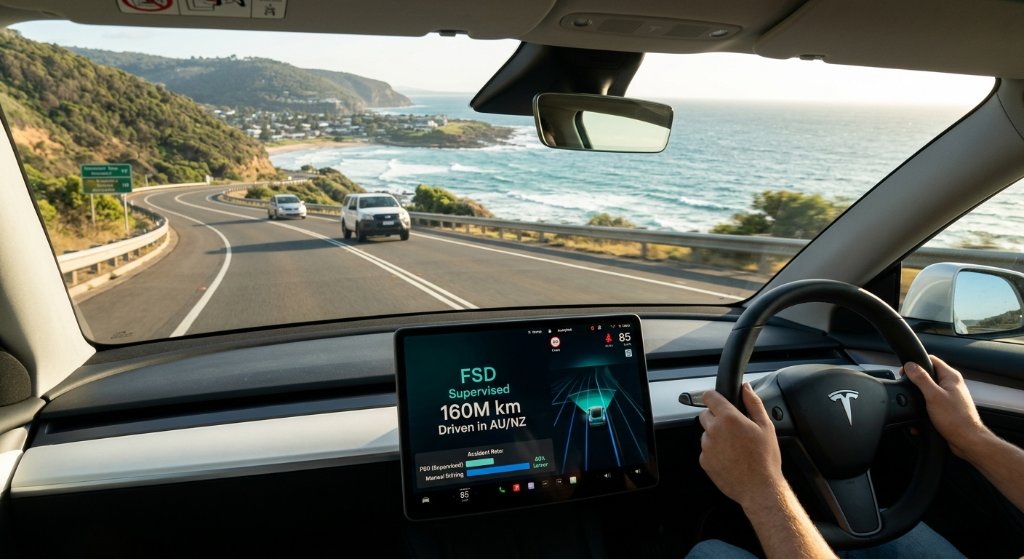
One year after Tesla took a massive gamble by introducing its Full Self-Driving (Supervised) technology to Australia and New Zealand—marking the world’s first right-hand-drive rollout—the hard telemetry is finally in. The results are a stark reality check for autonomy skeptics. Over the course of 160 million kilometers driven with the system active between September 17, 2025, and September 16, 2026, Tesla vehicles operating under FSD (Supervised) recorded a staggering 40% reduction in collision rates compared to manual driving.
This isn’t just a victory lap for Elon Musk’s engineering team; it’s a critical milestone for right-hand-drive localization. When FSD debuted in Oceania in late 2025, many doubted whether a system trained heavily on North American highways could master the complex roundabouts of Canberra or the unique, multi-lane challenges of Auckland. The telemetry released this week provides an emphatic answer, proving that Tesla's neural-net-driven vision approach can translate seamlessly across hemispheres.
The Telemetry Breakdown: FSD vs. Human Instinct
Tesla’s vehicle telemetry compared the 160 million kilometers driven under FSD with 2.4 billion kilometers of manual driving in Tesla vehicles equipped with active safety systems. Rather than relying on a generalized national average, Tesla used its own vehicle fleet with active safety features switched on as the baseline—a demographic that already represents a safer-than-average driving standard. Across every major safety metric, the software demonstrated superior risk aversion and smoother dynamics:
- Collision Rates: One collision (major or minor) per 1.78 million kilometers with FSD engaged, compared to one collision per 1.07 million kilometers driven manually—a clean 40% reduction.
- Automatic Emergency Braking (AEB): AEB activations dropped by 66%, firing once every 17,432 km on FSD versus once every 5,989 km manually.
- Harsh Braking & Swerving: Harsh braking events plummeted by 90% (one per 1,823 km on FSD vs. 180 km manually), while harsh lateral acceleration (sudden swerving) dropped by 76%.
- Traffic Harmony: FSD-driven Teslas saw an 80% reduction in horn honking, signaling a much smoother, calmer flow of traffic compared to human-driven counterparts.
The HW4 Edge and the Subscription Paradigm Shift
This 160-million-kilometer data set comes from a very specific subset of Tesla's Oceania fleet. FSD (Supervised) in Australia and New Zealand is currently restricted to Hardware 4 (HW4/AI4) vehicles, such as newer Model 3 and Model Y variants. Legacy Hardware 3 owners have been left waiting for a promised "v14 Lite" software branch tailored for their older processing chips, highlighting a growing technological divide in the Tesla ecosystem.
To drive adoption and collect this massive pool of data, Tesla completely restructured the financial barrier to entry on April 1, 2026. The company eliminated the lifetime upfront purchase price of $10,100 AUD/NZD in Oceania, migrating the entire regional user base to a $159/month subscription model. This lowered the immediate cost of entry, enabling more drivers to sample the tech and rapidly scaling the telemetry pipeline.
From Tech to Dollars: The Insurance Industry Reacts
The ultimate validator of safety data isn't a car manufacturer—it’s an underwriter. Just days before this safety release, Zurich Australian Insurance took the unprecedented step of integrating FSD (Supervised) usage as a direct risk-rating factor. Under their updated InsureMyTesla policy, FSD users now receive discounted premiums because of their lower accident frequency. It represents the first time a mainstream insurer in a right-hand-drive market has officially priced active autonomous software usage as a net safety benefit, putting real money back into the pockets of EV owners.
Why This Matters:
- The Big Winners: Tesla and Early Adopters. Tesla gains indisputable, real-world data to present to regulators globally (especially in highly-regulated regions like Europe and China) to prove that supervised autonomy makes roads safer. Meanwhile, early adopters win both in on-road safety and immediate financial returns, thanks to insurers like Zurich slashing premium costs.
- The Losers: Legacy Automakers and Skeptics. Legacy OEMs who rely on fragmented, third-party ADAS hardware are falling years behind. While Tesla updates its localized neural nets over-the-air, traditional brands are struggling to scale basic lane-keeping features globally, let alone navigate complex urban right-hand-drive environments.
- The Market Signal: This is a watershed moment for active safety. By demonstrating that FSD drives significantly "smoother" (evidenced by drastic drops in harsh braking, swerving, and aggressive honking), Tesla is reframing autonomous driving. It's no longer just about convenience or luxury; it's about preventative, defensive driving that outperforms human reflexes in high-stress scenarios. It establishes a template that will force the entire automotive industry to shift from passive safety ratings to active, telemetry-backed autonomous safety metrics.
As Tesla prepares to deploy its long-awaited Hardware 3 localized update, the initial HW4 telemetry from Oceania acts as a powerful proof of concept for global expansion. While localized edge cases like Melbourne’s hook turns and school zones still present software hurdles, a 40% reduction in crash frequency over 160 million kilometers is a metric that neither regulators nor competitors can afford to ignore. Tesla’s vision-only autonomy is no longer just a promise—in Australia and New Zealand, it is a proven statistical reality.