Death of the Assembly Line: Tesla's Unboxed Cybercab Production Shatters Manufacturing Rules With a 5x Speed Leap
For over a century, the global automotive industry has bowed to the gospel of Henry Ford: a single, sequential conveyor belt where a bare metal chassi...
Editorial Team
World Of EV
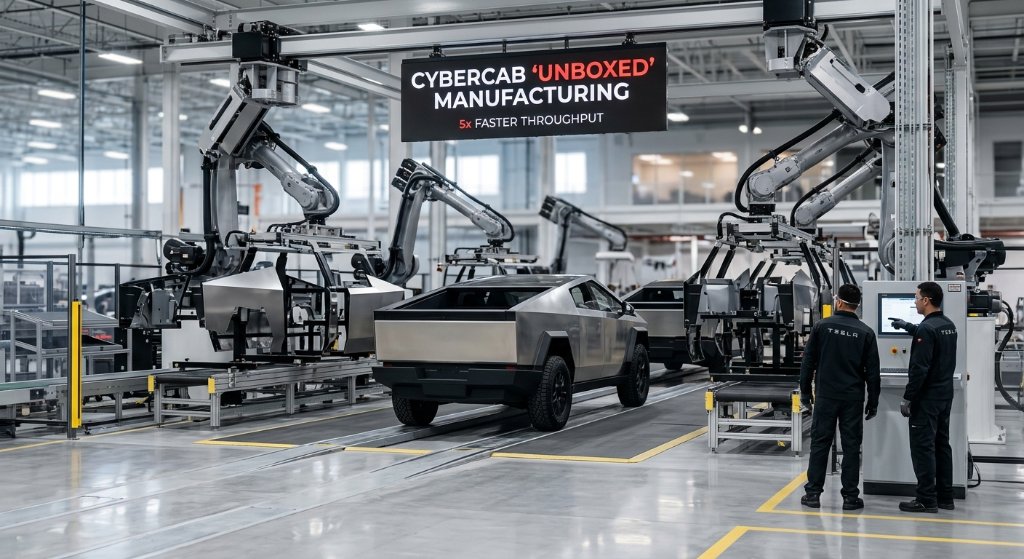
For over a century, the global automotive industry has bowed to the gospel of Henry Ford: a single, sequential conveyor belt where a bare metal chassis slowly winds through welding, painting, and final assembly. But Tesla is officially tearing up the rulebook. CEO Elon Musk has announced that Tesla has successfully redesigned the manufacturing pipeline for the newly launched Cybercab, utilizing an 'unboxed' assembly process that runs more than five times faster than traditional automotive production.
This is not just a minor iteration of Tesla's existing manufacturing methods—it is a philosophical rebirth. Having famously survived the 'production hell' of the Model 3 in 2017—where Musk slept on the factory floor trying to force automation into an outdated linear system—Tesla has spent years quietly re-engineering how a car is put together. The result is an aerospace-inspired, modular assembly method that represents the biggest structural shift in manufacturing since the Model T.
Breaking the Linear Mold: What is the 'Unboxed' Process?
Unlike a traditional production line where workers and robots cram parts into a hollowed-out car shell, Tesla's unboxed method breaks the Cybercab down into six distinct modules built in parallel. These modules—which include the front and rear castings, side assemblies, and a structural battery pack that doubles as the cabin floor with seats and interior trim pre-installed—are completed simultaneously. Only in the absolute final step are these modules merged and framed together.
Key features and specs of this revolutionary production pipeline include:
- Parallel Assembly: Six sub-assemblies are constructed independently in dedicated micro-bays, maximizing robot efficiency and minimizing human bottlenecks.
- 5x Faster Cycle Times: At full scale, the unboxed process targets a production cycle time of under 10 seconds per vehicle—a staggering leap compared to the 30-to-60-second industry average, and far quicker than the 34 seconds required for a Tesla Model Y.
- 50% Floor Space Reduction: Because modules are built separately and only joined at the end, the physical footprint of the assembly line is cut in half, freeing up massive amounts of factory floor space.
- No Traditional Paint Shop: A major bottleneck in car manufacturing is eliminated, as body panels are injected-molded with color directly, bypassing the capital-intensive and slow painting process.
Streamlining for the Autonomous Era
The Cybercab itself was built from the ground up for this radical production method. Unveiled as a purpose-built two-seater robotaxi without steering wheels, pedals, or side mirrors, it is the ultimate realization of Musk's 'first principles' engineering approach: eliminate unnecessary parts to slash costs and complexity. Operating with 60% fewer parts than a Model Y, the Cybercab is designed to achieve a target operating cost below $0.30 per mile, and a commercial purchase price around $25,000. By optimizing both the vehicle's physical design and its manufacturing pipeline simultaneously, Tesla is preparing to scale its autonomous fleet in record time.
Why This Matters:
This is a defining 'do-or-die' moment for the global automotive sector, shifting the landscape from traditional car building to consumer electronics-scale modular production.
- The Winners: Tesla and fleet operators. By cutting factory footprint in half and slashing production costs, Tesla can scale output with dramatically lower capital expenditure. A sub-$25,000 autonomous vehicle produced at lightning speed gives Tesla the ultimate economic weapon to aggressively expand its robotaxi operations across cities like Austin, Dallas, and Las Vegas.
- The Losers: Legacy automakers and ride-hailing incumbents like Uber and Lyft. Legacy OEMs are currently trapped in multi-billion-dollar, highly rigid assembly plants. They cannot easily transition to 'unboxed' manufacturing without demolishing existing factories. Meanwhile, ride-hailing services relying on human drivers will struggle to compete with a fleet of autonomous, low-overhead Cybercabs that cost less than a third of a typical Uber ride per mile. Waymo, too, faces pressure; while its technology is mature, retrofitting $80,000 Jaguar I-Pace EVs with expensive lidar suites cannot compete with a purpose-built, mass-produced $25,000 robotaxi.
- The Market Signal: Tesla is proving that the key to winning the EV and autonomy race is not just better software or larger batteries, but the 'machine that builds the machine.' Those who cannot reinvent their manufacturing floor will simply be priced out.
Conclusion
With the Cybercab now hitting public streets in Austin and the unboxed manufacturing process officially operational, Tesla is poised to redefine the limits of industrial scaling. While regulatory hurdles and full self-driving safety validation remain the final bottlenecks to nationwide autonomy, the manufacturing foundation is set. By breaking a century-old assembly line model, Tesla has secured a production advantage that competitors will likely spend the next decade trying to replicate.