Defensive Charging: Why a Kia EV9’s 50-Mile Detour Exposes the Mountain West’s Fragile EV Infrastructure
Road-tripping across America in a state-of-the-art electric vehicle should, in theory, be a showcase of modern engineering. The Kia EV9 is a prime exa...
Editorial Team
World Of EV
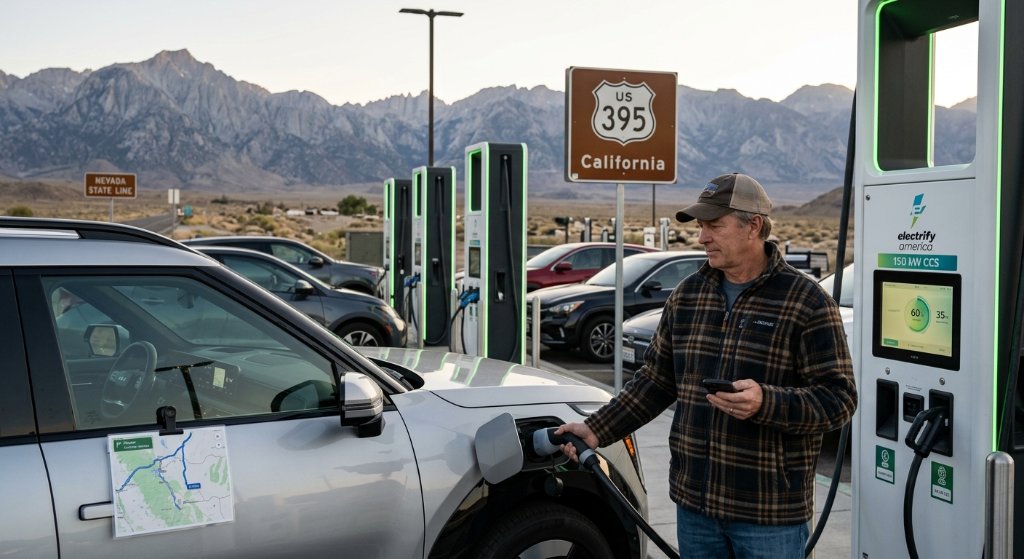
Road-tripping across America in a state-of-the-art electric vehicle should, in theory, be a showcase of modern engineering. The Kia EV9 is a prime example: a critically acclaimed, three-row family SUV built on Hyundai Motor Group’s cutting-edge 800-volt E-GMP platform. It is capable of pulling up to 235 kW and charging from 10% to 80% in a mere 24 minutes—specs designed to rival luxury heavyweights and Tesla's best. Yet, when EV enthusiast Scott Allison and his husband embarked on a six-day, long-distance road trip across Nevada in July 2026, their journey wasn't defined by the EV9’s fast-charging prowess. Instead, it was defined by "defensive charging"—the active routing workarounds required to survive the gaping holes in the Mountain West's charging grid.
To bypass the notoriously unreliable rural charging infrastructure along Nevada's direct north-south route on Highway 95, Allison was forced to reroute his vehicle through California's Highway 395, adding nearly 50 miles to his trip. His journey, which spanned Death Valley, Lake Tahoe, and Reno, serves as a stark warning. Even as legacy carmakers successfully manufacture highly capable, long-range EVs that can handle demanding climates, the physical charging grid in rural America remains so fragile that a single broken plug can completely derail a trip.
The Single Point of Failure: Fallon's Frozen Charger
The most glaring vulnerability of rural EV travel is the absolute lack of redundancy. In metro areas, if an Electrify America or EVgo charger is broken, drivers simply roll to the next block. In rural Nevada, a single offline charger is a trip-ending bottleneck. This became painfully clear during Allison's journey when he attempted to charge in Fallon, Nevada. The city—a vital gateway for drivers traversing the state—possesses only one fast charger. When Allison arrived, it was completely out of service.
By anticipating this "single point of failure," Allison bypassed Highway 95 entirely during key segments of his trip. He opted instead for California’s Highway 395. While the detour added almost 50 extra miles of driving, California's denser, more established charging network offered the peace of mind of backup stations. In Nevada, had the single Fallon charger been his only hope, the trip would have been severely compromised.
The Reality of Rural EV Routing
For prospective EV buyers, Allison's workaround illustrates that "range anxiety" has evolved into "infrastructure anxiety". The EV9 performed flawlessly, but the trip required the driver to behave more like a logistics manager than a casual vacationer. Key takeaways from this real-world test of the Mountain West's network include:
- The Dual-Class Driver Divide: Allison noted that EV drivers are increasingly split into two camps: "the people who are in the know" who aggressively research, crowdsource, and plan, and mainstream buyers who expect to "just jump in the car and go," only to face potential disaster in rural zones.
- The Slower-Than-Expected NEVI Rollout: Despite federal funding under the National Electric Vehicle Infrastructure (NEVI) formula program aimed at establishing reliable corridors, actual physical deployment of high-speed chargers in rural states has been sluggish.
- 800-Volt Bottleneck: The EV9's advanced charging architecture, while revolutionary, is ultimately bottlenecked by a rural network dominated by slower, neglected, or completely absent hardware.
Why This Matters:
This is a defining "do-or-die" moment for the mainstream adoption of electric vehicles. It highlights a massive industry mismatch: automakers have built the vehicles of the future, but state departments of transportation and network operators are lagging far behind.
- Who Wins? Tesla and third-party navigation apps like PlugShare and A Better Routeplanner (ABRP). Tesla’s Supercharger network continues to be the industry gold standard for uptime and redundancy. Meanwhile, crowdsourced apps are no longer optional tools; they are survival equipment for EV drivers venturing outside major metro areas.
- Who Loses? Rural tourism and state DOTs that are slow to deploy infrastructure. As long as key highway corridors are plagued by single points of failure, savvy EV drivers will actively detour around these areas. This means rural communities lose out on valuable tourism and dining dollars while drivers spend their money in states like California that have prioritized infrastructure resilience.
- The Market Signal: For EV adoption to successfully cross the chasm from early adopters to the mass market, rural states cannot afford single points of failure. Until NEVI-funded stations are deployed in multi-stall configurations with strict uptime requirements, road-tripping through the American West will remain a stressful logistics puzzle rather than a seamless family vacation.
Conclusion
Ultimately, Scott Allison’s Nevada road trip demonstrates that while the Kia EV9 is more than capable of handling grueling desert heat and long-distance travel, the infrastructure supporting it is not. EV drivers shouldn't have to plan 50-mile detours into neighboring states just to guarantee a reliable charge. Until rural charging networks offer the redundancy and uptime of traditional gas stations, long-distance EV travel in the Mountain West will remain a challenge reserved for dedicated enthusiasts rather than a seamless experience for the everyday driver.