Delightful Drive, Charging Disaster: A 1,900-Mile Road Trip Exposes America's Fractured EV Infrastructure
Think long-distance highway cruising is ready for prime-time EV adoption? Think again. A recent 1,900-mile road trip by Axios mobility correspondent J...
Editorial Team
World Of EV
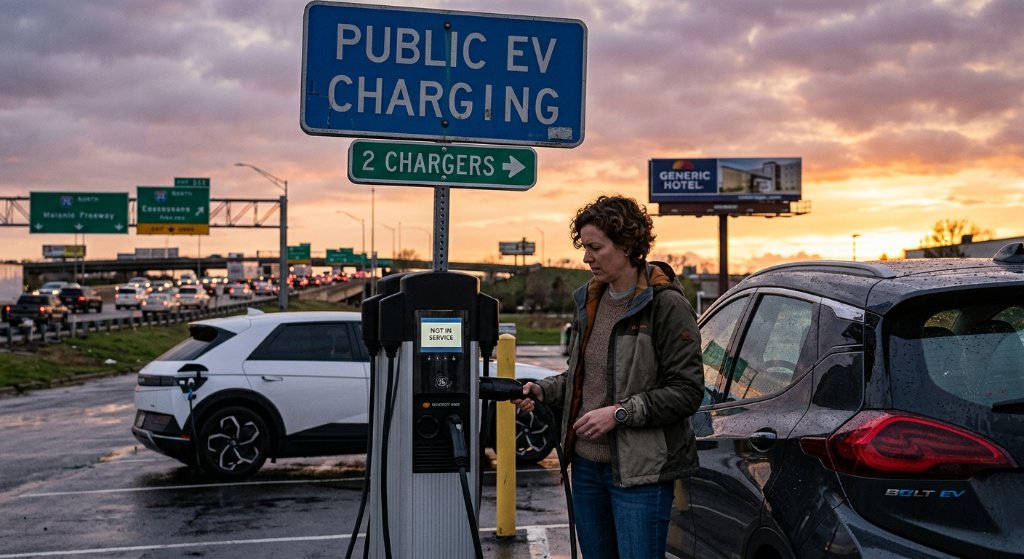
Think long-distance highway cruising is ready for prime-time EV adoption? Think again. A recent 1,900-mile road trip by Axios mobility correspondent Joann Muller has delivered a sobering reality check to the automotive world. While Muller reported that the actual dynamics of driving an electric vehicle over long stretches are absolutely delightful, she confirmed what millions of prospective buyers still fear: the public fast-charging experience is a fragmented, frustrating mess that remains light-years behind the simple convenience of pumping gasoline.
This tension comes at a critical juncture for the North American EV transition. Just as legacy automakers navigate fluctuating consumer demand and political headwinds, this real-world test underscores that "charging anxiety"—not range anxiety—remains the single greatest bottleneck to mainstream EV adoption. While vehicles themselves have evolved with larger batteries and faster charging curves, the ground-level infrastructure is still struggling to provide a basic, reliable, and comfortable user experience.
The Anatomy of a Fragmented Network
Muller’s extensive trek highlighted the glaring gap between the promise of fast charging and the daily reality on the highway. Despite the proliferation of high-voltage chargers fueled by the federal government's $5 billion National Electric Vehicle Infrastructure (NEVI) formula program, the physical and digital friction of charging on the go is still exhausting.
Key pain points from the road trip include:
- The Lack of Shelter: Of all the DC fast-charging stations encountered over 1,900 miles, only a single location—a Love's Travel Stop in Ripley, New York—featured a protective overhead canopy. The rest left drivers and expensive equipment completely exposed to rain, snow, and extreme heat.
- Payment and App Fragmentation: Unlike the universal "dip-and-go" credit card standard of gas stations, EV drivers are still forced to juggle multiple proprietary apps, accounts, and finicky RFID readers.
- Unpredictable Charging Curves: Even when chargers are functioning, actual charging speeds frequently fluctuate due to grid demand, thermal throttling, or broken hardware, stretching a planned 15-minute top-off into a sluggish 40-minute ordeal.
A Glimmer of Hope: The Next-Gen Networks
It isn't all doom and gloom. The stark contrast to legacy third-party charging networks is the rapid rollout of automaker-backed joint ventures like Ionna. Backed by eight automotive heavyweights—including BMW, GM, Honda, Hyundai, Kia, Mercedes-Benz, Stellantis, and Toyota—Ionna is fast-tracking a nationwide network designed specifically to address these exact grievances. Muller’s own experience at a newly opened Ionna "Rechargery" station was described as "a breeze," pointing to what the future could look like if automakers successfully wrest control of the customer experience from legacy networks like Electrify America.
Key details of the Ionna expansion include:
- Massive Scale: The joint venture is on track to deploy 30,000 high-speed, 400 kW charging bays across North America by 2030.
- Customer-First Design: Ionna stations are designed with protective canopies, on-site security, food amenities, lounges, and bathrooms, mimicking the best parts of traditional highway travel plazas.
- Universal Access: To accommodate the industry's massive transition, stations are deploying with both CCS and Tesla-style NACS connectors.
Why This Matters:
The implications of this infrastructural divide are massive. The clear winners in this scenario are companies like Tesla, whose integrated and robust Supercharger network continues to be the gold standard, and proactive joint ventures like Ionna that understand charging is a hospitality business, not just a utility. The clear losers are legacy third-party charging providers who refuse to upgrade their reliability, and legacy automakers who fail to secure seamless charging access for their buyers.
This is a do-or-die moment for the non-Tesla EV market. If mainstream buyers feel that buying an EV means sacrificing the basic dignity and convenience of road-tripping, they will simply stick to hybrids or internal combustion engines. Ionna's rapid scaling isn't just a corporate side project—it is a mandatory defensive maneuver to save the EV market from flatlining.
Conclusion
Ultimately, the transition to electric mobility will not be won on battery chemistry or horsepower specs alone; it will be won at the pavement. Until pulling up to a DC fast charger is as boring, predictable, and weather-sheltered as pulling up to a Mobil or Shell pump, the mass market will remain on the sidelines. The vehicles are ready, but the grid and the stations have a long way to go to prove they are, too.