Ditch the 80% Rule: How a Ford F-150 Lightning Owner Saved 90 Minutes by Defeating the 'Standard' Charging Myth
For years, electric vehicle rookies and veterans alike have treated the "charge to 80%" guideline as gospel. Plug into a DC fast charger, wait for the...
Editorial Team
World Of EV
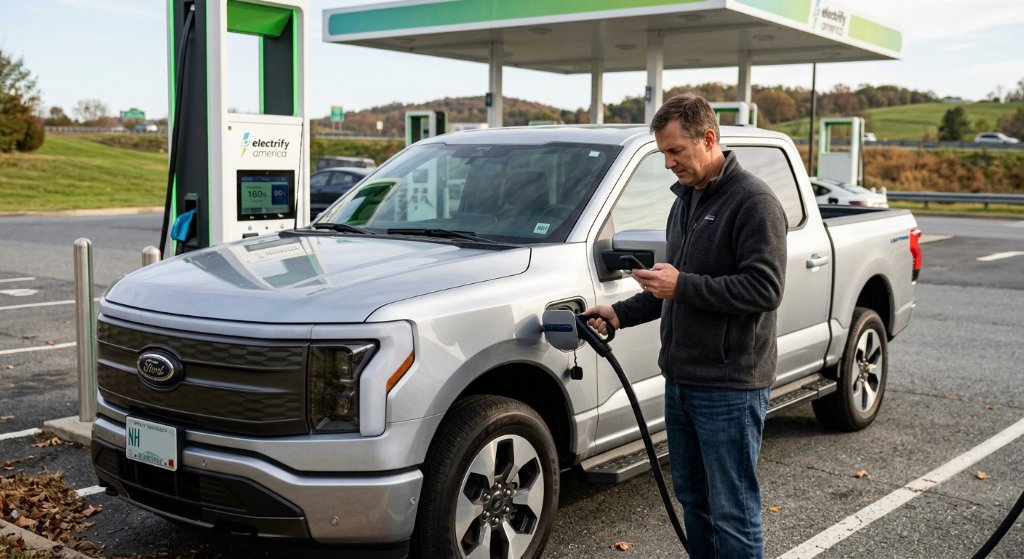
For years, electric vehicle rookies and veterans alike have treated the "charge to 80%" guideline as gospel. Plug into a DC fast charger, wait for the battery to hit that magic 80% threshold, unplug, and repeat. But as EV adoption matures, seasoned drivers are discovering that blindly adhering to this rule is actually costing them hours of travel time. A Ford F-150 Lightning owner recently proved this on an 1,828-mile road trip from New Hampshire to North Carolina, shaving a massive 90 minutes off their return leg simply by ignoring the 80% rule and "riding the charging curve."
This real-world experiment highlights a fundamental shift in EV road-tripping strategy. Traditionally, legacy automakers like Ford have focused on stuffing massive batteries into heavy vehicles—such as the Lightning’s heavy-duty 131-kWh Extended Range pack—to combat range anxiety. However, because these massive packs rely on 400-volt architectures rather than the faster 800-volt systems found in rivals like Hyundai, Kia, and Porsche, they suffer from dramatic charging-speed slowdowns as the battery fills. Understanding how to manage this slowdown is the ultimate efficiency hack for modern EV travel.
The Math Behind the 90-Minute Shave
On the return leg of their nearly 2,000-mile journey, the Lightning owner decided to try a different strategy. Instead of waiting at DC fast-charging stations until the vehicle reached an 80% State of Charge (SoC), they monitored the actual charging speed in real time. The moment the truck’s charging speed began to plunge, they unplugged, navigated to the next station, and repeated the process.
The results speak for themselves:
- Total Trip Distance: 1,828 miles (round trip between NH and NC)
- Average Efficiency: A highly respectable 2.2 mi/kWh (excellent for a heavy, aerodynamically challenged pickup truck)
- Time Saved: 90 minutes on the return leg compared to the outbound trip
- The Charging Strategy: Unplugging as soon as the charge rate began to taper, keeping the truck in its "sweet spot" of maximum intake speed at lower states of charge.
Why the '80% Rule' is an EV Road-Trip Trap
To understand why this strategy works, you have to look at the physics of a charging curve. Think of an EV battery like a crowded theater: when it's empty, it's easy for people (electrons) to find seats quickly. As the theater fills up, it takes longer for the remaining people to find open seats, slowing down the entire process.
For the Ford F-150 Lightning, its battery management software is programmed to throttle incoming power to protect battery health and prevent overheating. While the truck can briefly peak at around 150 kW to 180 kW under ideal conditions, that rate starts to drop progressively as the battery fills up. It often falls below 100 kW past 60% SoC, and drops to a crawl after 80%. By staying plugged in to reach 80%, drivers spend a disproportionate amount of time absorbing slow, low-power energy. By "curve hopping"—pulling into chargers at 10% and unplugging at 55% or 60%—the driver spent their time only at peak charging speeds, making more frequent but significantly shorter stops.
Why This Matters:
- The Death of the 'One-Size-Fits-All' EV Rule: The legacy 80% charging rule is officially obsolete for long-distance travel on 400-volt platforms. To optimize travel times, drivers must understand their specific vehicle's charging curve.
- The Winner: Driver Education and Sophisticated Software: The big winners of this paradigm shift are software developers and navigation tools. Platforms like A Better Routeplanner (ABRP) and Ford's integrated BlueOval navigation must get better at automating this "curve-hopping" strategy for average buyers who don't want to do mental math on the fly.
- A Relief for Charging Infrastructure: If drivers stop clogging fast chargers past 60% or 70% SoC (where they draw very little power), charger throughput will skyrocket. This shift in behavior could drastically reduce queue times at busy charging plazas, helping to ease nationwide infrastructure strain.
- Pressure on Legacy Automakers: While 800-volt EVs (like the Hyundai Ioniq 5 or Kia EV9) can charge from 10% to 80% in under 18 minutes, 400-volt legacy conversions like the F-150 Lightning are inherently slower. Automakers still building on 400-volt systems must optimize their software and preconditioning curves to ensure their vehicles remain competitive on long trips.
Ultimately, this F-150 Lightning road trip serves as a wake-up call for the entire EV ecosystem. Having a massive battery pack is no longer the ultimate metric for road-trip success. Instead, the future of EV travel belongs to drivers who charge smarter, not longer, and vehicles that can sustain high charging speeds for as long as possible.