Ditching the Petrol Pump Mindset: Why Mastering the '80% Rule' is Now Mandatory for New EV Owners
As global electric vehicle (EV) sales reach record heights—with entry-level models finally breaking the sub-$40,000 price barrier—millions of traditio...
Editorial Team
World Of EV
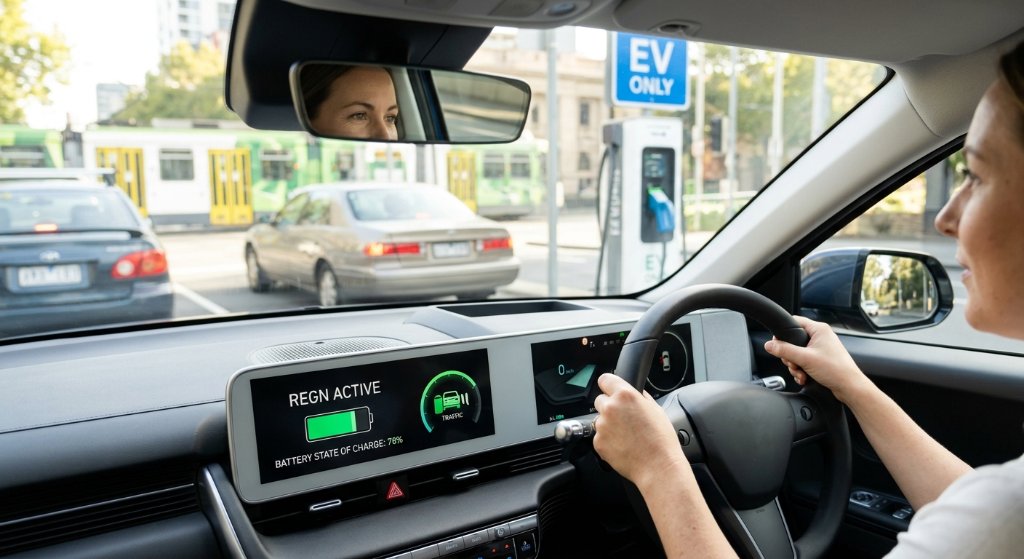
As global electric vehicle (EV) sales reach record heights—with entry-level models finally breaking the sub-$40,000 price barrier—millions of traditional combustion-engine drivers are transitioning to electric mobility. However, making the switch isn’t just about replacing a tailpipe with a plug; it demands a fundamental shift in how drivers think about fueling, efficiency, and vehicle maintenance.
According to a recent guide by acclaimed journalist and author Royce Kurmelovs, first-time EV buyers must shed their old habits to truly unlock the benefits of their new machines. From rethinking battery health to exploiting the unexpected advantages of gridlock, the transition to an EV requires mastering a completely new set of operational rules.
Demystifying the '80% Rule': Battery Longevity Meets Public Etiquette
Unlike legacy internal combustion engine (ICE) vehicles that drivers run until the fuel light flashes, electric vehicles operate best when managed within a precise "sweet spot". This is known as the 80% rule—the practice of keeping the battery state of charge (SoC) between 30% and 80% for daily use.
- Preventing Degradation: Lithium-ion batteries undergo severe chemical and thermal stress when pushed to extreme states of charge (0-20% and 80-100%). Operating within the 30% to 80% window preserves the microscopic structure of the battery anodes, ensuring the pack maintains its capacity over a decade or more.
- Chemistry Matters: It is critical to note that battery chemistry dictates this rule. While Nickel Manganese Cobalt (NMC) batteries—favored by many legacy brands—suffer under a constant 100% charge, Lithium Iron Phosphate (LFP) batteries (such as those used in standard-range Tesla Model 3s or BYD vehicles) are highly resilient and actually require a 100% charge once a week to calibrate their cell management software.
- Charging Etiquette: On public DC fast-charging networks, an EV's charging speed drops off a cliff after reaching 80% to protect the pack from overheating. Staying plugged in to claw back that last 20% can take as long as the initial 10% to 80% sprint. In a congested network, hogging a charger for a slow trickle is the ultimate EV faux pas.
Flipping the Efficiency Equation via Regenerative Braking
In a traditional petrol-powered vehicle, highway cruising is the gold standard for fuel efficiency, while stop-and-go city traffic is a fuel-guzzling nightmare. EVs invert this formula entirely.
- Kinetic Capture: EVs utilize regenerative braking, a system that reverses the electric motor to slow the vehicle down, converting kinetic energy back into electricity and feeding it directly into the battery.
- One-Pedal Mastery: By adjusting the regenerative braking to its highest setting, drivers can navigate heavy traffic almost entirely with one pedal, lifting off the accelerator to bring the car to a smooth stop.
- Drastic Cost Reductions: Because the motor does the heavy lifting to slow the car down, mechanical brake pads and rotors experience almost zero wear. This dramatically slashes long-term service and maintenance costs compared to ICE equivalents.
Why This Matters:
The transition to electric mobility is as much a psychological evolution as it is a technological one. For the EV transition to scale successfully worldwide, the mass market must move away from "gas station logic."
- The Winners: Public charging network operators and conscientious drivers. When owners embrace the 80% limit at public chargers, station throughput increases, reducing queue times and maximizing infrastructure profitability.
- The Losers: Legacy dealership service centers. Dealerships have historically relied on scheduled maintenance—specifically brake replacements—to maintain profitability. Regenerative braking decimates these revenue streams, forcing a complete restructure of the dealership business model.
- The Manufacturer Imperative: Automakers cannot afford to ignore customer education. Brands like Tesla and BYD have won by baking battery-saving features directly into their software (pre-conditioning the battery before charging and capping charges at 80% by default). Legacy automakers who fail to build intuitive software to guide first-time buyers risk a wave of premature battery degradation claims and frustrated, vocal customers.
Ultimately, joining the electric revolution means saying goodbye to the "empty-to-full" mentality of the gas station. By embracing active battery stewardship and adapting to the nuances of regenerative braking, drivers can protect their investments and ensure the public charging grid remains functional for everyone.