Don't Rush the Level 2 Upgrade: Why First-Time EV Buyers Can—and Should—Start with Standard Outlets
For years, the conventional wisdom surrounding electric vehicle ownership has dictated a stressful, expensive prerequisite: before you even drive your...
Editorial Team
World Of EV
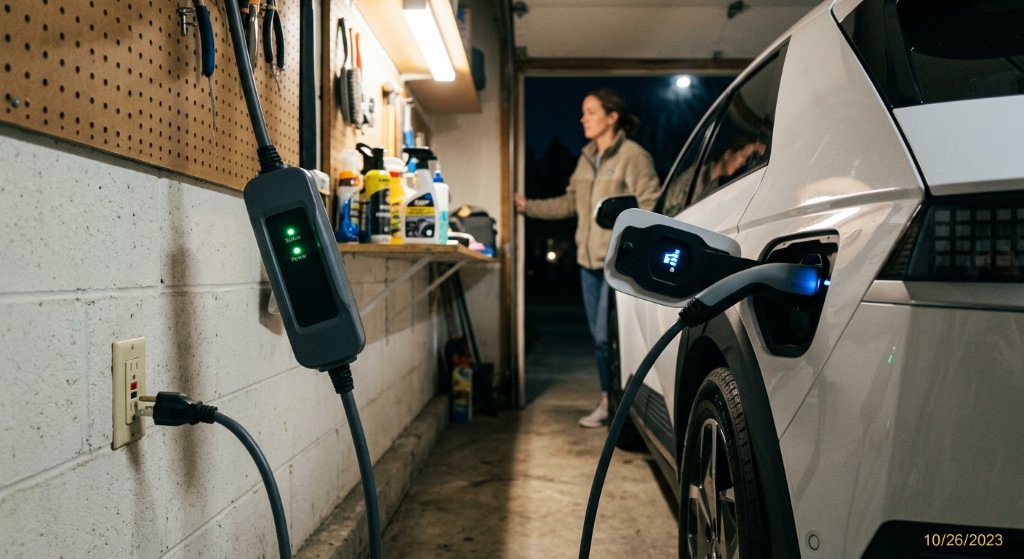
For years, the conventional wisdom surrounding electric vehicle ownership has dictated a stressful, expensive prerequisite: before you even drive your new EV off the lot, you must spend thousands of dollars upgrading your home's electrical panel to support a high-powered Level 2 charger. This perceived barrier to entry has sidelined countless prospective buyers who are hesitant to deal with permits, stubborn electricians, and hefty upfront costs.
Now, Hyundai is actively dismantling this gatekeeping narrative. Leveraging its position as a dominant force in the mainstream EV market—fueled by highly competitive offerings like the Kona Electric and the ultra-fast-charging Ioniq 5—the automaker's retail network is changing the conversation. A new EV home-charging advisory published by Advantage Hyundai highlights direct feedback from first-time owners who successfully bypassed the Level 2 rush entirely, utilizing pre-existing, standard Level 1 (120V) household outlets to comfortably power their daily commutes.
The Myth of the Mandatory Wallbox
The anxiety of waking up to an empty battery leads many buyers to believe that a 240V Level 2 charging station is a day-one necessity. However, real-world data reveals a massive disconnect between perceived charging needs and actual driving habits. By relying on standard three-prong outlets already present in almost every garage, new owners are discovering they can easily maintain their vehicles without any electrical upgrades.
- The Level 1 Reality: A standard 120V household outlet typically delivers 3 to 5 miles of range per hour of charging.
- The Average Commute: With the average American daily commute hovering around 30 to 40 miles, a simple 10-hour overnight charge on Level 1 recovers 30 to 50 miles of range—fully offsetting the day's driving.
- The Financial Buffer: Delaying a Level 2 installation saves buyers an immediate out-of-pocket expense that can range from $500 for a basic charger to upwards of $2,000 if a home's electrical panel requires a heavy-up upgrade to 200 amps.
Testing the Waters Before You Spend
The core advice from Hyundai's real-world owner panel is simple: live with the car first. By using a standard outlet during the initial months of ownership, drivers can accurately assess their actual weekly mileage, peak utility rate windows, and true charging needs.
Many drivers find that their weekly routine includes built-in opportunities for fast charging—such as at grocery stores, workplaces, or local malls—making a dedicated home Level 2 charging station redundant. If a buyer eventually decides they do need faster home charging, they can make that investment armed with real-world data rather than fear-based assumptions.
Why This Matters:
This advisory represents a critical shift in how legacy automakers approach EV education. For too long, the industry has allowed "charging anxiety" to be framed solely around public infrastructure, ignoring the friction of home-charging setup.
By validating Level 1 charging, Hyundai is lowering the cognitive and financial barriers to EV adoption.
- The Winners: Prospective buyers, particularly those renting homes or living in older houses with limited electrical capacity, who now have a green light to buy an EV without immediate infrastructure worries.
- The Losers: Aggressive third-party home charger installers who rely on high-pressure dealership partnerships to upsell expensive equipment at the point of vehicle sale.
- The Market Signal: This move highlights a maturing EV market where practical usability is triumphing over spec-sheet panic. It signals to hesitant buyers that transitioning to electric does not require a complete lifestyle overhaul.
Ultimately, standardizing the "start slow" approach could unlock a massive segment of pragmatic buyers who were previously intimidated by the logistics of home charging. As Hyundai continues to push the boundaries of EV architecture, proving that daily driving can be sustained by the humblest of outlets is perhaps its most practical innovation yet.