Don't Underestimate the Wall Outlet: How a Rivian R1S Owner Proved Level 1 Charging Is the Ultimate Overnight Life Hack
For years, electric vehicle road trips have been synonymous with meticulous route planning, high-speed DC fast-charging hubs, and the constant search ...
Editorial Team
World Of EV
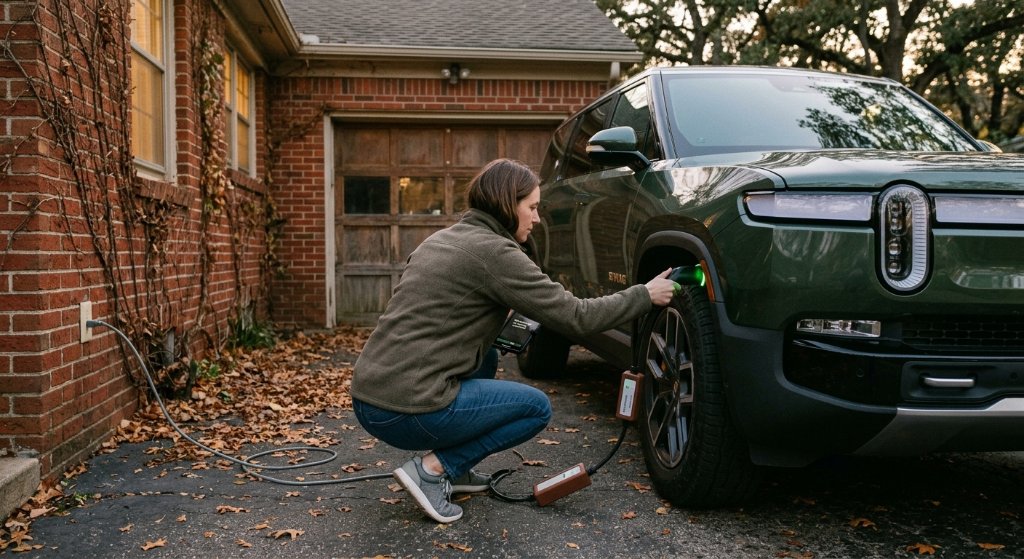
For years, electric vehicle road trips have been synonymous with meticulous route planning, high-speed DC fast-charging hubs, and the constant search for destination Level 2 chargers. But a recent real-world experience from a Rivian R1S owner has turned the traditional road-trip playbook on its head. By plugging into a standard 120V household wall outlet overnight, the owner demonstrated that "trickle charging" is not only a viable backup plan but a highly economical and practical life hack for overnight stays.
Historically, Level 1 charging (using a standard home outlet) has been the black sheep of the EV world. The conventional wisdom—especially for massive, energy-hungry electric SUVs like the Rivian R1S—is that trickle charging is akin to trying to fill a swimming pool with a garden hose. With battery packs ranging from 106 kWh to a massive 149 kWh, critics have long dismissed 120V charging as a waste of time. However, this real-world test proves that when your vehicle is parked for the night, every single watt counts.
The 12-Hour Trickle: Breaking Down the Numbers
While staying at a destination without dedicated EV infrastructure, the R1S owner plugged their vehicle into a standard outdoor 120V household outlet. The results after 12 hours of uninterrupted charging were surprisingly robust:
- Vehicle: Rivian R1S (Three-row adventure SUV)
- Power Source: Standard 120V household wall outlet (Level 1)
- Charging Duration: 12 hours (overnight)
- Range Added: 39 miles
- Battery Capacity Gained: 12%
- Total Cost: Under $2.00 (based on average U.S. residential electricity rates)
An added 39 miles might not sound like a game-changer on paper, but in the context of a road trip, it represents a crucial buffer. In many rural or mountainous destination areas, 39 miles is the difference between easily reaching the next high-speed DC fast charger or having to take an inconvenient, range-depleting detour to find one.
Overcoming the "Large Battery" Myth
The math behind this charging session is highly revealing. Gaining 12% capacity on a Rivian—which likely equates to roughly 13 to 16 kWh of energy depending on the battery pack option—means the R1S onboard charger was pulling close to its maximum continuous limit of 1.4 kW from the 120V circuit.
This level of efficiency is a major win for Rivian. Historically, larger EVs suffer from notable charging losses at lower voltages because the vehicle's internal computers and cooling loops must remain powered up during the charge cycle, consuming a higher percentage of the incoming trickle. The fact that the R1S managed to convert almost all of the wall power into usable range shows that modern EV thermal management and onboard chargers are becoming vastly more efficient, even at the lowest power tiers.
Why This Matters:
This simple test has profound implications for the broader EV transition, offering key takeaways for drivers, property owners, and the industry at large:
- The Death of Destination Charger Anxiety: EV buyers often suffer from anxiety about whether their hotel, Airbnb, or host's home has a dedicated Level 2 charger. This test proves that any standard, safe outdoor outlet is a functional destination charger. If you are parked for 12 hours, you can claw back valuable range for pennies.
- A Win for Rental Property Owners: Airbnb hosts and hotel operators do not need to immediately shell out thousands of dollars for dedicated Level 2 chargers to attract EV drivers. Simply providing access to a reliable, outdoor-rated 120V outlet can be marketed as a viable "overnight top-off" amenity.
- The "Always Be Charging" (ABC) Philosophy: This experiment reinforces the golden rule of EV ownership: Always Be Charging. Instead of viewing charging as an event (like visiting a gas station), successful EV road-tripping is about utilizing downtime. Twelve hours of sleep equals 40 miles of free, stress-free range.
- Economic Dominance: Adding nearly 40 miles of range for less than two dollars translates to an energy cost equivalent of over 70 miles per gallon in a gas-powered SUV of similar size, demonstrating the massive operational cost advantage of EVs, even when charging at the slowest speeds.
Conclusion
The humble 120V wall outlet is the unsung hero of the EV ecosystem. While it will never replace the necessity of high-speed DC fast-charging networks for highway cruising, this Rivian R1S real-world test highlights its immense value as an overnight safety net. For prospective EV buyers worried about traveling off the beaten path, the message is clear: as long as there is a wall plug, you have a way home.