Dubai Launches Smartest Autonomous Proving Ground—And Tesla Is Already Striking First
Dubai has just thrown open the gates to its crown jewel of transportation tech, and some of the world's most aggressive autonomous driving players hav...
Editorial Team
World Of EV
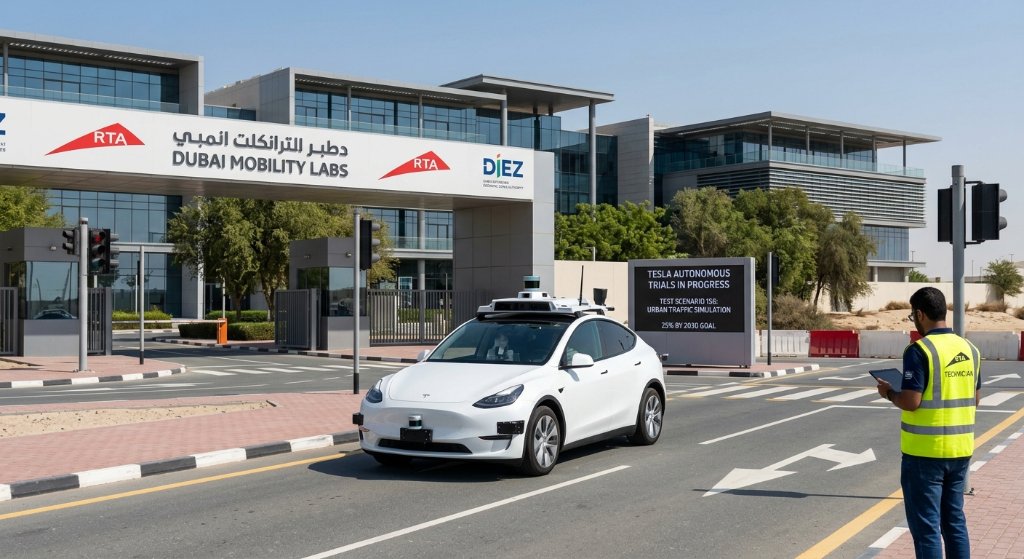
Dubai has just thrown open the gates to its crown jewel of transportation tech, and some of the world's most aggressive autonomous driving players have already claimed their lanes.
The Roads and Transport Authority (RTA) and the Dubai Integrated Economic Zones Authority (DIEZ) have officially inaugurated Dubai Mobility Labs at Dubai Silicon Oasis. Described as the Middle East’s smartest integrated proving ground, the facility isn’t just another closed track—it's a massive, multi-environment sandbox designed to catapult driverless technology into the real world. Strikingly, Tesla was among the very first global giants to deploy its vehicles and autonomous trials onto the new tarmac.
For years, Tesla has navigated a minefield of regulatory skepticism, safety probes, and sluggish policy rollouts in the U.S. and Europe for its Full Self-Driving (FSD) system. By jumping headfirst into Dubai’s state-of-the-art facility, Elon Musk’s automaker is executing a tactical pivot, leveraging a region that matches its breakneck speed. The stakes are immense: Dubai is aggressively aiming to convert 25% of all transport journeys in the emirate into autonomous trips by 2030.
A Proving Ground Engineered for the Future
Rather than isolating vehicles on simple, repetitive test loops, Dubai Mobility Labs combines high-tech closed testing with real-world public road trials. To run these operations, the RTA has tapped German testing giant DEKRA to manage the facility for its first three years, ensuring all testing meets rigid international safety standards.
The scope of the new facility is massive:
- 248 Unique Test Scenarios: Ranging from basic lane keeping to highly unpredictable real-world traffic events.
- The "Traffic Sandbox": A specialized multi-purpose area capable of replicating 195 distinct situations—such as pedestrian crossings, sudden lane cut-offs, and complex intersections.
- Public Road Integration: Test routes extend from the high-density tech hub of Dubai Silicon Oasis all the way to the open roads of Al Qudra, testing how systems transition from city streets to highway speeds.
- Extreme Weather Resilience: Vehicles are evaluated on how their camera and sensor suites handle intense desert heat, dust storms, and sudden shifts in solar glare—building directly on Tesla's history of local extreme-climate validation.
Tesla's Middle Eastern Playbook
Tesla is not the only resident in this sandbox. Robotaxi trailblazers WeRide and Pony.ai have also initiated active testing at the facility, signaling a fierce battle for dominance in the Middle East’s emerging autonomous transport corridor.
However, Tesla's early presence here is especially tactical. While the automaker continues to clash with federal authorities in North America and navigate complex UNECE regulations in Europe, Dubai provides an ecosystem that actively wants to deploy this technology. This isn't just a validation exercise for Tesla; it is a live-fire rehearsal for international FSD deployment.
Why This Matters:
The opening of Dubai Mobility Labs is a watershed moment for the global autonomous vehicle (AV) sector, and it signals a critical geographic shift in where the future of mobility is being forged.
The Regulatory Escape Hatch
For Tesla, this is an absolute lifeline. While the automaker faces slow-moving bureaucratic machinery in Washington and a highly fragmented regulatory landscape in the European Union, Dubai is offering a fast-tracked, unified pathway to commercialization. By validating its FSD stack under DEKRA’s strict protocols, Tesla can secure a vital stamp of institutional legitimacy that it can wave in front of skeptical Western regulators.
The Ultimate Smart City Gold Rush
The clear winners here are the early adopters—Tesla, WeRide, and Pony.ai. They are gaining invaluable, real-world data in a city that is legally and structurally preparing its infrastructure for driverless fleets. The losers? Legacy automakers who continue to treat autonomy as a distant, niche feature rather than an immediate strategic priority. If legacy players don't secure slots at proving grounds like Dubai Silicon Oasis now, they risk being entirely locked out of a market aiming to automate a quarter of its transport network in less than four years.
A Pivot to the East
This proving ground proves that the geographic center of gravity for autonomous driving is shifting. If Western regulators continue to drag their feet, the first fully realized, commercially viable, and scalable driverless ecosystems won't be crowned in Silicon Valley or Munich—they will be deployed in Dubai.
A Fast-Forward for Autonomous Tech
Dubai Mobility Labs is more than just a playground for cutting-edge software; it is a launchpad. As Tesla, Pony.ai, and WeRide push their vehicles to the limit across 248 grueling scenarios, they aren't just testing code—they are actively rewriting the rules of global transit. If you've been waiting for the moment when self-driving cars transition from experimental novelties to everyday infrastructure, look no further than Dubai Silicon Oasis. The future is arriving, and it’s moving at desert speeds.