End-to-End Autonomy Achieved: Tesla's FSD Supervised Rewrites the Self-Driving Playbook with 850-Mile Feat
For years, Tesla's Full Self-Driving (FSD) system has been a beacon of ambitious promises and, at times, considerable controversy. From bold declarati...
Editorial Team
World Of EV
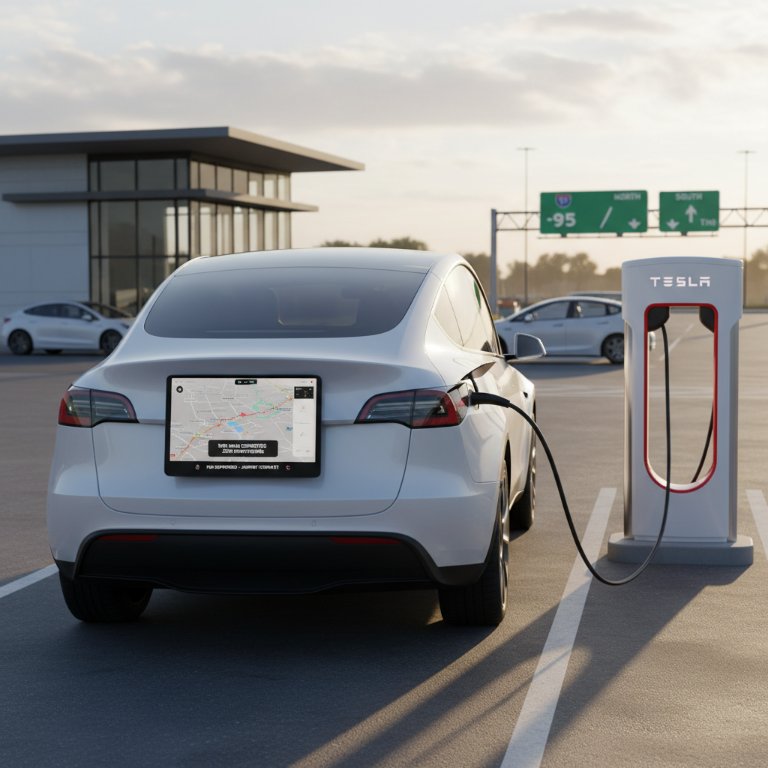
For years, Tesla's Full Self-Driving (FSD) system has been a beacon of ambitious promises and, at times, considerable controversy. From bold declarations of robo-taxis by a specific date to the system's iterative, sometimes challenging, rollout, the journey toward true autonomy has been a winding road. Now, in a move that could mark a significant inflection point, Tesla has officially announced a monumental achievement: its FSD Supervised system successfully completed an 850-mile journey without any human interventions. This isn't just another incremental update; it's a demonstration of end-to-end autonomy at a highway scale, featuring fully autonomous parking and Supercharger stops.
The 850-Mile Odyssey: A New Benchmark
This recent accomplishment by Tesla’s FSD Supervised system represents a new benchmark in the pursuit of consumer-grade autonomous driving. The 850-mile excursion, undertaken without a single human disengagement, showcases a level of sustained autonomous operation that few, if any, other production systems can claim. While companies like Waymo and Cruise operate robust autonomous services, they typically do so within geo-fenced urban environments. Tesla's test, spanning hundreds of miles of diverse highway driving, including complex navigation and necessary charging stops, highlights the system's maturation beyond localized, predictable scenarios.
Key aspects of this impressive journey include:
- Uninterrupted Navigation: The vehicle navigated 850 miles autonomously, a critical indicator of the system's ability to handle extended driving scenarios without human intervention.
- Autonomous Supercharging: The FSD system independently located, navigated to, and initiated charging at Supercharger stations, a crucial capability for long-distance EV travel.
- Precision Parking: The journey concluded with fully autonomous parking, demonstrating the system's dexterity in complex, low-speed maneuvers.
Tesla highlighted this achievement as its internal validation of the system's progress, signaling a newfound and perhaps higher level of confidence in FSD's comprehensive capabilities. This internal confidence boost suggests that the company believes FSD Supervised is evolving from an advanced driver-assistance system into something far more robust, pushing the boundaries of what's currently available to the public.
Why This Matters:
This 850-mile autonomous journey is more than just a headline; it carries significant implications for Tesla, the broader automotive industry, and, crucially, for EV enthusiasts and prospective buyers.
For Tesla: This achievement is a colossal validation for Elon Musk’s long-standing vision and the significant resources poured into FSD development. It provides tangible evidence that their camera-only, AI-driven approach can achieve high levels of autonomy, potentially quieting some critics and invigorating customer trust. A robust FSD system could become a massive differentiator, justifying its premium price and bolstering Tesla's technological leadership claims. It also strengthens their hand in future regulatory discussions, presenting a compelling case for the system's capabilities.
For the Industry: This accomplishment puts immense pressure on rivals. While traditional automakers and dedicated autonomous driving companies like Waymo and Cruise have made strides, Tesla's demonstration of long-distance, end-to-end highway autonomy in a production vehicle challenges the industry to accelerate its own timelines. It signals that a vertically integrated approach, controlling both hardware and software, can yield profound results, forcing competitors to re-evaluate their strategies.
For Consumers: For the savvy EV enthusiast and prospective buyer, this news means the promise of FSD is becoming more tangible. The 'Supervised' moniker still necessitates driver attention, but an 850-mile intervention-free drive significantly narrows the gap between supervised assistance and true hands-off driving. It answers the silent question: "Why does this matter to me?" by indicating a future where long road trips could become considerably less fatiguing, with the vehicle handling the majority of driving tasks, including the often-fiddly logistics of charging and parking. It suggests that the substantial investment in FSD is inching closer to delivering on its transformative potential.
The Road Ahead: From Supervised to Seamless
While this 850-mile feat is undeniably impressive, the journey to truly unsupervised, ubiquitous full self-driving is far from over. Challenges remain, including navigating diverse weather conditions, complex urban environments with unpredictable variables, and, critically, securing broader regulatory acceptance. However, this demonstration by Tesla’s FSD Supervised system marks a pivotal moment. It signals a shift from incremental updates to a potentially exponential leap in autonomous capability, setting a new expectation for what full self-driving can achieve in the real world and paving the way for a more autonomous future.
" } ```