E
World Of EVEditorial
News 1 hour ago
EV Market Recalibrates: August Sales Rise 2.5% as Off-Lease Tsunami Sparks Pre-Owned Gold Rush
The American electric vehicle sector is quietly executing a dramatic transition, shifting from a policy-propped sprint to a marathon driven by organic...
E
Editorial Team
World Of EV
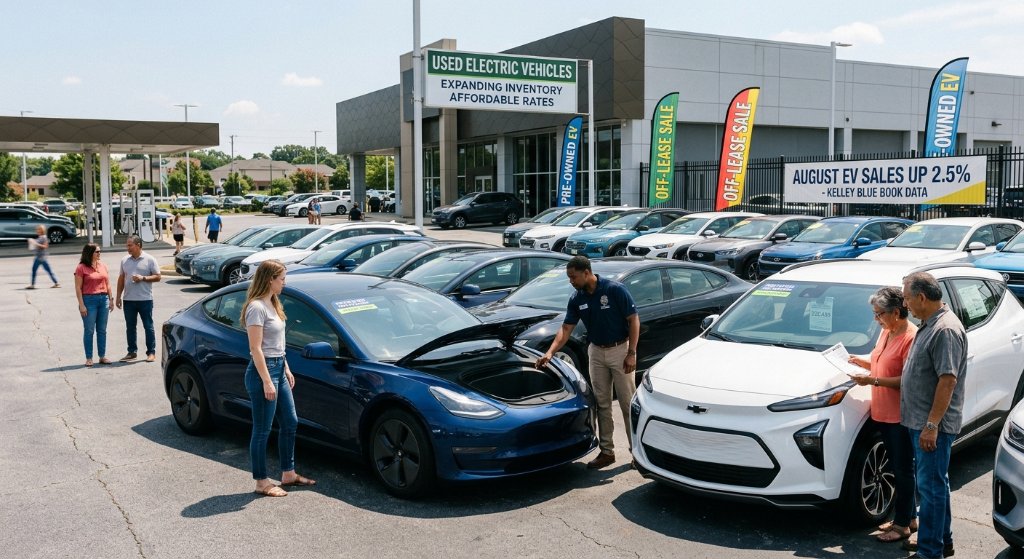
The American electric vehicle sector is quietly executing a dramatic transition, shifting from a policy-propped sprint to a marathon driven by organic, value-seeking demand. Fresh data released by Cox Automotive and Kelley Blue Book reveals that new EV sales in the U.S. rose 2.5% in August 2026 compared to July, totaling an estimated 78,895 units. However, this modest sequential rise sits in the shadow of a staggering 46.9% year-over-year decline—a drop that is not a sign of a dying market, but rather a harsh hangover from August 2025's historic sales surge, which was artificially inflated as buyers scrambled to claim federal EV tax credits before their late-September expiration.
Now, as the market recalibrates in a post-incentive landscape, the real story is moving from the showroom to the used car lot. A massive tidal wave of off-lease returns is hitting the pre-owned sector, creating highly affordable, low-depreciation entry points for mainstream drivers who are desperate to escape skyrocketing fuel costs and high maintenance bills.
### The Sequential Climb and the Post-Incentive Hangover
While a 2.5% month-over-month growth rate may seem modest, it represents a resilient stabilization for an industry trying to find its "natural demand" baseline. In the new-vehicle market, a combination of manufacturer pricing corrections and an influx of lower-priced models is helping narrow the gap between EVs and internal combustion engine (ICE) vehicles. This is happening at a crucial time: the average transaction price (ATP) for all new U.S. vehicles climbed back above $50,000 in August for the first time in 2026, making affordable, pre-owned alternatives look more attractive than ever.
Key sales metrics from the August 2026 data highlight:
* **Total New EV Sales**: An estimated 78,895 units, representing a 2.5% bump from July but an expected 46.9% drop from the record-breaking August 2025.
* **The Market Share Static**: EVs accounted for 5.7% of all new U.S. vehicle sales, holding steady with July's numbers.
* **Tesla's Slow Bleed**: Tesla remains dominant with 40,816 units, but saw a 3.8% month-over-month decline, dropping its EV market share to 51.7%.
* **Toyota's Surge**: Led by the bZ series, Toyota's EV sales jumped 34.9% month-over-month to 4,964 units, proving that legacy giants are successfully chipping away at Tesla's dominance.
### The Off-Lease Tsunami Hits the Pre-Owned Market
The true catalyst for mass EV adoption in 2026 isn't coming from high-end showrooms—it is coming from the used car lanes. Cox Automotive projects that roughly 301,000 EVs will come off lease in 2026, nearly tripling the volume seen in 2025. This number is set to explode further, reaching an estimated 589,000 returns in 2027. This influx of off-lease vehicles is rapidly expanding the pre-owned EV inventory, with more than half of used EV inventory now sitting under the magic $30,000 threshold.
For buyers, the timing could not be better. With geopolitical tensions keeping average gas prices painful, the appeal of an electric powertrain's lower operating costs is irresistible. Savvy buyers are realizing they can bypass the brutal initial depreciation curve of a brand-new EV, securing a gently used, tech-forward machine for a fraction of its original MSRP.
### Why This Matters:
This data signals a fundamental restructuring of the EV ecosystem, shifting power from premium pioneers to mainstream value-seekers.
* **Who Wins**: Budget-conscious consumers and legacy dealerships. Buyers get "like-new" EVs with battery health still largely intact at sub-$30,000 prices, enjoying immediate fuel and maintenance savings. Meanwhile, established legacy brands with massive dealer networks (like Ford, Hyundai, and Toyota) stand to win as buyers seek reputable local service centers to support their pre-owned purchases.
* **Who Loses**: Tesla's margins and EV residual values. As the market is flooded with off-lease Model 3s and Model Ys, used prices will continue to soften, putting further downward pressure on Tesla's ability to command premium prices for its aging new vehicle lineup. Additionally, automakers who failed to build a cohesive used-EV remarketing strategy will take heavy hits on lease-end residual values.
* **The Broader Market Signal**: This is a critical "grow-up" moment for the industry. The era of selling $70,000 technology showcases to early adopters is officially over. By offering a robust secondary market, EVs are finally becoming what they always needed to be: practical, highly economical, everyday transport for the average American commuter.
### Looking Ahead
The transition to electric mobility was never going to be a straight line, and August 2026's data shows the market is doing exactly what it needs to do to survive: democratizing. While the new EV market continues to grind out slow, sequential gains in a post-incentive world, the booming pre-owned market is building the real foundation for the next wave of EV adoption. The electric revolution isn't slowing down; it's just changing gears.