Fast Chargers vs. Toddlers: Why Human Biology, Not Battery Tech, Wins the EV Road Trip Debate
Range anxiety remains the ultimate psychological hurdle for electric vehicle adoption, heavily weaponized by critics and legacy automotive skeptics al...
Editorial Team
World Of EV
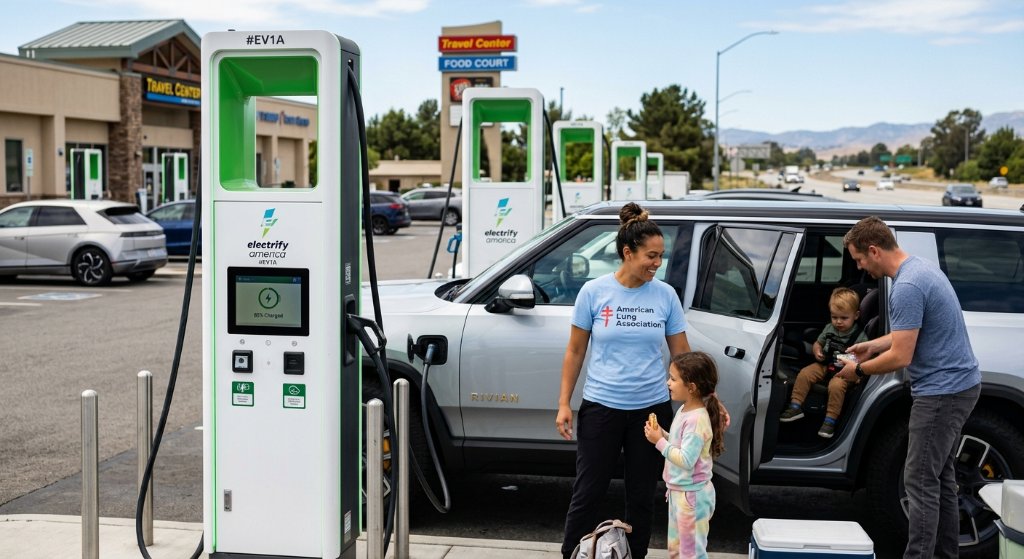
Range anxiety remains the ultimate psychological hurdle for electric vehicle adoption, heavily weaponized by critics and legacy automotive skeptics alike. Yet, real-world experiences continue to prove that the "hour-long charging stops" narrative is a relic of the past. In the early days of EVs, when pioneering vehicles like the first-generation Nissan Leaf limped along with under 80 miles of range and zero thermal battery management, road-tripping was indeed an extreme sport. Today, a new generation of high-voltage architectures has completely flipped the script, revealing that the true bottleneck of a modern road trip isn't the car's battery—it's human biology.
A compelling testimonial from Diana Van Vleet, an EV owner and American Lung Association staffer, highlights this paradigm shift. Van Vleet’s real-world family road trips demonstrate that modern EV charging seamlessly integrates with natural human behavior. Far from slowing her family down, her EV regularly finishes charging before her young children are even done with restroom, diaper, and food breaks, proving that the modern EV is already faster than the average family's patience.
The Myth of the '5-Minute Fill-up' vs. Human Reality
For decades, the standard benchmark for any alternative fuel has been the gas pump: pull up, fill for five minutes, and drive another 400 miles. However, this benchmark ignores the reality of family travel. A stop with children is never just a quick refuel; it is a logistical operation.
When we map out the typical stops during a long-distance family drive, the synergy between human needs and EV capabilities becomes obvious:
- The Family Stop Duration: A standard restroom, snack, and stretch break for a family with young kids takes between 20 to 30 minutes.
- The 800-Volt Advantage: Vehicles built on modern platforms (such as the Hyundai Ioniq 5, Kia EV6, or Porsche Taycan) can charge from 10% to 80% in as little as 18 minutes using a 350 kW DC fast charger.
- The 'Ready-Before-You-Are' Reality: As Van Vleet experienced, the vehicle is often topped up and sending push notifications to the driver's phone while the family is still standing in the restroom line or waiting for their food.
Redefining Road Safety and Well-Being
By forcing drivers to stop every two to three hours for a quick top-up, EVs are inadvertently solving a major highway safety hazard: driver fatigue. The National Highway Traffic Safety Administration (NHTSA) has long warned against the dangers of "highway hypnosis" and drowsy driving, which contributes to thousands of accidents annually.
Integrating EV charging into road trips shifts the travel paradigm in several beneficial ways:
- Built-in Cognitive Resets: Regular 15-to-20-minute intervals allow drivers to rest their eyes, stretch, and recover mental focus.
- Cleaner Rest Stop Environments: EV charging plazas lack the toxic, idling exhaust fumes of traditional gas stations—a crucial point of advocacy for health-focused owners like Van Vleet.
- Productive Travel Cadence: Instead of staring at a gas pump, drivers spend their stops actively resting, eating, or managing their families.
Why This Matters:
This shift in perspective is a major blow to the anti-EV narrative. For years, opponents have modeled EV road trips as mathematical optimization problems, calculating to the second how much "time is lost" compared to internal combustion engine (ICE) vehicles. This approach fundamentally ignores how humans actually travel.
Who wins here? EV manufacturers utilizing advanced 800V architectures and charging networks that prioritize site amenities. By placing fast chargers near restaurants, parks, and clean restrooms, operators like Pilot Flying J, Stuckey's, and Tesla are capturing a highly engaged retail audience.
Who loses? Traditional gas stations that refuse to adapt. A dingy, isolated pump with no working restroom is no longer acceptable. The future of roadside retail belongs to those who can keep humans comfortable for 20 minutes while their cars charge.
The Market Signal: The bottleneck has officially shifted from the car to the infrastructure's location. The debate is no longer about whether an EV can handle a road trip, but whether our highway service plazas are pleasant enough to spend 20 minutes in.
Ultimately, as EV infrastructure matures, the debate will shift from "how long does it take to charge" to "what can I do while it charges." Real-world testimonials from everyday drivers like Van Vleet show that the transition to electric isn't just a win for the environment, but a subtle, civilized upgrade to the road trip itself.