Fast Charging's Double-Edged Sword: New Geotab Study Reveals Major Impact on EV Battery Health
For years, the longevity of electric vehicle batteries has been a persistent concern for prospective buyers and a critical talking point among industr...
Editorial Team
World Of EV
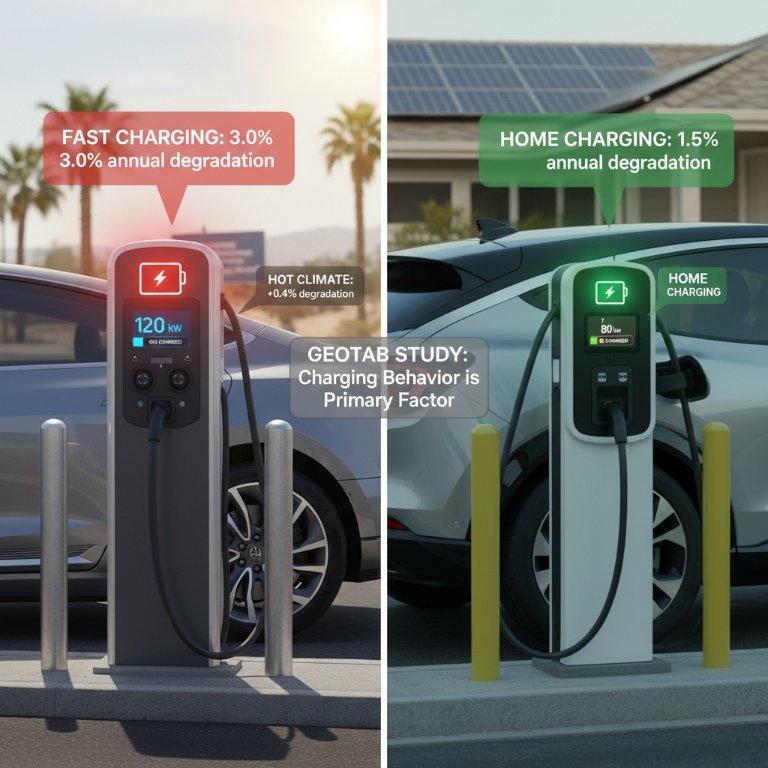
For years, the longevity of electric vehicle batteries has been a persistent concern for prospective buyers and a critical talking point among industry professionals. While modern EV batteries are robust and designed to outlast a vehicle's typical service life, new data from Geotab's comprehensive study of over 22,700 electric vehicles provides unprecedented, data-driven insights into the primary factors affecting battery health. This latest analysis unequivocally positions charging behavior as the dominant influence on battery degradation, with significant implications for owners and the industry alike.
The DCFC Dilemma: Speed Comes at a Cost
The most striking finding from Geotab's extensive research is the quantifiable impact of high-power DC fast charging (DCFC). Vehicles that routinely utilize DCFC above 100 kW can experience battery degradation rates up to 3.0% annually. This figure is roughly double the 1.5% degradation rate observed in EVs primarily relying on AC or lower-power charging. This stark contrast underscores that while the convenience of rapid charging is undeniable, it introduces considerable thermal and electrical stress on battery cells, accelerating their aging process.
It's important to put this into broader context. The study found an average annual battery degradation rate of 2.3% across all vehicles analyzed. This marks a slight increase from Geotab's 2023 findings, which reported an average of 1.8%, a shift largely attributed to the growing reliance on higher-power DC fast charging as EV adoption scales.
Beyond the Plug: Climate and Usage's Lesser Roles
While charging habits emerge as the principal factor, other environmental and operational elements do play a role, albeit a secondary one. Climate, for instance, contributes to battery wear, with vehicles consistently operating in hot regions experiencing approximately 0.4% faster degradation annually compared to those in milder climates. This reinforces the long-held understanding that extreme temperatures are not ideal for battery chemistry. Surprisingly, the impact of higher vehicle utilization, or simply driving more, proved to be quite modest, adding only about 0.8% additional degradation per year. For fleets and high-mileage drivers, this suggests that the operational benefits often outweigh the slightly increased battery wear.
Debunking State-of-Charge Myths: Nuance Over Extremes
The study also brings clarity to the often-debated topic of maintaining optimal state-of-charge (SOC). Conventional wisdom often advises against habitually charging to 100% or fully depleting the battery. Geotab's data supports this, but with critical nuance: degradation only accelerates if vehicles spend over 80% of their total time at very high (near full) or very low (near empty) charge levels. This challenges the notion that occasional full charges or deep discharges are inherently detrimental. It's the habitual prolonged exposure to these extremes that truly matters, suggesting that most drivers don't need to be overly rigid with their daily charging constraints.
Why This Matters:
This Geotab study isn't merely an academic exercise; it's a critical roadmap for the EV ecosystem, offering actionable insights for everyone from individual owners to global automakers.
For the Savvy EV Owner: This data empowers you to make informed decisions that directly impact your vehicle's long-term health and resale value. If your driving patterns allow for it, prioritizing AC charging or lower-power DC charging, especially for routine top-offs, can significantly extend your battery's lifespan. Fast charging remains indispensable for long-distance travel, but a balanced approach is key.
Industry's Reckoning: Automakers will face increased pressure to integrate more intelligent battery management systems (BMS) that can dynamically advise or even manage charging strategies to optimize longevity. Charging network operators may need to educate users on the long-term trade-offs of constant ultra-fast charging. For fleet operators, this data is invaluable for maximizing asset lifespan and optimizing total cost of ownership.
A Call for Balance: Charlotte Argue, Geotab's Senior Manager of Sustainable Mobility, encapsulates the core takeaway: "Using the lowest charging power that still meets operational needs can make a measurable difference to long-term battery health without limiting vehicle availability." This signals a maturing EV market where raw speed must be balanced with sustainable battery care.
Conclusion:
The narrative around EV battery health continues to evolve. While the inherent durability of modern EV batteries remains strong, Geotab's latest analysis provides undeniable proof that how we charge our vehicles is the single most controllable factor in their long-term degradation. As the EV revolution charges forward, intelligent, balanced charging strategies will be paramount for maximizing battery longevity, protecting owner investments, and ensuring the sustainable growth of electric mobility. The future demands not just faster charging, but smarter charging.