Federal Probes and Lawsuit Collide After Fatal Tesla Katy Crash: Why FSD 'Pedal Misapplication' Is the Industry’s New Battleground
When a Tesla Model 3 left a residential road in Katy, Texas on June 19 and crashed through a brick home, killing 76-year-old Martha Avila inside, it i...
Editorial Team
World Of EV
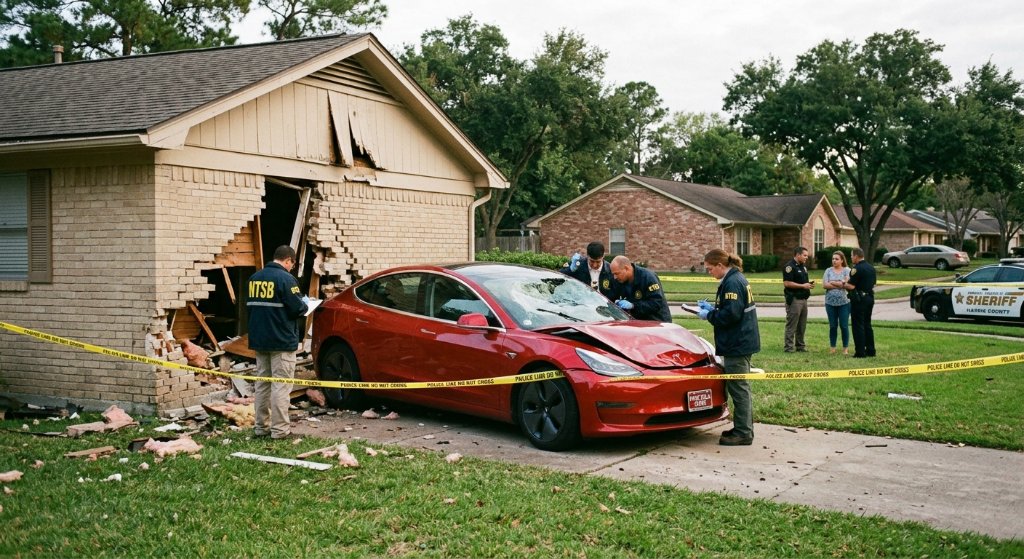
When a Tesla Model 3 left a residential road in Katy, Texas on June 19 and crashed through a brick home, killing 76-year-old Martha Avila inside, it immediately reignited the fiercest debate in modern motoring. Five days later, on June 24, 2026, the National Transportation Safety Board (NTSB) joined the National Highway Traffic Safety Administration (NHTSA) in launching a full federal investigation. Coupled with a massive wrongful death lawsuit from the victim's family, the incident forces the automotive industry to confront a terrifying reality: the dangerous cognitive gap of Level 2 automation.
For years, Tesla has operated in a legal grey area, marketing "Full Self-Driving" (FSD) to enthusiastic buyers while legally shifting 100% of the liability to the driver. But as federal regulators descend on the Katy crash site, the narrative is shifting from a simple question of "did the software fail?" to "how does the software influence human panic?"
The Telemetry Clash: Software Log vs. Driver Claim
The driver of the Model 3, Michael Butler, told law enforcement that Tesla’s driver-assist system was engaged before the vehicle jumped the curb. But Tesla's Head of AI, Ashok Elluswamy, and CEO Elon Musk were quick to use X (formerly Twitter) to publish their own verdict from the vehicle's black box.
- The Override: Tesla's data shows the driver manually overrode FSD by pressing the accelerator pedal to its absolute limit—100% capacity.
- The Velocity: The Model 3 reached a staggering 73 mph on the residential street before breaching the home, with the accelerator pedal remaining depressed even after impact.
- The Legal Backlash: Unmoved by Tesla's data-driven defense, the family of Martha Avila filed a state-level wrongful death lawsuit seeking over $1 million, accusing Tesla of gross negligence and failing to warn users of FSD's inherent defects.
Dual Federal Scrutiny and the Ghost of Texas Past
The federal response has been exceptionally swift. With both the NHTSA and NTSB conducting parallel investigations, the regulators are moving past minor fender-bender inquiries into deep, systemic evaluations of how drivers interact with Level 2 systems.
- Historical Echoes: This isn't the first time Texas has hosted a high-profile Tesla probe. In 2021, a fatal Model S crash in Spring, Texas, led to sensationalized reports of a driverless vehicle. A multi-year NTSB investigation ultimately vindicated Tesla, finding the driver was impaired and in the seat.
- A Different Beast: Unlike the 2021 crash, the Katy incident involves an active "panic-and-hold" scenario. Regulators are no longer just asking if the vehicle can drive itself; they are probing the transition of control—the chaotic handoff when a machine fails and a human panics.
The Cognitive Trap of 'Panic-and-Hold'
Tesla treats the 100% accelerator telemetry as a total exoneration, but safety experts point out that this is a classic, documented failure mode of Level 2 autonomy. When a vehicle is driving itself, the driver's feet are naturally resting away from the pedals. If the FSD software makes a sudden, unexpected maneuver on a suburban street, a disengaged driver will blindly scramble to take over. In that split second of terror, pedal misapplication occurs: the driver stomps on the accelerator instead of the brake, and as the car surges forward, panic causes them to press down even harder, convinced they are trying to stop.
Why This Matters:
This is a defining regulatory moment for Tesla and the broader autonomous vehicle industry. While Tesla seeks to win the battle of liability by pointing to the telemetry, it is losing the war of public trust.
- The Fallacy of 'Full Self-Driving': Calling a Level 2 driver-assistance suite "Full Self-Driving" while requiring constant human intervention is fundamentally misleading. When drivers treat the system as a true chauffeur, their reaction times in an emergency are severely compromised.
- Winners and Losers: Legacy automakers like Ford, GM, and Mercedes-Benz, who utilize robust, infrared eye-tracking driver-monitoring systems (DMS) and geofenced hands-free driving, will likely see their cautious approach validated. Tesla, conversely, faces the threat of severe regulatory backlash.
- The Regulatory Pivot: The NTSB and NHTSA probes could culminate in mandated changes to how Level 2 systems operate. We could see forced OTA updates that strictly limit FSD's top speed in residential zones or completely disable the system on non-highway roads without physical barriers. For Elon Musk, who has pegged Tesla's multi-trillion-dollar valuation to a future of autonomous robotaxis, any regulatory capping of FSD is a devastating threat.
The tragedy in Katy, Texas, serves as a grim reminder of the messy, half-automated world we currently inhabit. While Tesla’s black box might protect the company in a courtroom, it cannot solve the psychological trap of Level 2 automation. As federal investigators dissect the telemetry over the coming months, the industry may finally have to face the music: if a self-driving system requires a human to prevent it from killing someone, yet makes it harder for that human to do so in a panic, the system itself is the hazard.