Feds Strike Back: NHTSA Launches Audit of Tesla’s Pedal-Free Cybercab Hours After Austin Rollout
Tesla’s long-promised autonomous future finally hit public streets in Austin, Texas, this week, but the celebration lasted less than 24 hours. Just on...
Editorial Team
World Of EV
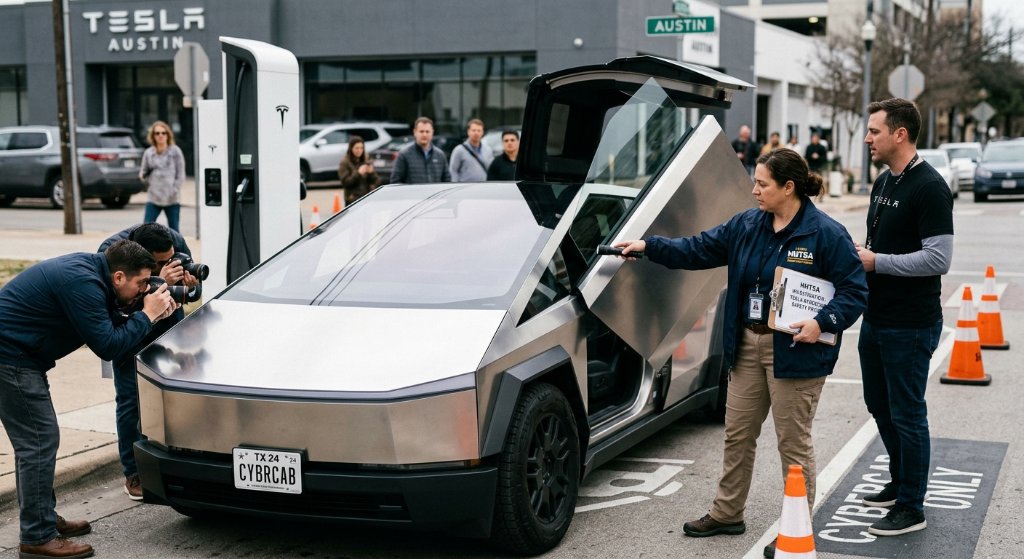
Tesla’s long-promised autonomous future finally hit public streets in Austin, Texas, this week, but the celebration lasted less than 24 hours. Just one day after Tesla launched paid, driverless Cybercab rides for the public, the National Highway Traffic Safety Administration (NHTSA) struck back, opening a federal safety audit into the vehicles. Regulators are questioning whether the two-seat robotaxi—which lacks a steering wheel, pedals, or traditional mirrors—was properly certified to drive on public roads.
This rapid regulatory clampdown exposes the immense friction between Elon Musk’s move-fast-and-break-things philosophy and rigid federal safety standards. Historically, autonomous vehicle (AV) players have treaded carefully around regulators; Google’s Waymo and General Motors’ Cruise initially deployed modified production vehicles that retained manual controls. When Cruise attempted to bypass this by designing the steering-wheel-free 'Origin,' regulatory gridlock eventually forced GM to shelve the project entirely. By launching a custom, pedal-free vehicle directly onto public roads without a traditional federal exemption, Tesla has triggered a high-stakes regulatory game of chicken.
Inside the Cybercab’s Unsupervised Austin Debut
On September 3, 2026, Tesla held an exclusive launch event in Austin, and by the next morning, paying passengers were booking rides in a fleet of 45 purpose-built Cybercabs via the Tesla Robotaxi app. Running on Tesla's unsupervised Full Self-Driving (FSD) v15 software, these vehicles represent a radical departure from conventional automotive design.
Key technical specifications of the deployed Cybercab include:
- Seating and Cabin: A spacious, two-passenger cabin with a massive center display, butterfly doors, and zero manual driving controls.
- Powertrain and Range: A 48 kWh battery pack utilizing Tesla's proprietary 4680 cells, delivering a range of 293 miles.
- Performance: A 219-horsepower electric motor driving the rear wheels.
- Efficiency: An impressive 5.5 mi/kWh energy consumption rate.
- Sensor Suite: A pure-vision setup utilizing 9 external cameras, completely eschewing expensive LiDAR and radar sensors.
The Self-Certification Loophole Under Fire
The heart of the federal investigation centers on how Tesla legally put these vehicles on the road. Under current Federal Motor Vehicle Safety Standards (FMVSS), vehicles must possess manual controls like steering wheels and brake pedals. To bypass the capped 2,500-vehicle-per-year limit imposed by traditional NHTSA exemptions, Tesla 'self-certified' the Cybercab. The company argued that because the vehicle is entirely autonomous, standards requiring manual physical controls simply do not apply.
The NHTSA’s newly opened Audit Query is specifically examining the validity of this self-certification. This isn't the first time an automaker has used this legal maneuver; Amazon-backed Zoox self-certified its custom, steering-wheel-free robotaxi in 2022, which immediately prompted a similar, ongoing NHTSA audit. By initiating this audit, the NHTSA signals that it will not allow Tesla to unilaterally rewrite the rules of road safety.
Why This Matters:
This investigation is a do-or-die moment for Tesla’s entire valuation. Elon Musk has repeatedly staked the company’s financial future on autonomy, effectively sidelining a traditional, sub-$25,000 human-driven EV in favor of the Cybercab. If the NHTSA rules that Tesla’s self-certification is invalid, the agency could ground the Austin fleet, legally deadlocking Tesla’s robotaxi ambitions for years.
- Who Wins: Incumbent robotaxi operators like Waymo. By playing strictly within existing regulatory frameworks and utilizing retrofitted vehicles with physical controls, Waymo has safely logged millions of commercial miles. A regulatory halt on the Cybercab keeps Waymo’s near-monopoly on urban robotaxis secure.
- Who Loses: Tesla and its investors. Wall Street has priced Tesla as an AI and robotics powerhouse rather than a mere car manufacturer. A federal block on the Cybercab would shatter the timeline for Tesla’s promised nationwide robotaxi network, forcing the company to rely on its slowing consumer EV sales.
Ultimately, this clash signals that the transition to an autonomous society cannot be achieved by software updates alone. While Tesla has successfully solved the engineering puzzle of building a highly efficient, pedal-free EV, it has yet to solve the far more complex puzzle of federal bureaucracy.
Conclusion
The Cybercab's rapid rollout in Austin proved that Tesla's hardware and vision-only software are ready for the prime time, offering incredibly smooth and futuristic rides to early passengers. However, the NHTSA's immediate federal safety investigation serves as a stark reminder that technology does not operate in a vacuum. Tesla may have built the car of tomorrow, but until it can convince regulators that physical steering wheels are truly obsolete, the Cybercab’s revolution remains parked on a very tight leash.