Ford Braces for 'Inevitable' Chinese EV Invasion: CEO Jim Farley Sounds Alarm, Bets Big on Secret $30K Skunkworks Platform
### Facing the Inevitable: The Tariff Shield is Temporary In a candid, closed-door company town hall, Ford CEO Jim Farley issued a stark warning to e...
Editorial Team
World Of EV
Facing the Inevitable: The Tariff Shield is Temporary
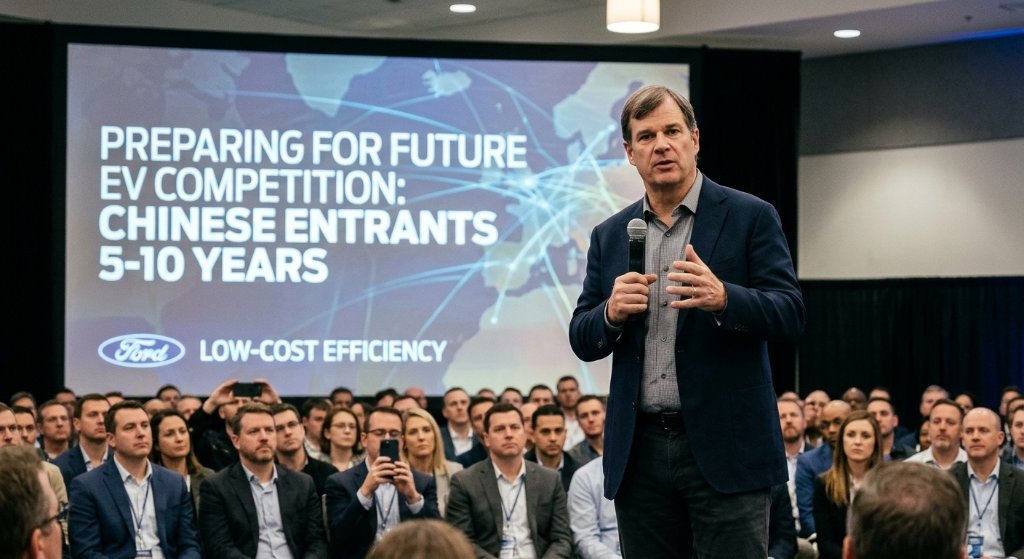
In a candid, closed-door company town hall, Ford CEO Jim Farley issued a stark warning to employees: do not get comfortable behind Washington's trade barriers. Despite the current 100% tariffs protecting the U.S. from cheap Chinese imports, Farley stated that Ford must prepare for Chinese automakers to breach the American market within the next five to ten years.
This is not an abstract concern. Giant conglomerates like BYD and Geely are already establishing massive footprints in South America, Mexico, and Canada. Over a decade-long timeline, these players will inevitably localize manufacturing in North America to bypass tariff walls, bringing ultra-affordable, highly advanced EVs directly to U.S. showrooms. To survive this onslaught, Farley revealed that Ford's counter-strategy is already in motion: building a low-cost, ultra-efficient family of electric vehicles engineered from scratch to match Chinese cost structures.
Demolishing Detroit's Old Playbook: The $30,000 UEV Platform
To understand why this matters, you have to look at Ford's recent EV history. First-generation compliance vehicles and adapted platforms, like the F-150 Lightning and Mustang Mach-E, were well-received by early adopters but hemorrhaged cash due to bloated supply chains, heavy battery packs, and legacy engineering.
To fix this, Ford bypassed its traditional Dearborn headquarters and set up a highly secure, 350-person 'skunkworks' hub in Long Beach, California. Led by Alan Clarke—the former Tesla engineering director who spent a decade perfecting the Model 3 and Model Y—this team is developing the Universal EV (UEV) platform.
Designed from a clean sheet of paper, the UEV platform aims to launch a mid-size electric truck and SUV family by 2027 using radical engineering breakthroughs:
- Sub-$30,000 Target MSRP: Engineered to be highly profitable at an entry-level price point without relying on federal tax credits.
- Structural LFP Battery Packs: Shifts away from expensive nickel-cobalt chemistries to cheaper, ultra-durable Lithium Iron Phosphate (LFP) cells packed structurally to reduce overall volume by 30%.
- 48-Volt Zonal Architecture: Strips out more than 4,000 feet of heavy copper wiring, replacing it with simplified zonal controllers.
- The 'Bounty System' Culture: Engineers are assigned direct dollar values for saving single grams of weight or millimeters of space, driving relentless component efficiency.
- 15% Faster Production: Replaces the traditional moving assembly line with an 'Assembly Tree' process that radically simplifies factory footprint and labor.
Why This Matters:
This is a do-or-die transition for Ford, and arguably the entire U.S. automotive sector.
- The Ultimate Reality Check: Farley’s town hall confession proves that Detroit knows the 'tariff shield' is a temporary political band-aid, not a long-term business strategy. Relying on protectionism breeds complacency; Ford is choosing to fight engineering with engineering.
- Who Wins: Consumers. If Ford can successfully deploy the UEV platform at a $30,000 price point with competitive range, it democratizes electric vehicles for the masses, putting real pressure on Tesla and forcing other legacy OEMs to follow suit.
- Who Loses: Legacy automakers who refuse to change. OEMs relying on heavy, bloated, $80,000 electric SUVs will find themselves structurally uncompetitive and utterly defenseless when agile, low-cost Chinese EVs eventually land on American soil.
- A Shift in Power: By hiring top-tier talent from Tesla and Formula 1 and giving them the freedom to run a startup inside a 122-year-old giant, Ford is trying to spark its own modern 'Model T' revolution. If Alan Clarke’s team succeeds, they won't just save Ford's EV division; they will rewrite how Ford manufactures gas and hybrid vehicles globally.
The Bottom Line
Jim Farley is playing a high-stakes game of chess. By publicly validating the threat of Chinese manufacturers and privately funding a disruptive California startup within his own company, he is forcing Ford to evolve. The UEV platform isn't just another electric car project—it is Ford's survival guide for the next decade of global automotive warfare.