Ford's $28,350 Fathom EV Truck Faces Political Firestorm as Feds Target Chinese Tech Licensing
The global transition to affordable electric vehicles has officially collided with Washington’s geopolitical hardline. In a sharply worded letter to F...
Editorial Team
World Of EV
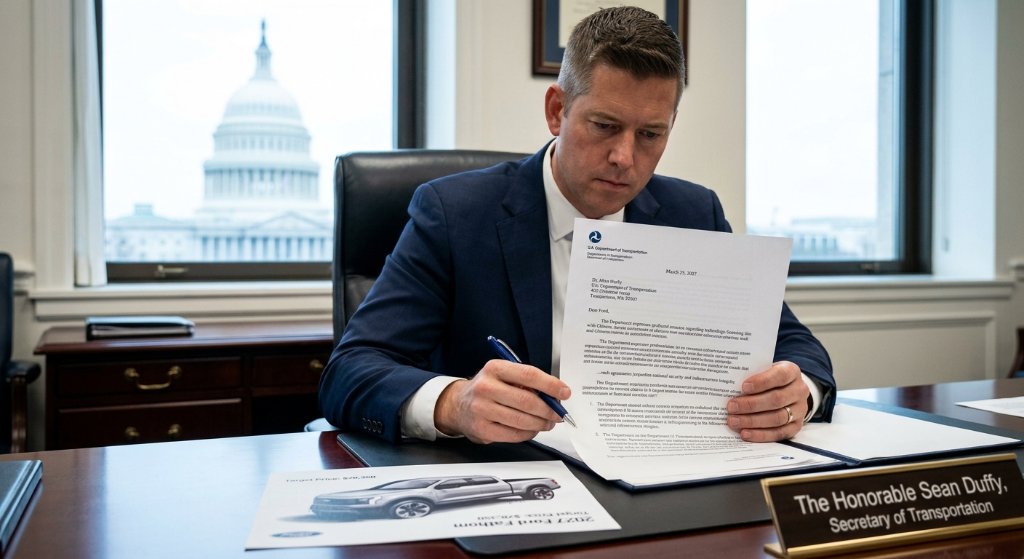
The global transition to affordable electric vehicles has officially collided with Washington’s geopolitical hardline. In a sharply worded letter to Ford CEO Jim Farley, US Transportation Secretary Sean Duffy expressed "profound concern" and "deep alarm" over the legacy automaker's strategic and technological alliances with Chinese battery giant CATL and automotive powerhouse Geely. But as political pressure mounts inside the Beltway, Ford is standing firm. The Detroit automaker has made it clear that its technology-licensing strategy is the only viable path to deliver the holy grail of the modern EV market: a fully capable, American-built electric pickup starting at just $28,350.
The Political Crossfire: Washington's Deep Alarm
Secretary Duffy’s letter represents a hardening bipartisan stance against Chinese integration into the domestic automotive supply chain. The Department of Transportation (DOT) specifically took aim at three pillars of Ford's current global operations:
- The CATL License: Ford’s technology-licensing agreement with Contemporary Amperex Technology Co. Ltd. (CATL) to manufacture lithium iron phosphate (LFP) battery cells at its BlueOval Battery Park in Marshall, Michigan.
- The Geely Partnership: A newly established joint venture with Geely Auto aimed at manufacturing low- and zero-emission vehicles at Ford’s historic Valencia plant in Spain.
- Lincoln Production Delays: Ford's decision to delay reshoring production of select Lincoln models from China to the US until 2030.
Duffy argued that by intertwining its operations with state-backed Chinese enterprises, Ford is compromising its role as a "reliable partner" to the American public and the DOT, urging the company to instead "out-innovate" its competitors through complete technological self-reliance.
Ford's American Shield: How the Fathom Stays Cheap
Ford has pushed back sharply against the DOT's criticisms, calling the letter a "wrongheaded attempt to capture headlines" and pointing out key structural realities of its Marshall, Michigan facility. Unlike traditional joint ventures, Ford maintains 100% ownership, operational control, and employment of the domestic workforce at the BlueOval Battery Park. The arrangement with CATL is strictly a limited technology-licensing agreement—meaning Ford is buying the recipe, not the kitchen.
This distinction is not merely academic; it is the financial backbone of Ford's upcoming next-generation EV platform. Specifically, these Michigan-made LFP cells are the secret weapon behind the highly anticipated 2027 Ford Fathom. By building the batteries domestically using licensed chemistry, Ford bypasses heavy import tariffs, qualifies for domestic manufacturing credits, and targets an unprecedented starting price of $28,350.
Meet the 2027 Ford Fathom: Specs and Expectations
Designed to usher in the era of the "universal EV," the Fathom is shaping up to be a disruptor in the compact and midsize pickup segment. Key details include:
- Base Pricing: A starting MSRP of $28,350 (projected at roughly $29,945 including destination fees).
- Battery Tech: Advanced LFP (lithium iron phosphate) cells, which eliminate expensive nickel and cobalt, manufactured right in Marshall, Michigan.
- Utility & Cabin Space: A clever cab-forward design yielding more passenger volume than a Toyota RAV4, complete with a front trunk (frunk) and a highly functional cargo bed.
- Standard Tech: Packed with Ford's BlueCruise hands-free driving assistant, bidirectional power-to-home charging, and a high-resolution central infotainment screen.
Why This Matters:
This clash is a defining moment for the North American EV transition. It highlights a critical friction point: the massive gulf between political goals and manufacturing realities.
- The Battle of Pragmatism vs. Protectionism: Washington wants a clean break from Chinese technology. However, Chinese companies like CATL currently control the patents, scaling expertise, and supply chains for LFP battery chemistry—the exact low-cost technology required to make EVs affordable. If the government forces Ford to tear up its CATL licensing agreement, the $28,350 Fathom cannot exist at that price point. Without LFP, Ford would have to rely on expensive, nickel-manganese-cobalt (NMC) chemistry, pushing prices back into the $45,000+ range and alienating mainstream buyers.
- The "Recipe vs. Ingredient" Precedent: Ford’s defensive stance establishes a crucial regulatory framework. By asserting that licensing software and chemistry patents to build products on American soil with American labor is "patriotic manufacturing," Ford is trying to draft a blueprint for other Western automakers. If the DOT successfully blocks this arrangement, it signals to the entire industry that even licensed foreign IP is off-limits, which would severely stunt EV cost-reduction timelines.
- Wall Street Sides with Ford: Despite the political theater and federal warnings, investment heavyweights are looking past the noise. UBS maintained its "Buy" rating on Ford stock, recognizing that Farley's strategy is financially sound. The market understands that to survive the impending wave of cheap global EV competition, legacy OEMs must lower battery costs immediately, even if it means renting the intellectual property to do so.
Conclusion
The political pressure on Ford is unlikely to fade as the 2027 Fathom approaches its pre-order window in early 2027. However, Ford's refusal to back down reveals just how high the stakes are. By fighting to keep its Michigan-based CATL licensing agreement intact, Ford is not just defending a factory—it is defending the economic viability of its entire next-generation EV portfolio. If Ford wins this battle, the Fathom could represent the first true democratized electric truck for the masses; if Washington wins, affordable EVs in America may remain out of reach for years to come.