Ford's Model e Steers Towards Solvency, Unlocks Billions in New Energy Venture
Ford's dedicated electric vehicle division, Model e, is finally showing tangible progress in stemming its significant financial outflows. After years ...
Editorial Team
World Of EV
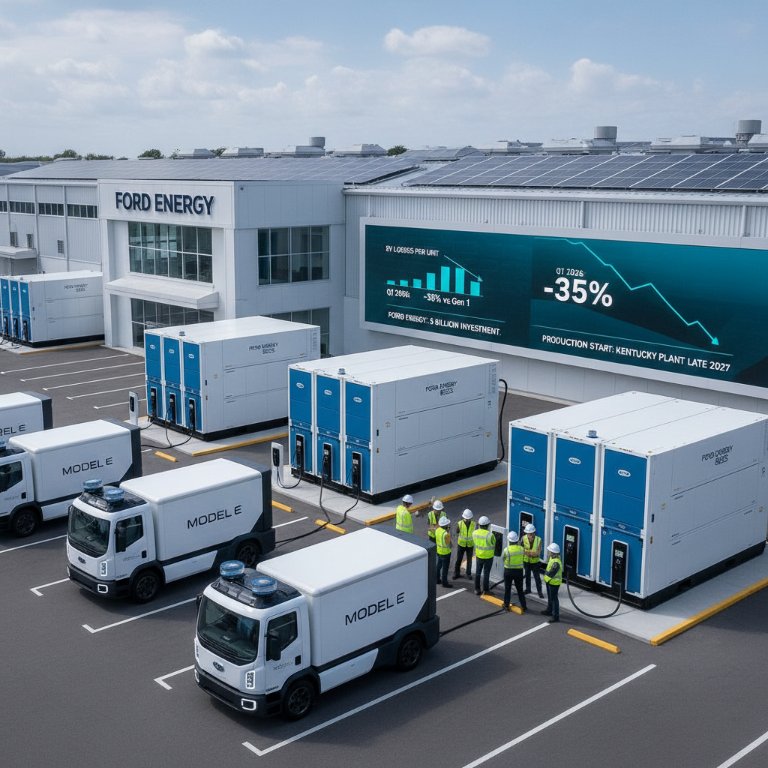
Ford's dedicated electric vehicle division, Model e, is finally showing tangible progress in stemming its significant financial outflows. After years of substantial investments yielding equally substantial losses, the automaker reported a Q1 2026 EBIT (Earnings Before Interest and Taxes) loss of $777 million, marking a nearly 35% reduction in 'Gen 1' losses. This critical improvement signals that Ford is beginning to optimize its current EV production and cost structures, a vital step toward long-term profitability.
This positive shift in Model e's performance arrives alongside a strategic pivot into the burgeoning energy storage market. Ford has officially launched Ford Energy, a new, wholly-owned subsidiary backed by a robust $2 billion investment. This venture aims to manufacture sophisticated lithium-iron-phosphate (LFP) Battery Energy Storage Systems (BESS) designed for a broad spectrum of clients, including utilities, industrial heavyweights, and the rapidly expanding sector of AI data centers.
Model e's Path to Profitability Takes Shape
Ford's Model e division has been a financial drain since its inception, with full-year 2025 EBIT losses reaching $4.81 billion. The reported $777 million loss in Q1 2026 represents a notable improvement of $72 million compared to the same period last year, demonstrating Ford's concerted efforts to tackle the operational complexities of EV manufacturing. While still in the red, this nearly 35% reduction in losses for its first-generation EVs is a crucial indicator. Ford now projects its full-year Model e losses to be between $4.0 billion and $4.5 billion, a welcome reduction from the previous year's figures.
- Q1 2026 EBIT Loss: $777 million
- Reduction in Gen 1 Losses: Nearly 35%
- Projected Full-Year 2026 Loss: $4.0 billion to $4.5 billion (down from $4.81 billion in FY 2025)
This improvement comes as Ford continues to streamline its operations, acknowledging that profitability for Model e is not expected until 2029. The company is also heavily investing in its next-generation, more affordable Universal EV Platform, which is slated to debut with a midsize pickup in 2027.
Ford Energy: A Strategic Power Play
Ford Energy represents a bold and calculated move by the automaker to diversify its revenue streams and leverage its burgeoning battery expertise beyond passenger vehicles. Backed by a $2 billion investment, this new subsidiary will focus on the high-demand market for stationary energy storage. Production of LFP battery energy storage systems (BESS) is set to commence at a repurposed Kentucky battery plant, a facility originally intended for EV battery production under a dissolved joint venture. First deliveries are anticipated in late 2027, with Ford Energy targeting a minimum of 20 GWh of annual deployments.
- Initial Investment: $2 billion
- Product Focus: Lithium-Iron-Phosphate (LFP) Battery Energy Storage Systems (BESS)
- Target Customers: Utilities, industrial clients, and AI data centers
- Production Location: Repurposed Kentucky battery plant
- First Deliveries: Expected late 2027
- Targeted Annual Deployments: Minimum of 20 GWh
This pivot capitalizes on the massive growth in the BESS market, which is projected to reach $75 billion by 2033. LFP chemistry is particularly well-suited for stationary storage due to its enhanced stability, longer cycle life (3,000–7,000 cycles), and lower cost compared to other lithium-ion chemistries. Ford Energy's flagship product, the DC Block, will be a standardized 20-foot containerized system built around 512Ah LFP prismatic cells, designed for a 20-year service life. This directly addresses the surging demand from data centers and the broader need for grid stabilization and renewable energy integration.
Why This Matters: A Dual Strategy for Ford's Future
Ford's latest announcements paint a picture of a company aggressively adapting to the evolving automotive and energy landscapes. The shrinking losses within Model e are more than just numbers; they represent a fundamental improvement in manufacturing efficiency and cost control within Ford's EV operations. For savvy EV enthusiasts and prospective buyers, this signals a more sustainable future for Ford's electric vehicle lineup, potentially leading to more competitive pricing and improved product viability as the company moves towards its more affordable Universal EV Platform. While a $777 million quarterly loss is still substantial, the trajectory is undeniably positive, indicating that the painful early lessons of EV production are starting to pay off.
The launch of Ford Energy, however, is the real game-changer, positioning Ford as a significant player in the rapidly expanding energy storage sector. This is a strategic masterstroke, allowing Ford to:
- Monetize Existing Assets: By repurposing a Kentucky plant originally intended for EV battery production, Ford is converting a potential liability into a substantial new revenue stream. This pragmatic approach avoids wasted investment and leverages existing infrastructure and battery manufacturing expertise.
- Diversify Revenue: Relying solely on volatile EV sales is a risk. Ford Energy provides a crucial diversification, tapping into a distinct, high-growth market driven by factors like the AI power crunch and the global push for renewable energy integration.
- Capitalize on LFP Advantage: LFP batteries, while less energy-dense for vehicle applications, are ideal for stationary storage due to their cost-effectiveness, safety, and longevity. This allows Ford to compete effectively with established BESS players and even rivals like Tesla, whose energy storage segment generated $12.7 billion in revenue last year.
- Hedge Against EV Uncertainty: Should EV adoption rates fluctuate, Ford Energy offers a significant hedge, utilizing core battery technology in a different, equally critical application. This makes Ford a more resilient and versatile player in the broader energy transition.
This dual strategy — optimizing Model e while launching Ford Energy — signifies Ford's commitment to a future far beyond traditional internal combustion engine vehicles. It’s a signal to the market that Ford is not just reacting to changes but proactively shaping its destiny in the electrified world. For industry professionals, this move underscores the increasing convergence of automotive and energy sectors, highlighting new pathways for growth and competitive advantage. The $2 billion investment and aggressive deployment targets are not merely aspirational; they mark a clear intention to capture a significant share of this vital market.
Ford is strategically reshaping its business for the electric and electrified future. The shrinking losses in Model e demonstrate a growing command over EV production challenges, while the launch of Ford Energy positions the company to capitalize on the immense opportunities within the battery energy storage market. This pragmatic and diversified approach is critical for Ford’s long-term financial health and its standing as a leader in the global energy transition, proving that the 'Blue Oval' is thinking far beyond the dealership lot.