Ford's Power Move: Domestic LFP Production Begins as Detroit Chases the $30,000 EV Dream
For years, legacy automakers have treated the electric vehicle transition like an expensive science experiment, bleeding billions of dollars on heavil...
Editorial Team
World Of EV
For years, legacy automakers have treated the electric vehicle transition like an expensive science experiment, bleeding billions of dollars on heavily modified internal combustion platforms and pricey nickel-cobalt-manganese (NCM) batteries. Ford's Model e division has felt this pain acutely, absorbing staggering losses while trying to make high-end trucks like the F-150 Lightning appeal to mainstream wallets. But the Blue Oval is finally drawing a line in the sand.
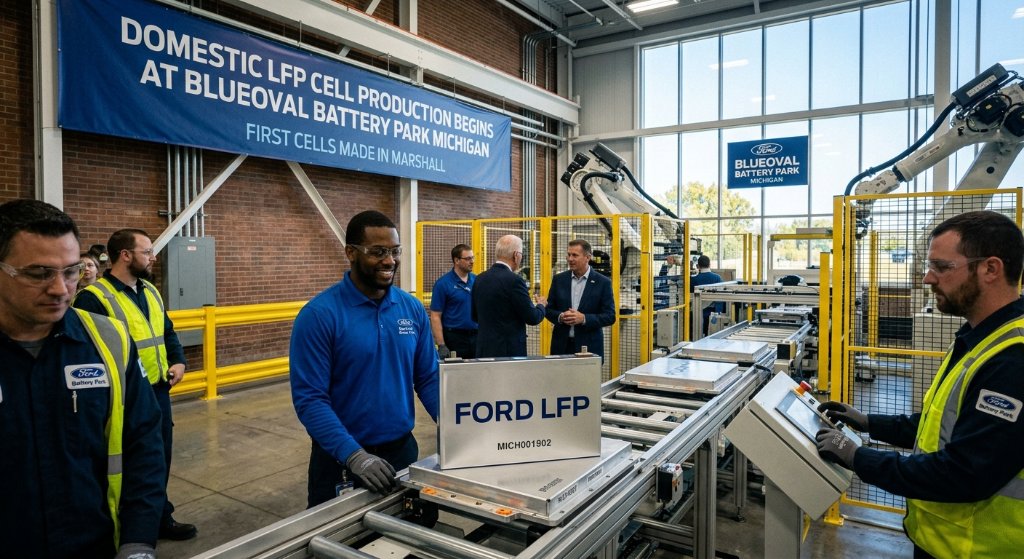
By kickstarting lithium-iron phosphate (LFP) battery cell production at its BlueOval Battery Park in Marshall, Michigan, Ford is executing a massive strategic pivot. This isn't just about localized manufacturing; it is a calculated effort to build a resilient, domestic supply chain that will support Ford’s clean-sheet "Universal Electric Vehicle" (UEV) platform, scheduled to debut with a highly anticipated $30,000 midsize pickup truck in 2027.
D-Samples and Onshoring: The Road to Late 2026
The facility in Marshall is currently humming with activity, already producing "D-sample" cells made with production-intent materials for final testing and validation. This follows a successful run of "C-sample" training cells earlier this spring. Ford aims to have launch-ready cells rolling off the line by the end of 2026. This represents a monumental step toward localizing battery tech on American soil.
- Capacity Goal: The plant is targeting an annual capacity of 20 gigawatt-hours (GWh)—enough to power roughly 200,000 to 300,000 EVs annually.
- Jobs Engine: The facility already employs 500 workers, with plans to scale to 800 by the end of the year and eventually 1,700 employees.
- Geopolitical Workaround: Ford licensed the manufacturing tech from Chinese giant CATL, the undisputed king of LFP. However, to qualify for lucrative U.S. Inflation Reduction Act (IRA) subsidies and avoid federal scrutiny, Ford retains 100% ownership and operational control.
Why LFP? Dismantling the Cost Barrier
LFP chemistry is the holy grail for affordable EVs, popularized globally by BYD's Blade battery and Tesla's standard-range vehicles. Unlike energy-dense NCM cells, LFP completely bypasses expensive, geopolitically volatile materials like cobalt and nickel.
- The LFP Advantage: LFP chemistry is structurally safer, virtually immune to thermal runaway, and boasts a much longer lifespan. It can comfortably be charged to 100% daily without the severe degradation seen in NCM batteries.
- The Trade-off: LFP has historically suffered from lower energy density and sluggish performance in freezing conditions. Ford is tackling this by optimizing cell-to-pack integration and relying on extreme vehicle efficiency rather than just stuffing larger, heavier packs into the chassis.
The UEV Platform: Merging "The Chapel of Love" with LFP
The first vehicle to benefit from Marshall's LFP cells is a rumored Maverick-sized midsize electric truck built on Ford’s radical "Universal Electric Vehicle" (UEV) platform. Ford is utilizing advanced "unicasting" (megacastings) to drastically reduce parts counts.
- Unicasting Assembly: The UEV platform consists of giant front, middle, and rear sections cast as single pieces.
- The "Chapel of Love": This is Ford’s nickname for the final assembly station where these massive sections are "married" together, cutting production complexity by an estimated 30%.
- Unmatched Value: Combining a low-cost LFP battery with megacastings allows Ford to target a $30,000 entry point while integrating premium features like hands-free, eyes-off Level 3 ADAS and AI-driven software.
Why This Matters:
This is a do-or-die moment for Ford’s electric future. The Model e division cannot survive on $80,000 F-150 Lightnings that require heavy discounting to leave dealership lots. To survive the onslaught of ultra-cheap Chinese imports and keep pace with Tesla, Ford must build a profitable, affordable EV.
Who Wins:
- The American Consumer: A $30,000, domestically-built electric pickup with LFP durability and Level 3 autonomy completely redefines the entry-level EV landscape.
- Ford's Bottom Line: Onshoring LFP allows Ford to capture hefty IRA manufacturing tax credits, accelerating its timeline to reach Model e profitability by 2029.
Who Loses:
- Legacy Rivals: Competitors still relying on expensive NCM chemistry for entry-level models will find themselves hopelessly priced out.
- Mineral Cartels: By shifting to LFP, Ford breaks its reliance on foreign cobalt and nickel mining monopolies, establishing supply chain sovereignty.
This move signals that Ford has stopped treating EVs as a compliance chore and is finally fighting to win. If they can execute the 2026 battery ramp-up and the 2027 UEV pickup launch without quality hitches, they will have successfully democratized the electric truck.
Ford’s Marshall milestone is the first real brick in building an affordable, American-made EV ecosystem. By marrying LFP's rugged durability with a highly efficient, megacast platform, the Blue Oval is positioning itself to lead the next wave of mass-market EV adoption. The era of the high-priced electric truck is drawing to a close; the era of the practical, $30,000 workhorse has officially begun.