Ford's Strategic Pivot: Repurposing EV Ambitions for Energy Storage and a 'Multi-Energy' European Comeback
Ford Motor Company is executing a significant strategic pivot, signaling a recalibration of its electrification efforts while simultaneously reasserti...
Editorial Team
World Of EV
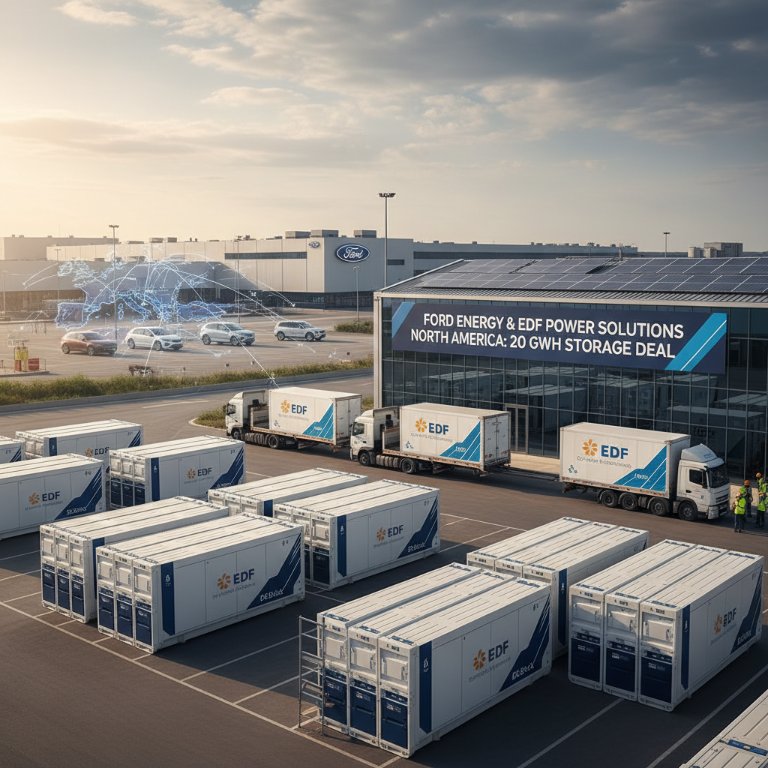
Ford Motor Company is executing a significant strategic pivot, signaling a recalibration of its electrification efforts while simultaneously reasserting its commitment to the critical European market. The headline news comes from its new energy unit, Ford Energy, which has inked a substantial five-year agreement with renewable power developer EDF Power Solutions North America. This deal will see Ford supply up to 20 gigawatt-hours (GWh) of DC Block battery energy storage systems (BESS), leveraging plant space in Kentucky originally earmarked for electric vehicle (EV) battery production. Deliveries are slated to commence in 2028.
This move arrives as Ford concurrently details an intensified, and notably diversified, approach to Europe. The automaker plans to launch five new passenger vehicle models, encompassing both electric and 'multi-energy' powertrains, by the close of 2029. This dual-pronged strategy suggests a maturing understanding of market complexities, shifting resources where immediate opportunities lie while prudently navigating diverse regional demands.
Ford Energy's Strategic Pivot: From EV Cells to Stationary Storage
Ford's decision to repurpose its Kentucky plant space, initially intended for EV battery production, for BESS manufacturing is a powerful signal of evolving priorities. While the automotive industry has largely focused on increasing battery cell production for vehicles, the stationary energy storage market is rapidly expanding, driven by the global push for renewable energy integration and grid stabilization. The agreement with EDF Power Solutions North America positions Ford to capitalize on this burgeoning sector.
Key aspects of this shift include:
- 20 GWh BESS Supply: A significant volume that underscores Ford Energy's ambition in the stationary storage market.
- Leveraging Existing Infrastructure: Reutilizing the Kentucky plant space demonstrates a pragmatic approach to asset management, transforming a potential stranded asset (should EV battery production ramp-up face delays or changing market conditions) into a new revenue stream.
- Diversification of Battery Strategy: This move suggests Ford is not solely reliant on producing EV batteries in-house but is also exploring other high-growth applications for battery technology, potentially mitigating risks associated with the highly competitive and capital-intensive EV battery manufacturing space.
Reigniting Europe: A Multi-Energy Offensive
Ford's reaffirmed commitment to the European market is equally noteworthy, especially given the fiercely competitive landscape and varied pace of EV adoption across the continent. Rather than a pure-play EV assault, Ford is adopting a 'multi-energy' strategy, a pragmatic acknowledgement that different markets and consumer segments within Europe still demand a mix of powertrain options.
Ford's European roadmap includes:
- Five New Passenger Vehicles: A substantial product offensive designed to revitalize its presence.
- Electric and Multi-Energy Powertrains: This approach allows Ford to offer EVs in markets with strong charging infrastructure and incentives, while providing hybrids or even advanced internal combustion engines (ICE) in regions where EV adoption is slower or infrastructure is less developed.
- Strategic Timing: The rollout by the end of 2029 provides a clear runway for product development and market penetration, aiming to capture demand as the energy transition progresses.
Why This Matters:
Ford's latest announcements are more than just news; they represent a significant strategic recalibration with profound implications for its future direction and the wider automotive and energy sectors. The pivot towards BESS production, utilizing previously designated EV battery plant space, suggests a savvy diversification. In an environment where EV battery manufacturing is incredibly costly and fiercely contested, Ford is hedging its bets by tapping into the equally vital and rapidly expanding stationary energy storage market. This could prove to be a more immediate and profitable avenue, allowing Ford Energy to build expertise and scale in battery technology, which could eventually feed back into its automotive division.
For the European market, Ford’s ‘multi-energy’ strategy is a masterclass in pragmatism. While some competitors are doubling down on pure-EV portfolios, Ford recognizes the mosaic of European consumer preferences, regulatory pressures, and charging infrastructure readiness. This flexible approach could allow Ford to capture market share across a broader spectrum of buyers, rather than alienating those not yet ready for a full EV commitment. This signals that Ford is prioritizing market relevance and profitability over a dogmatic adherence to a single powertrain type, potentially positioning it as a more resilient player in Europe against a backdrop of fluctuating demand and policy changes. Who wins? Ford stands to gain market agility and potentially more robust revenue streams. Who loses? Perhaps those who expected Ford to follow a purely monolithic EV strategy, but in reality, this move underscores a more sophisticated understanding of global energy and automotive transitions. It signals to the market that Ford is willing to adapt and innovate beyond traditional automotive manufacturing.
Ford's latest moves underscore a mature and pragmatic approach to the energy transition. By strategically diversifying its battery focus into stationary storage and adopting a flexible 'multi-energy' strategy for Europe, the automaker is positioning itself for resilience and growth in an increasingly complex global landscape. The coming years will reveal whether this calculated repositioning provides the competitive edge Ford needs to thrive in both the automotive and broader energy sectors.