Free Midday Fuel: How Australia's New 'Solar Sharer' Rules Can Slash Your EV Running Costs by $1,900 a Year
Free fuel is no longer a pipe dream for Australian electric vehicle owners. A radical new regulatory shift is turning the country's massive over-abund...
Editorial Team
World Of EV
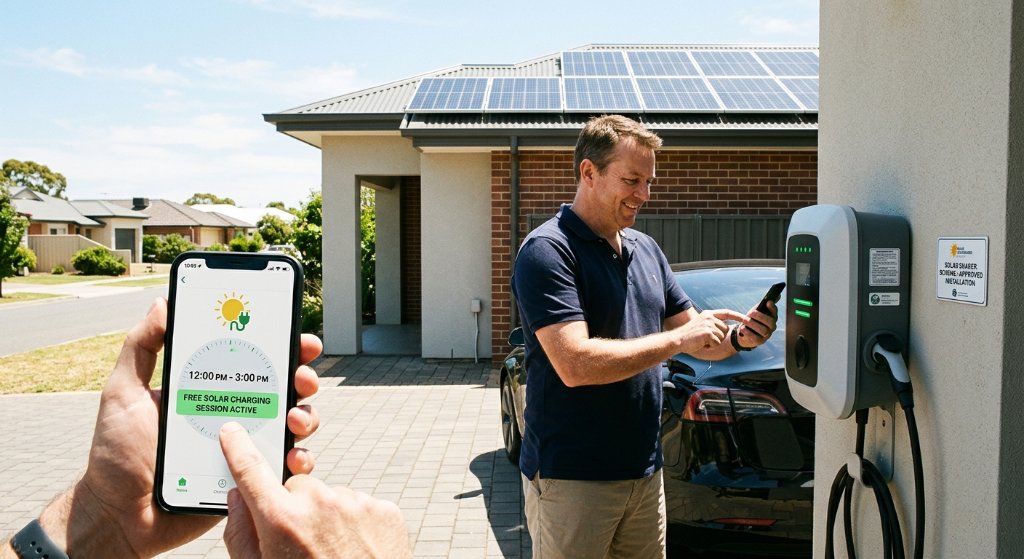
Free fuel is no longer a pipe dream for Australian electric vehicle owners. A radical new regulatory shift is turning the country's massive over-abundance of daytime solar energy into a massive financial win for EV drivers. According to new modeling released by the Institute for Energy Economics and Financial Analysis (IEEFA), electric vehicle owners who switch to Australia's newly legislated "solar sharer" plans can slash their energy bills by $800 to $1,900 annually—simply by programming their cars to charge during the middle of the day.
This milestone comes at a crucial transition point for Australia. Historically branded a global EV laggard due to policy inertia and a lack of vehicle standards, Australia is rapidly rewriting its energy narrative. Just recently, in August 2026, EV sales outpaced traditional petrol car sales for the first time in the nation's history. Combined with the country's world-leading rooftop solar penetration, the grid has faced unprecedented midday "solar spikes" that drive wholesale energy prices into negative territory. The government's solution? A legally mandated scheme that practically gives electricity away to keep the grid stable.
The Mechanics of the 'Solar Sharer' Grid Hack
Under the federal government’s newly launched Solar Sharer Offer (SSO), which went active in July 2026, electricity retailers in regions covered by the Default Market Offer (DMO) are legally required to offer consumers a plan containing three free hours of power every single day.
- The Key Geography: The program is currently active in New South Wales (NSW), South Australia (SA), and South-east Queensland (QLD). Victoria is set to launch its equivalent scheme, the Victorian Midday Power Saver (VMPS), in October 2026.
- The Golden Windows: Free electricity is offered daily from 11:00 AM to 2:00 PM in NSW and QLD, and from 12:00 PM to 3:00 PM in SA.
- The Generous Cap: Households can draw up to 24 kWh of free electricity during this three-hour window each day.
- No Panels Required: Crucially, tenants, apartment dwellers, and homeowners do not need to own solar panels to participate; they only need an active smart meter to track their usage.
Quantifying the IEEFA Savings Modeling
The financial analysis, authored by IEEFA electricity analyst Jay Gordon, demonstrates how leveraging the SSO turns an EV into the ultimate "battery on wheels" to capture this free power.
- Single-EV Households: A home charging one electric vehicle (traveling an average of 270 km per week) can save between $731 and $893 annually by shifting charging strictly to the midday free window using a standard 7 kW home charger.
- Two-EV Households: For the majority of Australian homes that own more than one vehicle, shifting two EVs to midday charging yields staggering annual savings of $1,341 to $2,257.
- The Compounding Effect: By combining EV charging with other automated shifts—such as putting electric hot water systems on midday timers—households can routinely bypass over $1,000 to $2,000 in annual utility costs.
Why This Matters:
This regulatory shift represents a watershed moment for both the automotive and energy industries, offering several critical implications:
- EVs as Grid Stabilizers, Not Liabilities: For years, critics warned that electric vehicles would collapse the energy grid. Instead, Australia is proving that EVs are the ultimate grid-balancing tool. By acting as massive "sponges" to soak up excess solar generation during peak sun hours, EVs prevent grid overloads and stabilize negative wholesale energy prices.
- The Rise of the "Split-Class" EV Owner: To capture these savings, vehicles must be parked and plugged in during the day. This creates a massive financial advantage for remote workers, retirees, fleet operators, and households with a secondary vehicle parked at home. Conversely, traditional 9-to-5 commuters who cannot charge at work miss out, highlighting a critical need for employers to install destination charging.
- A Double-Edged Sword for Consumers: The "Solar Sharer" plans are not a free lunch. To offset the free midday window, retailers levy higher peak-rate and supply charges during the morning and evening. EV owners who switch to these plans but fail to automate their midday charging could actually see their bills skyrocket.
Ultimately, Australia’s "solar sharer" initiative signals the future of global energy policy. By turning a grid management challenge—excess solar generation—into a consumer incentive, the government has created a highly effective, zero-tax subsidy for EV adoption. As smart-charging software becomes standard in new EVs, expect this "solar-soaking" model to become the blueprint for high-penetration renewable grids worldwide.