Giga Berlin's Covert FSD Lab: Tesla's 93,000-Mile Autonomous Logistics Masterclass Redefines Factory Efficiency
Tesla’s Giga Berlin facility isn't just a beacon of European EV manufacturing; it's quietly transforming into a colossal, real-world proving ground fo...
Editorial Team
World Of EV
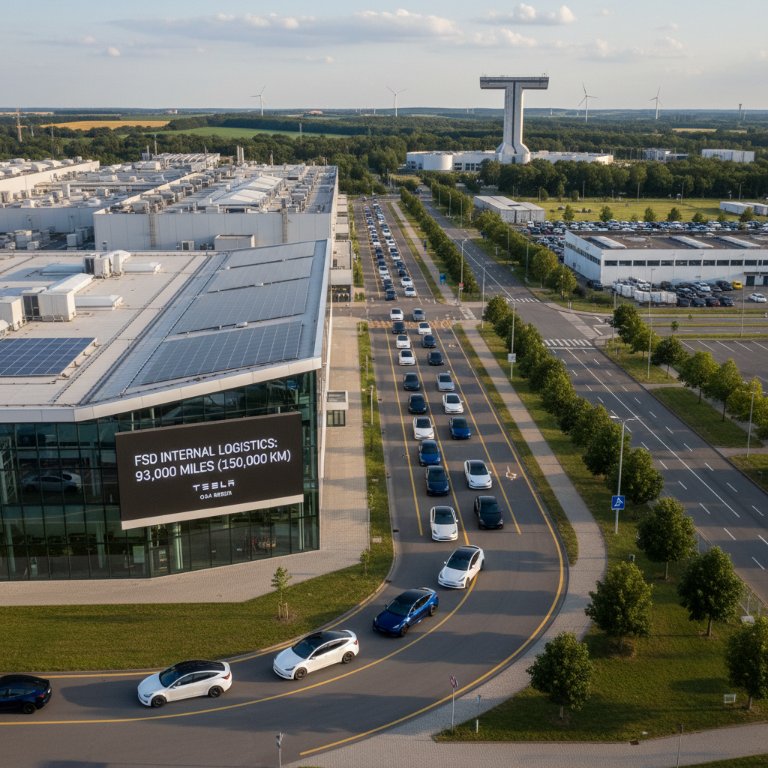
Tesla’s Giga Berlin facility isn't just a beacon of European EV manufacturing; it's quietly transforming into a colossal, real-world proving ground for the company’s ambitious Full Self-Driving (FSD) software. While regulatory bodies across Europe, particularly in Germany, deliberate FSD’s readiness for public roads, Tesla has leveraged the software to autonomously shuttle finished Model Y vehicles within its sprawling factory complex, amassing an impressive 93,000 miles (approximately 150,000 km) of driverless operation for internal logistics. This isn't just a quirky internal project; it's a strategic maneuver that provides invaluable data, refines the technology, and quietly pushes the boundaries of industrial automation, all while FSD's public deployment remains a contentious topic.
Giga Berlin's Autonomous Milestone
The scale of this internal deployment is staggering. Imagine thousands of Model Ys, fresh off the assembly line, navigating complex factory layouts without human intervention, moving seamlessly to their designated outbound lots. This critical, repetitive task, traditionally handled by human drivers, is now the domain of Tesla's FSD software. The 93,000 miles accumulated underscore a commitment to leveraging advanced AI not just for external consumer applications but for optimizing internal operational efficiency. This isn't merely a demonstration; it’s a sustained, high-volume application of cutting-edge autonomy in a highly controlled, yet dynamic, environment.
FSD's Unique European Challenge
Tesla’s FSD, while offering increasingly sophisticated capabilities to North American consumers, has faced a significantly steeper climb in Europe. Germany, renowned for its stringent automotive safety regulations and a preference for established Level 3 autonomous driving systems like Mercedes-Benz's DRIVE PILOT, has historically presented a formidable barrier to widespread FSD adoption. Unlike Tesla's FSD, which operates as an advanced Level 2 system requiring constant driver supervision, certified Level 3 systems allow drivers to legally disengage from driving tasks under specific conditions. This dichotomy highlights Tesla’s unconventional approach: refining its Level 2 system to near Level 3 capabilities, collecting vast amounts of data, and slowly chipping away at the regulatory and public perception hurdles. The internal deployment at Giga Berlin, while not directly addressing public road certification, provides a massive, uninterrupted stream of real-world operational data within a complex, often unpredictable, private setting.
Why This Matters:
- Data, Data, Data: Every mile driven, every turn navigated, and every obstacle avoided within Giga Berlin funnels invaluable data back to Tesla’s FSD training models. This continuous, real-world data collection in a highly consistent environment allows for rapid iteration and improvement of the FSD software, accelerating its learning curve in a way that simulated environments simply cannot match.
- Operational Efficiency and Cost Savings: Eliminating human drivers for these repetitive tasks translates directly into reduced labor costs, increased operational speed, and potentially fewer logistical errors, significantly boosting the factory’s overall efficiency. This is a clear signal of the long-term economic benefits autonomous technology can unlock beyond consumer vehicles.
- Stealth Validation and Robustness Testing: Giga Berlin serves as a gigantic, private test bed. FSD is being pushed to operate reliably, day in and day out, in a complex environment that, while private, mimics many real-world challenges like varying traffic, changing weather, and dynamic obstacles. This builds a robust, battle-tested software stack away from the direct scrutiny of public road incidents.
- A Regulatory Tease: By demonstrating such high-volume, reliable autonomous operation within its own premises, Tesla subtly builds a case for FSD's capabilities, even as it navigates the more complex public road regulations. It’s a powerful, if indirect, form of advocacy, showcasing the technology's maturity in a practical, undeniable application.
- Competitive Pressure: No other major automaker is known to be deploying their advanced ADAS suites for internal factory logistics on this scale. This move further highlights Tesla’s unique, vertically integrated approach to technology development and puts pressure on rivals to consider similar applications to optimize their own manufacturing processes.
Tesla’s Giga Berlin is more than just a car factory; it’s a living laboratory for the future of autonomy. The 93,000 miles of FSD-powered logistics are not merely an impressive statistic but a testament to Tesla's relentless pursuit of self-driving technology, proving its viability in a critical industrial application. This internal deployment accelerates FSD's refinement, optimizes Tesla's production capabilities, and sends a clear message: autonomous driving is not just for public roads; it’s poised to revolutionize every facet of transportation and logistics, starting from within the factory gates.