GM Cracks the Circular Battery Code with 100% Recycled Ultium Cells
General Motors (GM) has taken a massive step toward securing its electric future, announcing the successful testing of EV battery cells using cathode ...
Editorial Team
World Of EV
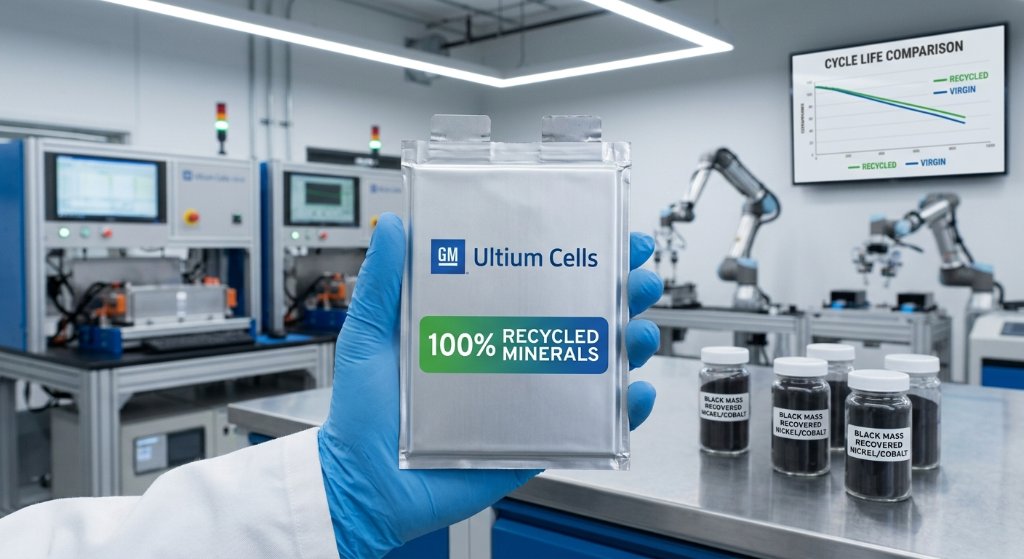
General Motors (GM) has taken a massive step toward securing its electric future, announcing the successful testing of EV battery cells using cathode active materials (CAM) made from 100% recycled nickel, cobalt, and manganese. Developed in partnership with recycling giant Cirba Solutions, the breakthrough proves that recycled battery materials can perform at the exact same quality, safety, and energy density standards as virgin, mined materials.
This milestone comes at a critical juncture for GM. The automaker’s heavily scrutinized Ultium platform has suffered a rocky rollout, marred by sluggish production ramps, battery pack assembly bottlenecks, and high-profile software stop-sales on models like the Chevrolet Blazer EV. To move past these early-stage struggles and truly compete with global giants like Tesla and BYD, GM must establish a battery supply chain that is not only scalable but also resilient to geopolitical and economic volatility.
The Closed-Loop Breakthrough
The collaboration between GM and Cirba Solutions represents a complete circular lifecycle for EV batteries. By recovering end-of-life EV battery packs, Cirba Solutions processed the spent cells into "black mass"—the raw, shredded mixture of battery materials. This black mass was then refined into high-purity battery-grade metals, which Ultium Cells processed directly into brand-new, functional battery cells.
Key highlights of the testing and manufacturing process include:
- 100% Recycled Cathode Active Materials (CAM): The core active materials (nickel, cobalt, and manganese) were sourced entirely from recycled feedstock.
- No Performance Deficit: Rigorous testing proved these cells meet the exact performance, safety, and durability specifications of standard Ultium virgin-material cells.
- Scalable Integration: By processing these recycled materials within the Ultium Cells joint-venture network, GM proved that circular manufacturing can be integrated into existing mass-production pipelines.
Eliminating the Recycling Penalty
Historically, the automotive industry viewed recycled battery materials with a degree of skepticism. Engineers feared that microscopic impurities in recycled feedstock would accelerate cell degradation, limit driving range, or pose thermal runaway risks. GM’s successful testing obliterates this "recycling penalty," proving that modern hydrometallurgical refining can deliver battery-grade purity indistinguishable from newly mined minerals. This places GM at the forefront of the circular economy, rivaling the recycling initiatives of Tesla and the Ford-backed Redwood Materials.
Why This Matters:
This breakthrough is a geopolitical and financial game-changer for General Motors, signaling the dawn of a self-sustaining domestic EV ecosystem.
The Big Winner: GM’s Bottom Line and the IRA Tax Credit
Under the U.S. Inflation Reduction Act (IRA), battery minerals must meet strict domestic sourcing requirements to qualify for the lucrative $7,500 consumer clean vehicle tax credit. Conveniently, the IRA classifies minerals recycled in North America as domestic, regardless of where they were originally mined. By mastering 100% recycled cathodes, GM secures long-term eligibility for these tax credits, driving down consumer costs and accelerating adoption while insulating itself from Chinese dominance in raw material refining.
The Strategic Pivot: Mitigating Supply Chain Volatility
Mining virgin nickel, cobalt, and manganese is an expensive, environmentally destructive, and politically fraught endeavor. By establishing a viable closed-loop recycling system, GM significantly reduces its exposure to volatile commodity markets and supply chain bottlenecks.
For the EV industry at large, this signals that the transition to sustainable transport does not require an endless, unsustainable expansion of global mining. The raw materials we need for tomorrow's EVs are already on the road today; they just need to be reclaimed.
GM’s successful integration of 100% recycled cathode materials proves that the circular EV economy is no longer a distant green dream—it is a viable commercial reality. As the automaker works to scale this process across its Ultium production network, it sets a formidable benchmark for the industry. The future of electric mobility will belong to those who can build cars without continuously digging up the planet, and GM has just positioned itself at the front of that race.