GM Idles Factory ZERO: A Strategic Retreat in the Evolving EV Landscape
General Motors (GM) has temporarily halted production at its state-of-the-art Detroit-Hamtramck assembly facility, known as Factory ZERO, from March 1...
Editorial Team
World Of EV
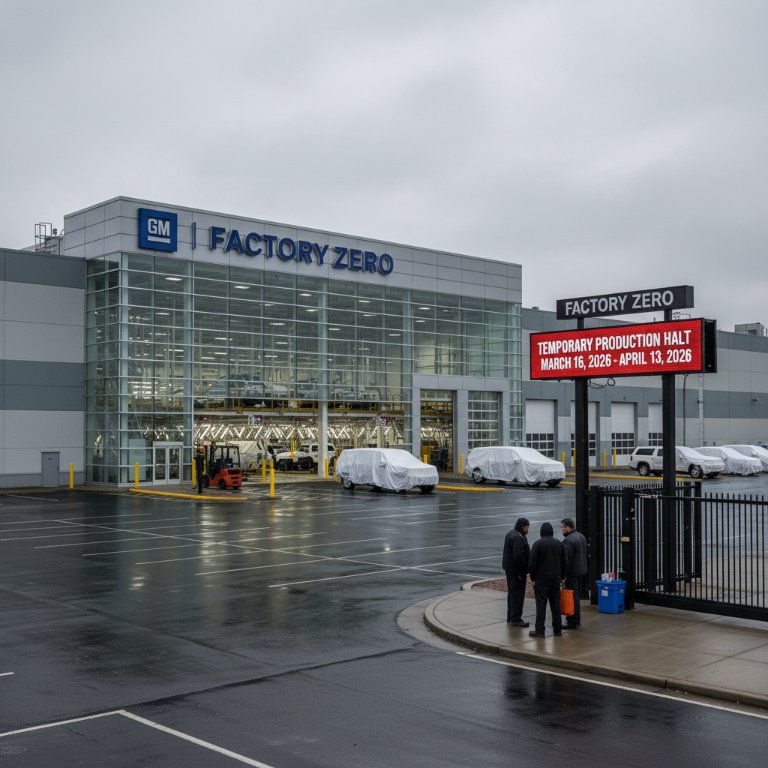
General Motors (GM) has temporarily halted production at its state-of-the-art Detroit-Hamtramck assembly facility, known as Factory ZERO, from March 16, 2026, through April 13, 2026. This significant pause directly impacts 1,300 manufacturing employees and signals a strategic recalibration to align electric vehicle (EV) production with current market demand. This move follows a substantial $6 billion charge related to EV investments that GM recorded in January 2026, alongside a $1.6 billion charge in October 2025, underscoring the formidable challenges in scaling EV profitability.
For years, GM aggressively championed an 'all-electric future,' pouring billions into dedicated EV platforms and advanced manufacturing facilities like Factory ZERO. However, the recent production adjustments and considerable financial write-downs paint a picture of a company navigating a far more complex and volatile EV market than initially anticipated.
The Production Halt and Its Immediate Impact
The temporary shutdown at Factory ZERO affects the production of GM's most prominent and premium electric vehicles, including the GMC Hummer EV Pickup and SUV, the Chevrolet Silverado EV, the GMC Sierra EV, and the Cadillac Escalade IQ. This isn't the first disruption for Factory ZERO; the plant has experienced a series of production slowdowns and shift reductions since mid-2025, including a reduction to a single shift in early January 2026, impacting approximately 1,200 workers. GM spokesman Kevin Kelly confirmed the decision as a necessary adjustment to align EV production with market demand.
GM's Ambitious EV Vision Meets Market Reality
GM's multi-billion-dollar investment in facilities like Factory ZERO, originally envisioned as the cornerstone of its EV future, showcased the company's commitment to electrification. CEO Mary Barra frequently highlighted Factory ZERO as a symbol of this resolve. However, the broader EV landscape has shifted dramatically. The $6 billion impairment charge, disclosed in January 2026, primarily covers asset write-downs and settlements with suppliers due to scaled-back EV production plans. This charge, combined with an earlier $1.6 billion charge in October 2025, brings GM's total EV-related charges for 2025 to approximately $7.6 billion. These financial adjustments reflect a substantial rollback of parts of its North American EV strategy.
Factors contributing to this recalibration include the expiration of federal tax credits for EV purchases in late 2025, which had previously stimulated demand, and a general cooling of the broader EV market, particularly for high-priced models. While global EV sales are still growing, the pace has moderated, and many regions are experiencing slower adoption rates influenced by policy shifts, tariffs, and changing consumer confidence.
Why This Matters:
This temporary idling of Factory ZERO is more than just a production hiccup; it's a profound signal from one of the world's largest automakers regarding the current state and near-term outlook of the electric vehicle market. For savvy EV enthusiasts and prospective buyers, it underscores that the transition to electric vehicles will not be a linear, uninterrupted ascent. The market is maturing, and manufacturers are now prioritizing sustainable execution over rapid, unchecked expansion.
Market Correction, Not Collapse: This isn't a sign of the EV market collapsing, but rather a significant correction, especially in the high-end truck and SUV segments where GM had initially placed a heavy bet. Consumer demand for premium-priced EVs, particularly without incentives, has proven softer than anticipated, forcing automakers to adjust their strategies.
GM's Strategic Pivot: GM is now actively balancing its ambitious electrification goals with financial prudence. The company's CFO indicated expectations for these losses to improve by $1–1.5 billion in 2026 through lower production volumes. This suggests a pragmatic shift, emphasizing profitability and efficiency over sheer volume in the near term. The company is also doubling down on traditional strengths, increasing production of heavy-duty internal combustion trucks at its Flint plant.
Industry-Wide Implications: GM is not alone in adjusting course. This move reflects a broader industry trend where automakers are re-evaluating their EV strategies amid evolving regulations, fluctuating consumer interest, and intense competition. Who wins? Companies with flexible production capabilities and a diverse product portfolio, including more affordable EVs and profitable ICE vehicles, appear better positioned. Who loses? Companies overly reliant on high-volume, high-cost EV models without robust demand, or those unable to quickly adapt their manufacturing footprint, face greater risks.
Impact on the Workforce: The temporary layoffs of 1,300 employees highlight the human cost of these market adjustments. While temporary, such pauses create uncertainty for workers in a rapidly evolving automotive industry.
In conclusion, GM's decision to pause production at Factory ZERO is a stark reminder that the journey to an all-electric future is fraught with economic realities and market dynamics. It signifies a necessary, albeit painful, adjustment by a major player to find a sustainable path in a competitive and evolving EV landscape. While the long-term commitment to electrification remains, the immediate focus has shifted to profitability and a more realistic pace of adoption. The coming months will reveal if this strategic pause allows GM to regain its footing and accelerate its EV ambitions on firmer ground.