Grassroots Advocacy Beats Slick Marketing: How Community Events Are Solving the EV Adoption Puzzle
As global EV adoption faces a crucial transition point—moving past tech-savvy early adopters and into the skeptical mainstream market—carmakers are di...
Editorial Team
World Of EV
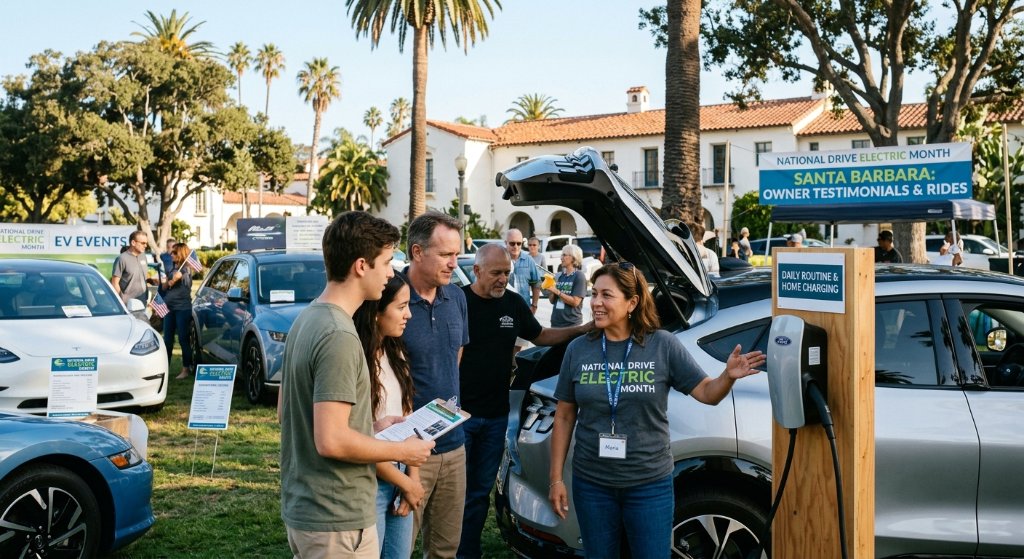
As global EV adoption faces a crucial transition point—moving past tech-savvy early adopters and into the skeptical mainstream market—carmakers are discovering that traditional multi-million dollar advertising campaigns are failing to move the needle. Instead, the real battle for the future of electrification is being fought on the ground. In Santa Barbara, California, the Community Environmental Council (CEC) recently took this grassroots approach to the next level, hosting interactive events for National Drive Electric Month that targeted the exact pain points keeping everyday buyers on the fence.
Historically, EV adoption has relied on high-income tech enthusiasts willing to tolerate the quirks of early-stage charging infrastructure. However, as the industry tries to scale, it has hit a roadblock: the "early majority" is highly risk-averse. By focusing on real-world experiences rather than glossy brochures, the CEC's events offer a blueprint for how the industry can overcome this plateau.
Real Owners, Real Solutions
Rather than relying on polished dealership pitches, the CEC gatherings leveraged the ultimate sales tool: the firsthand experience of local EV owners. Prospective buyers were able to bypass corporate talking points and get unfiltered, real-world data on daily driving routines, home charging logistics, and actual operating costs. This peer-to-peer approach directly addresses the lingering "range anxiety" that continues to stall mainstream adoption despite modern EVs regularly exceeding 250 miles of range.
Navigating the Complex Incentive Maze
One of the biggest barriers for prospective EV buyers isn't the technology itself, but the sheer complexity of purchasing one. Between fluctuating federal tax credits, state-level rebates, and hyper-local utility incentives, the financial math can be overwhelming. The Santa Barbara events acted as an interactive decoder ring for these programs. Key takeaways from these owner-led sessions included:
- The Power of the Point-of-Sale (POS) Credit: Clarifying how the $7,500 federal tax credit can now be applied directly at dealerships to lower upfront costs, rather than waiting until tax season.
- Local Utility Goldmines: Pointing out lesser-known rebates from regional utilities for installing Level 2 home chargers.
- Real-World Cost-to-Run: Breaking down actual monthly electricity bill increases versus the immediate savings of skipping the gas pump.
Why This Matters:
This shift toward community-driven, peer-to-peer education signals a critical pivot point for the automotive industry. As traditional dealerships continue to struggle with EV education—often steering customers back to internal combustion engine (ICE) vehicles due to a lack of salesperson training—local advocacy groups are stepping into the vacuum.
- Who Wins: Mainstream consumers and legacy automakers who are desperate to scale their EV platforms. By demystifying the day-to-day reality of EV ownership, these events build the high-trust environment needed to convert skeptics.
- Who Loses: Traditional dealership models that refuse to adapt. If buyers have to get their information from neighbors rather than the sales floor, dealerships risk becoming entirely obsolete in the consultative phase of the buying journey.
- The Big Picture: This is a clear signal to OEMs (Original Equipment Manufacturers) like Ford, GM, and Hyundai. To sell the next wave of EVs, they must stop pouring money exclusively into Super Bowl ads and start funding hyper-local, community-led experiential marketing. True adoption won't be driven by 0-60 mph stats, but by reassuring conversations over a neighbor's driveway charging setup.
Ultimately, the success of National Drive Electric Month in Santa Barbara proves that the key to unlocking the mass EV market lies in human connection, not corporate hype. Until the industry can replicate this level of trusted, localized education at scale, grassroots community action will remain the most powerful engine driving the electric transition forward.