Gravity Wins: How Smart EV Drivers Are Turning Mountain Descents Into Massive Range Gains
For decades, the dread of climbing a steep mountain pass was a shared anxiety among internal combustion engine (ICE) drivers and early EV adopters ali...
Editorial Team
World Of EV
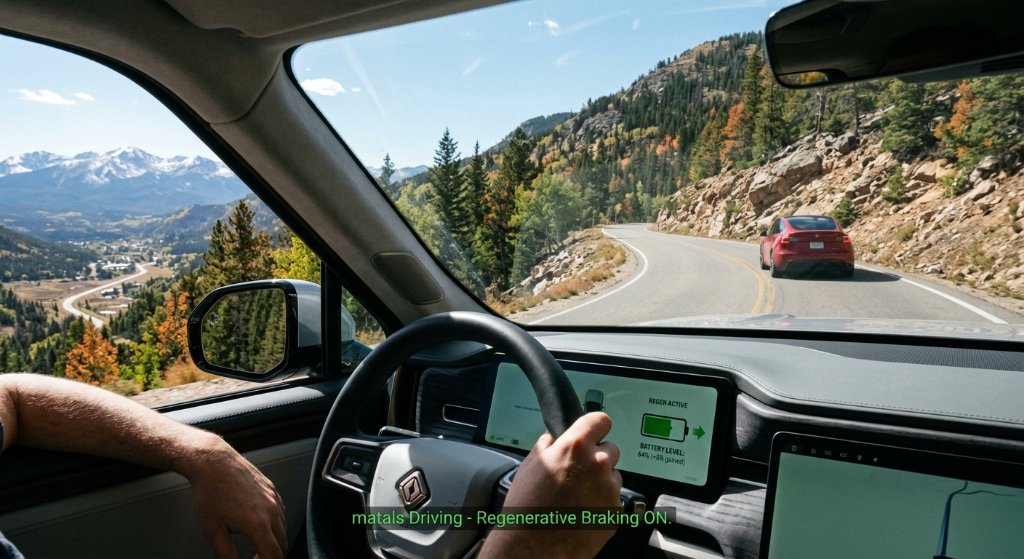
For decades, the dread of climbing a steep mountain pass was a shared anxiety among internal combustion engine (ICE) drivers and early EV adopters alike. But a paradigm shift is underway. EV drivers are increasingly reporting that mountainous terrain—long feared as a battery-killer—is actually functioning as a range "cheat code." By utilizing strong regenerative braking settings on steep downhill descents, drivers are recapturing up to 30% of the energy normally lost to friction braking, effectively turning gravity into a free, high-speed battery charger.
Historically, the automotive industry accepted kinetic energy loss as an unavoidable cost of driving. Traditional ICE vehicles convert kinetic energy into useless heat via mechanical friction brakes, wearing down pads and rotors while burning extra fuel on the climb. Early electric vehicles, with their primitive regenerative braking systems and lack of sophisticated thermal management, did little to challenge this dynamic. Today, however, high-efficiency electric powertrains and advanced software are transforming how we view elevation, proving that what goes up must not only come down—it must also pay dividends.
The Physics of the Gravity Charger
When an EV descends a mountain pass, gravity does the heavy lifting. Instead of relying on mechanical brake pads to slow the vehicle, the electric motor runs in reverse, acting as a generator. This process resists the vehicle's forward momentum and converts that kinetic energy back into electricity, routing it directly into the battery pack.
- Up to 30% Energy Recovery: Drivers descending steep passes can reclaim nearly a third of the energy consumed during the grueling uphill climb.
- Reduced Brake Wear: Because the electric motor handles the bulk of the deceleration, mechanical brakes remain cool and untouched, virtually eliminating brake fade and dramatically extending the lifespan of brake pads and rotors.
- One-Pedal Driving Dominance: Sophisticated driving modes allow operators to modulate speed using only the accelerator pedal, maximizing energy recapture without constant manual braking.
Rewriting the Road Trip Strategy
This phenomenon is fundamentally changing how EV owners plan their journeys. On popular routes through the Rocky Mountains or the Sierra Nevada, drivers frequently report reaching a summit with a depleted battery, only to watch their state-of-charge (SoC) climb steadily by 5% to 15% on the way down.
In contrast, a gasoline-powered SUV descending the same pass generates nothing but brake dust and hot air. For the EV driver, the mountain is no longer a barrier; it is a giant mechanical battery charger waiting to be harvested.
Why This Matters:
This shift represents a massive psychological and technological milestone. First, it completely dismantles the traditional notion of "range anxiety" in mountainous regions. Prospective buyers who live in hilly or mountainous areas can purchase an EV knowing that terrain is an asset, not a liability.
The Winners: EV manufacturers who prioritize aggressive, highly customizable regenerative braking systems—such as Hyundai and Kia with their steering-wheel-mounted regen paddles, or Porsche with its highly engineered recuperation systems. Drivers also win through reduced maintenance costs, as regenerative braking drastically extends the life of physical brakes.
The Losers: The automotive aftermarket brake industry, which will see a long-term decline in replacement parts demand. Legacy ICE manufacturers also lose ground, as their vehicles remain fundamentally incapable of recapturing wasted kinetic energy, widening the efficiency gap between fossil fuels and electrons.
The Market Signal: This highlights the importance of software-driven efficiency. The hardware of an EV is only as good as the algorithms managing energy flow. As automakers continue to refine their power electronics, route planning software will begin to incorporate elevation data to optimize charging stops dynamically, recognizing that a mountain range is just another charging station on the map.
Driving Into a High-Efficiency Future
The ability to harvest gravity as a fuel source is a superpower unique to electric propulsion. As battery chemistries improve and dual-motor all-wheel-drive systems become more adept at blended braking, the efficiency of these downhill descents will only increase. The next time you face a daunting mountain pass, remember: it is no longer an obstacle to overcome, but an opportunity to recharge.